At a fixed-base operator (FBO), the customer service representative is often the first person a pilot, passenger, crew member, vendor, or aircraft owner meets—and the person who keeps the customer experience organized once the aircraft is on the ground. It is a fast-moving aviation role that combines hospitality, operational coordination, communication, problem-solving, and a constant awareness of safety.
For aviation professionals who enjoy working around aircraft but prefer a customer-facing, operations-centered career path, FBO customer service can be an excellent entry point and long-term specialty.
Explore current aviation opportunities through AllAviationJob.com, including roles in FBO operations, customer service, dispatch, line service, maintenance, and flight support.
What an FBO Customer Service Representative Does
An FBO is a commercial aviation service provider located at an airport. Depending on the location and its capabilities, an FBO may support business aircraft, private aircraft, charter operators, owner-flown aircraft, airline diversions, military flights, and occasionally commercial traffic.
The FBO customer service representative—often called an FBO CSR—acts as a communication hub between customers and the teams delivering service. They may coordinate fuel requests, catering, rental cars, hotels, hangar space, crew transportation, passenger arrivals, invoices, aircraft services, and special requests.
The position is not simply a front-desk hospitality role. A strong CSR needs to understand how customer commitments affect ramp activity, line-service workloads, fuel coordination, aircraft movement, vendor timing, crew schedules, and the safety procedures that govern airport operations.
The National Air Transportation Association describes FBO CSRs as professionals who coordinate client needs with vendor requirements while meeting organizational performance and safety goals in a fast-paced environment.
Before the Shift Begins
Many FBO customer service representatives start their day before the first customer walks through the door. The opening routine commonly includes reviewing overnight messages, checking the day’s flight activity, confirming reservations, and identifying special arrangements that must be completed before arrivals.
A typical morning review may include:
- Aircraft arrivals and departures, including estimated times of arrival and departure
- Fuel releases, contract-fuel information, and fueling preferences
- Hangar reservations, overnight parking, and aircraft-storage needs
- Passenger and crew transportation arrangements
- Hotel bookings, catering orders, and special meal requests
- International or customs-related coordination, where applicable
- Weather conditions that may affect schedules or ground activity
- Maintenance, cleaning, lavatory service, potable-water service, or other aircraft-support requests
- VIP, corporate, medical, pet-travel, or accessibility accommodations
This preparation matters because aviation schedules can change quickly. A flight may arrive early, divert because of weather, remain overnight unexpectedly, or depart within minutes of landing. The CSR’s ability to anticipate needs and communicate changes promptly can determine whether the operation feels smooth or disorganized.
A Typical Day on the FBO Floor
Coordinating an Aircraft Arrival
When an aircraft is inbound, the CSR may confirm its estimated arrival time and make sure the appropriate internal teams are ready. That can involve communicating with line service, ramp personnel, fuelers, concierge staff, ground transportation providers, caterers, cleaners, and maintenance personnel.
For example, a corporate jet arriving with four passengers might require the following coordination:
- A fuel order and approved payment or contract-fuel confirmation
- A rental SUV positioned near the terminal
- A hotel shuttle or executive car for passengers
- Ice, beverages, catering, or special onboard provisions
- A hangar reservation due to severe-weather risk
- A return-departure plan for later that day or the following morning
The CSR does not personally perform every service. Instead, they make sure requests are accurately documented, relayed to the right people, monitored, and confirmed. This is where clear communication becomes essential.
Welcoming Pilots, Crew, and Passengers
The visible portion of the role is the hospitality experience. CSRs greet customers, direct them to crew lounges or conference areas, answer local questions, arrange transportation, process payments, and help resolve immediate concerns.
The customer base can be broad. A CSR might assist an owner-pilot on one transaction, a Part 135 charter crew on the next, and a Fortune 500 flight department later that afternoon. Each group may have different expectations, operational pressures, and preferences.
A professional CSR learns to recognize the difference between being friendly and being operationally reliable. A warm greeting is important, but so is confirming that the fuel request is correct, the hotel reservation is guaranteed, the vehicle is ready, and the invoice accurately reflects the services provided.
Managing Changing Priorities
No two shifts are identical. Weather, maintenance issues, delayed passengers, unexpected arrivals, and airport traffic can change the day’s priorities without warning.
A common scenario might look like this:
- A crew requests a rapid turnaround because their passengers arrive early.
- The aircraft also needs fuel, catering, and a lavatory service.
- Another aircraft arrives unexpectedly due to weather.
- A transportation vendor is late for a VIP passenger pickup.
- The line-service team is managing multiple aircraft on the ramp.
In that moment, the CSR must communicate calmly, establish priorities, update customers honestly, and coordinate internally without making promises that cannot be fulfilled. The job rewards people who can stay organized under pressure while preserving a high standard of service.
The Operational Side of Customer Service
FBO customer service is closely connected to safe ground operations. Although individual responsibilities vary by company, CSRs regularly communicate with personnel involved in aircraft marshaling, fueling, parking, towing, and ramp support.
The Federal Aviation Administration’s guidance on aircraft ground handling, servicing, and marshalling emphasizes that airport ground personnel must follow established procedures and local requirements; FAA guidance is not a replacement for an airport’s or operator’s specific procedures. For a CSR, this means understanding operational boundaries, knowing whom to contact, and avoiding assumptions about aircraft movement, fueling status, ramp access, or safety-sensitive tasks.
A capable CSR should understand the importance of:
- Accurate aircraft identification and tail-number verification
- Clear, timely communication with line service and ramp teams
- Correct fuel-order documentation and customer authorization
- Awareness of ramp restrictions and secure-access areas
- Escalation procedures when service requests create operational conflicts
- Confidentiality, especially when serving high-profile passengers or corporate clients
- Proper handling of billing questions, receipts, and service records
The best customer service representatives respect the fact that the ramp is not simply a parking lot. It is an active aviation work environment where procedures, communication, and situational awareness matter.
The Customer Experience Is the Product
At many FBOs, the aircraft services offered may be similar to those at nearby competitors. Fuel, hangar space, ramp parking, crew lounges, transportation, and catering can be obtained from multiple providers. What differentiates one FBO from another is often the consistency of the customer experience.
That is why the CSR’s work has a direct impact on customer retention, online reputation, repeat traffic, fuel sales, hangar occupancy, and relationships with flight departments.
Customers tend to remember whether:
- Their crew car was ready when promised
- A last-minute catering request was handled professionally
- The front desk knew their preferences
- Billing was accurate and easy to understand
- Communication remained clear during weather delays or service disruptions
- The staff handled a stressful situation with composure
NATA’s industry recognition for FBO customer service representatives reflects the role’s contribution to the success of aviation businesses and the broader general aviation service ecosystem.
Skills That Make an FBO CSR Successful
Aviation knowledge is valuable, but technical familiarity alone is not enough. The strongest FBO CSRs combine operational awareness with excellent service habits.
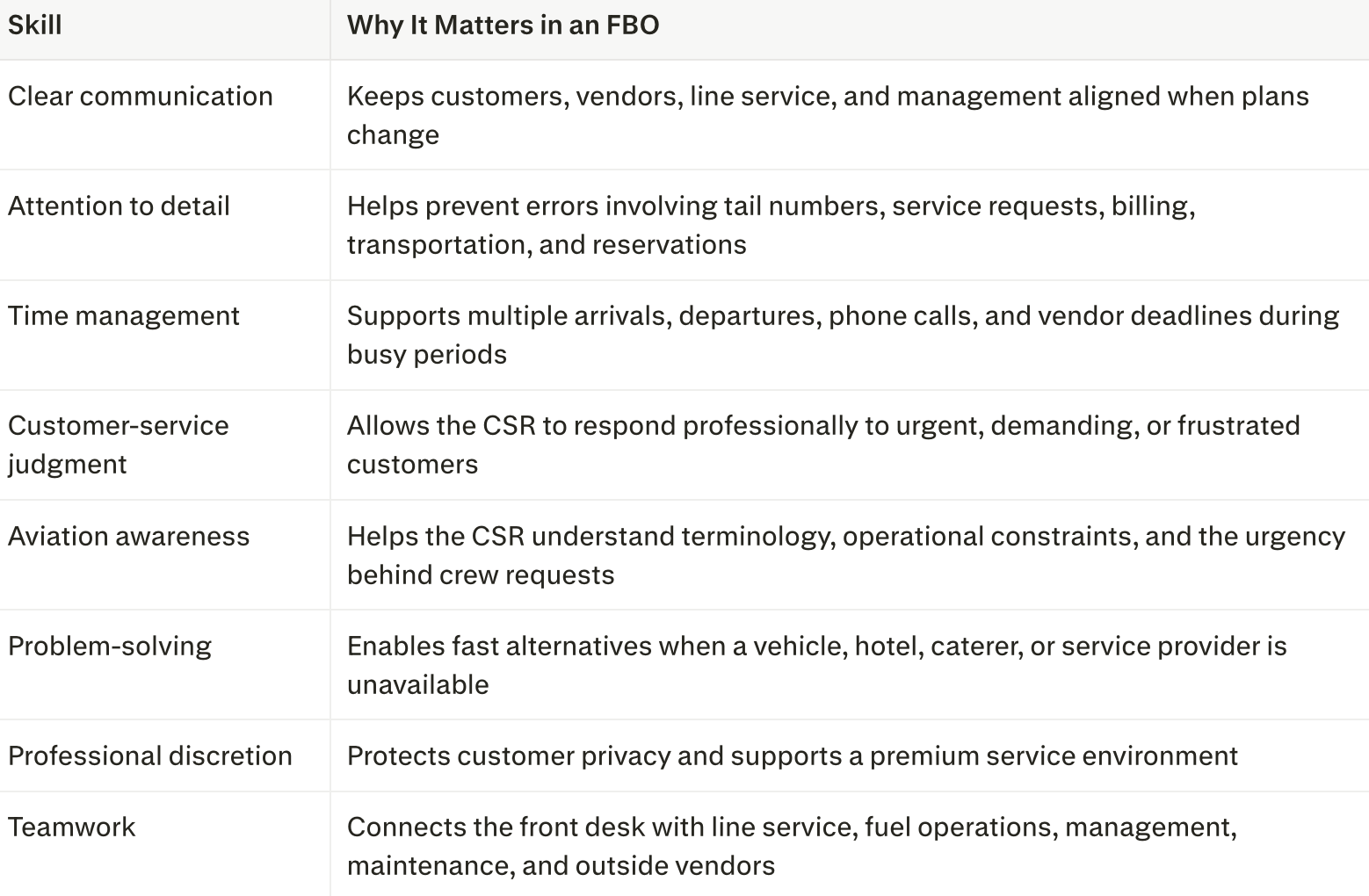
Computer proficiency also matters. Depending on the employer, CSRs may use flight-tracking systems, FBO-management software, fuel-order platforms, point-of-sale systems, billing tools, customer relationship management software, and airport access systems.
Career Growth From an FBO CSR Role
An FBO customer service role can build a strong foundation for several aviation career paths. Daily exposure to pilots, corporate flight departments, charter operators, line-service technicians, airport personnel, and aviation vendors gives CSRs practical insight into how aircraft operations are supported from the ground.
Possible next steps include:
- Customer service supervisor or customer service manager
- FBO operations coordinator
- Concierge or corporate-flight-support specialist
- Dispatch or flight-following roles
- Charter sales or trip-support positions
- Aircraft scheduling and flight-department administration
- Line-service leadership, for employees who pursue ramp operations training
- Airport operations or aviation-services management
For employers, hiring the right person for this position matters. An FBO CSR must represent the brand while reliably coordinating important operational details.
Aviation staffing firms such as OSI Recruit support aviation organizations seeking qualified professionals across ground operations, flight departments, maintenance, cabin services, and aviation leadership.
OSI Recruit’s aviation staffing coverage includes ground staff and flight-department professionals, making it a relevant resource for companies building customer-service and operational-support teams.
Finding FBO Customer Service Jobs
If you are pursuing an FBO customer service representative position, focus your résumé on customer-facing experience, aviation familiarity, multitasking, scheduling, dispatch coordination, hospitality, transportation coordination, billing, vendor management, and any experience working in time-sensitive environments.
Applicants can stand out by showing that they understand the balance between premium service and operational discipline. A hiring manager wants someone who can welcome a passenger professionally—but who can also recognize that a late fuel release, incorrect tail number, missed catering order, or unclear communication can affect the entire customer experience.
Ready to build your aviation career?
Visit AllAviationJob.com to search aviation jobs, explore opportunities across FBO and flight-support operations, and connect with employers looking for qualified aviation professionals.
Whether you are entering the industry or advancing into a higher-responsibility role, AllAviationJob.com can help you find your next opportunity.
For aviation companies seeking experienced professionals, visit OSI Recruit to learn more about aviation recruiting and staffing support.
Sources
- Federal Aviation Administration, “Aircraft Ground Handling, Servicing, and Marshalling, Advisory Circular 00-34B.” Guidance for airport ground personnel involved in aircraft servicing, handling, and marshalling.
- National Air Transportation Association, “FBO Customer Service Representative Award.” Overview of the FBO CSR’s role in coordinating customer and vendor needs while supporting safety and performance goals.
- National Air Transportation Association, “Industry Excellence Awards.” Information on NATA’s recognition of the role and impact of FBO customer service representatives.
- OSI Recruit, “BBJ MAX 9: Specifications, Performance, and Flight Department Staffing.” Information on OSI Recruit’s aviation staffing coverage, including ground staff and flight-department professionals.