Negotiating compensation in aviation is not about making an unreasonable demand. It is about clearly connecting the value you bring—your qualifications, experience, safety record, operational reliability, and market demand—to a compensation package that reflects the role.
Whether you are a pilot, aircraft mechanic, avionics technician, flight attendant, dispatcher, maintenance manager, operations professional, engineer, or aviation sales leader, the strongest negotiations begin long before an offer arrives.
Preparation, timing, professionalism, and a clear understanding of total compensation can help you advocate for yourself without damaging a promising opportunity.
Why Aviation Salary Negotiation Is Different
Aviation compensation is rarely as simple as a base salary. The actual value of an offer can depend on the aircraft, operation type, schedule, travel requirements, certifications, seniority, location, and the cost of maintaining professional credentials.
For example, two pilot positions with identical base salaries may have dramatically different real-world value if one includes a predictable schedule, employer-paid recurrent training, international per diem, strong health coverage, a retirement match, and guaranteed days off—while the other requires frequent short-notice travel and offers limited benefits.
In aviation, employers often evaluate candidates based on operational risk, technical ability, insurance requirements, regulatory qualifications, and the difficulty of replacing specialized talent. That means your negotiation should focus on the measurable business value you create, not simply on what you would personally prefer to earn.
A well-prepared conversation communicates that you understand the market, respect the employer’s budget, and know how your credentials affect the operation.
Start With Market Research
Before discussing a number, build a realistic compensation range for the specific job—not just the job title.
A “Captain,” “A&P Mechanic,” or “Director of Maintenance” can have widely different responsibilities depending on the organization. A Part 91 corporate flight department, Part 135 charter operator, airline, MRO, FBO, OEM, defense contractor, and helicopter operator may all structure compensation differently.
Research should account for:
- Job title and actual responsibilities.
- Aircraft type, fleet complexity, and type-rating requirements.
- Years of relevant experience, not only total years in aviation.
- Flight time, turbine time, PIC time, international experience, and instructor qualifications for pilot roles.
- A&P, IA, avionics, inspection, repair station, OEM, or specialized maintenance credentials for technical roles.
- Location, cost of living, travel expectations, and local labor availability.
- Schedule, on-call obligations, rotations, overnights, and holiday coverage.
- Employer-paid training, recurrent training, licensing, medicals, uniforms, and professional memberships.
- Bonuses, per diem, overtime, retention incentives, relocation, retirement contributions, and health benefits.
The U.S. Bureau of Labor Statistics’ Occupational Employment and Wage Statistics can provide a broad starting point, while aviation job boards, trade associations, recruiter insight, peer networks, and current job postings can help you narrow the range for a particular market. The key is to compare similar jobs—not unrelated roles that happen to use the same title.executive.
For an aviation-specific starting point, review active opportunities and role requirements on AllAviationJob.com. Comparing multiple listings can help reveal which skills, certifications, aircraft experience, and work schedules employers value most.
Define Three Numbers Before You Negotiate
Do not enter a salary conversation with only one number in mind. Establish three figures before the employer makes an offer:
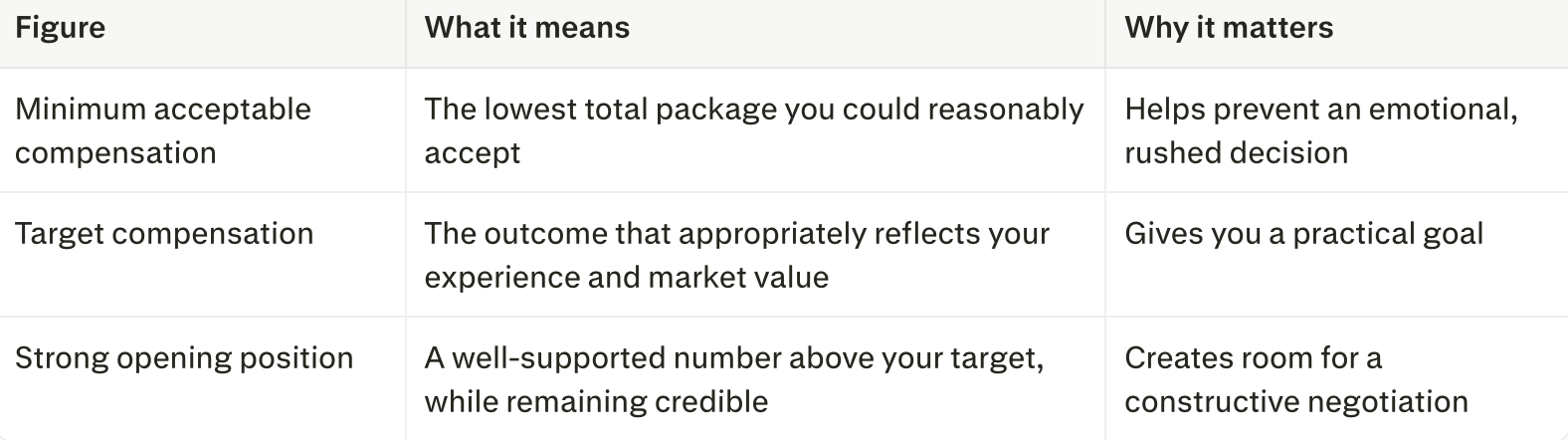
Your target should be based on evidence, not guesswork. A candidate who says, “I need $X because my expenses have increased,” gives the employer little business context. A stronger approach is: “Based on the position’s responsibilities, the required aircraft experience, my qualifications, and comparable market opportunities, I am targeting total compensation in the range of $X to $Y.”
That statement is clear, professional, and grounded in the role.
Build Your Aviation Value Case
Your résumé may get you into the conversation, but your value case supports your compensation request. Before the interview or offer stage, prepare three to five specific points that demonstrate why you are qualified to perform well in the role.
Strong aviation value points are measurable and relevant to the employer’s operation.
Examples for pilots
- Total time, PIC time, turbine time, multi-engine time, or time in a relevant aircraft category.
- Type ratings, instructor credentials, international operations experience, or oceanic and RVSM familiarity.
- Strong training performance, clean safety history, and consistent regulatory compliance.
- Experience with high-net-worth principals, executive travel, complex itineraries, or confidential operations.
- Dispatch coordination, crew leadership, mentoring, or flight-department management experience.
Examples for maintenance professionals
- A&P, IA, avionics, inspection authorization, or specialized OEM training.
- Experience troubleshooting recurring defects, reducing downtime, or managing heavy-maintenance events.
- Familiarity with a specific aircraft platform, engine program, maintenance-tracking system, or repair station environment.
- Parts sourcing, vendor management, inventory control, and cost-containment results.
- Leadership experience, technician development, quality assurance, or regulatory audit readiness.
Examples for operations and support roles
- Dispatch reliability, trip-planning expertise, international permit coordination, and customer-service performance.
- Safety management system participation, audit support, compliance knowledge, or process improvement.
- Reduced scheduling conflicts, improved crew utilization, faster client response times, or improved operational margins.
- Experience with key aviation software, CRM systems, scheduling platforms, or maintenance-tracking tools.
Avoid vague claims such as “I work hard” or “I am a team player.” Those traits matter, but they are not a negotiation strategy. Instead, connect your achievements to outcomes that matter in aviation: safety, reliability, compliance, passenger experience, cost control, maintenance availability, and operational continuity.
Know the Right Time to Ask
In most situations, the strongest time to negotiate is after the employer has made a formal offer and clearly indicated that you are their preferred candidate. At that point, the employer has already invested time in the selection process and has determined that your skills fit their needs.
If salary expectations arise early in the interview process, avoid locking yourself into a number before you understand the full role. You can respond with a statement such as:
“I am very interested in the position. Before providing a precise expectation, I would like to better understand the schedule, aircraft, responsibilities, training support, and complete benefits package. Based on the market and the scope we have discussed so far, I would expect compensation to be competitive for the role.”
This keeps the conversation professional while preserving flexibility.
Once an offer is made, thank the employer, show enthusiasm, and ask for time to review the details if necessary. You do not have to accept immediately. A thoughtful review is normal, especially when aviation roles include variable schedules, travel, duty requirements, or compensation components beyond salary.
Use a Clear, Professional Counteroffer
A counteroffer should be brief, respectful, and supported by relevant facts. The goal is not to “win” a confrontation. It is to reach an agreement that allows both parties to begin the employment relationship with clarity and confidence.
A practical structure includes four parts:
- Express appreciation. Thank the employer and confirm your interest in the opportunity.
- Reinforce fit. Briefly restate why the role and organization are a strong match.
- Make a specific, evidence-based request. Refer to scope, qualifications, market information, and relevant operational value.
- Invite discussion. Ask whether there is flexibility in salary or another part of the overall package.
Here is an example:
“Thank you for the offer. I am genuinely excited about the opportunity to support the flight department and contribute my experience in [aircraft type, operational area, maintenance specialty, or leadership function]. After reviewing the responsibilities, schedule, and market expectations for comparable positions, I was targeting a base salary closer to $X. Given my [specific qualifications and results], would there be flexibility to adjust the base salary to $Y, or to consider another component of the package that brings the total compensation closer to that level?”
This approach is direct without being adversarial. It gives the employer a specific request and leaves room for alternatives.
Negotiate Total Compensation—Not Only Salary
If the employer cannot move on base pay, there may still be meaningful ways to improve the offer. Aviation work can involve irregular schedules, substantial travel, recurrent training, credentialing costs, and periods of high operational demand. Those realities should be reflected in the overall package.
Consider discussing:
- Sign-on, retention, performance, or annual bonuses.
- Per diem and reimbursement policies for domestic and international travel.
- Overtime, holiday pay, call-out pay, and day-rate policies.
- Guaranteed minimum days off, rotations, schedule predictability, or on-call limitations.
- Employer-paid initial and recurrent training.
- Type ratings, simulator training, OEM training, or continuing education.
- Medical certificate support, licensing fees, dues, uniforms, and professional-development expenses.
- Relocation reimbursement or temporary housing.
- Health insurance, disability coverage, life insurance, retirement matching, and paid time off.
- A written compensation review after six or twelve months tied to defined performance or training milestones.
For example, a candidate may prefer a $10,000 increase in base salary, but an employer may have a fixed salary band. If the company can offer a sign-on bonus, paid recurrent training, stronger retirement contributions, and a guaranteed review after the first year, the final package may be more valuable than the original salary discussion suggests.
Always ask for the complete offer in writing. Confirm base pay, bonus eligibility, schedule expectations, per diem, benefits, training commitments, start date, and any conditions tied to reimbursement or repayment agreements. Reviewing the full package prevents misunderstandings later.executive.
Common Salary Negotiation Mistakes
A strong negotiation is usually calm, prepared, and focused. Avoid these mistakes:
- Negotiating without research. An unsupported number can sound arbitrary and weaken your credibility.
- Using personal expenses as the main justification. Your bills may be real, but the employer will generally make compensation decisions based on market conditions and business value.
- Making demands before understanding the full role. Aircraft, schedule, travel, training, and benefit details can materially change the value of an offer.
- Being vague. “I was hoping for more” is less effective than a specific, supported request.
- Overstating another offer. Be truthful. Aviation is a relationship-driven industry, and credibility matters.
- Focusing only on base salary. A competitive overall package may include components that do not appear in the initial salary figure.
- Accepting verbally without reviewing terms. Request written confirmation before making a final commitment.
- Treating the conversation as a conflict. Employers are more likely to respond well to a collaborative, businesslike discussion.
When to Ask for a Raise
Salary negotiation is not limited to new job offers. Existing aviation professionals can make a strong case for a compensation review when their role has materially changed.
Appropriate moments include:
- You earned a new type rating, certification, authorization, or technical qualification.
- You assumed additional aircraft, routes, shifts, team leadership, or management responsibilities.
- You completed a successful training cycle or passed a performance-review milestone.
- You consistently improved safety, uptime, customer satisfaction, cost control, dispatch reliability, or compliance.
- The organization expanded its fleet, operations, service offerings, or maintenance capabilities.
- Your compensation has fallen behind the market for comparable professionals.
Frame the conversation around changes in your value and responsibilities. For example:
“Over the past year, I have taken on responsibility for [specific duties], completed [training or qualification], and supported [measurable result]. I would appreciate the opportunity to review my compensation in light of the expanded scope of my role and current market conditions.”
This is more persuasive than asking for a raise based solely on tenure.
Your Aviation Career Has Value
The best aviation professionals do more than meet minimum requirements. They protect safety standards, keep missions moving, solve problems under pressure, reduce operational risk, maintain compliance, and represent their organizations professionally.
Salary negotiation is your opportunity to communicate that value clearly. Research the market, understand your complete compensation needs, prepare evidence, make one reasonable request, and stay open to solutions. You do not need to be aggressive to be effective. You need to be prepared.
Find Aviation Opportunities Worth Negotiating For
Your next aviation role should match more than your qualifications—it should align with your experience, career goals, lifestyle, and compensation expectations.
Explore current aviation jobs, compare role requirements, and position yourself for better opportunities at AllAviationJob.com. Whether you are pursuing pilot jobs, aircraft maintenance careers, avionics opportunities, aviation operations roles, or executive aviation positions, AllAviationJob.com can help you identify employers seeking your specific expertise.
Do not wait for the right role to find you. Create your profile, upload your résumé, and start exploring aviation opportunities at AllAviationJob.com today.
For candidates seeking personalized recruiting support, confidential career guidance, or specialized aviation placement assistance, visit OSI Recruitment. You can also explore aviation recruiting expertise and candidate-focused opportunities through OSI Recruitment’s website.
Sources
- U.S. Bureau of Labor Statistics, Occupational Outlook Handbook and Occupational Employment and Wage Statistics.
- All Aviation Job, How to Negotiate Salary in Aviation Without Losing the Offer.allaviationjob
- UC Berkeley Executive Education, Salary Negotiation Tips That Deliver Results.