When comparing an avionics technician vs. aircraft mechanic career, the main difference is the focus of the work: avionics technicians specialize in aircraft electronic systems, while aircraft mechanics maintain and repair a broader range of aircraft components, including engines, landing gear, brakes, and electrical systems. Both occupations involve testing, troubleshooting, repairs, and maintenance records, so the distinction is not simply “electronics versus everything else.” (U.S. Bureau of Labor Statistics)
For someone choosing a training program or evaluating aviation jobs, understanding that overlap is essential. This guide explains the duties, U.S. certification pathways, working conditions, compensation, and career considerations that can help you make a more informed decision.
Avionics Technician vs. Aircraft Mechanic at a Glance
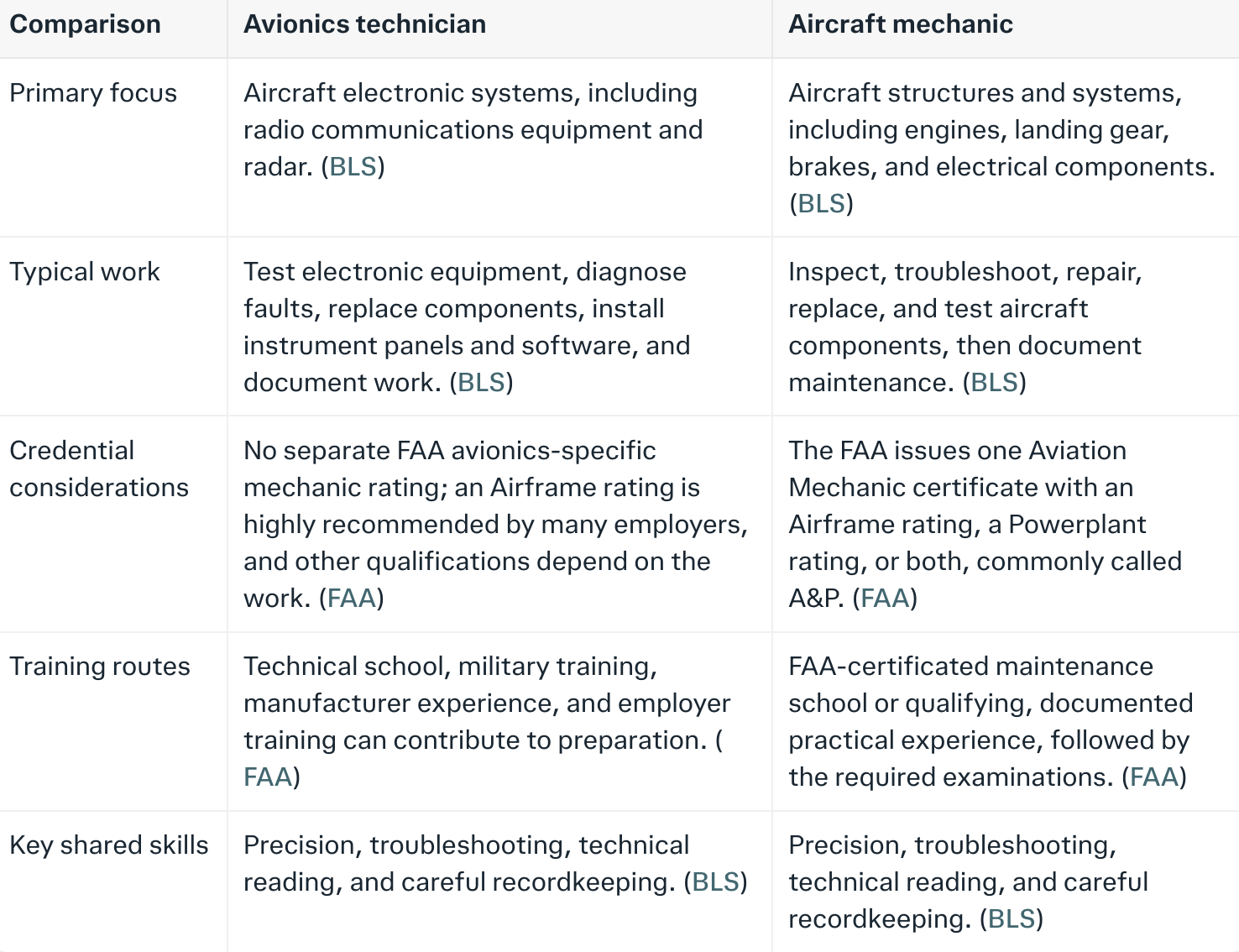
The comparison below describes typical occupational differences rather than an absolute division of responsibilities. The FAA treats “aviation mechanic” and “aviation maintenance technician,” or AMT, as equivalent terms, while avionics identifies a technical specialty. (FAA: Become an Aviation Mechanic)
What Does an Avionics Technician Do?
Avionics technicians install, test, maintain, and repair aircraft electronic equipment, with communications and radar among the systems identified by the Bureau of Labor Statistics. Their work includes testing circuits, diagnosing malfunctions, replacing defective components, assembling electrical controls, installing software, and keeping maintenance records. (U.S. Bureau of Labor Statistics)
Typical responsibilities include:
- Electronic testing: Use circuit testers, voltmeters, and other instruments to evaluate equipment performance. (BLS)
- Fault diagnosis: Interpret test information, including flight-test data where applicable, to identify malfunctions and performance problems. (BLS)
- Installation and replacement: Install instrument panels, assemble components such as junction boxes, and replace malfunctioning equipment within the applicable authorization. (BLS; FAA)
- Software and system integration: Develop the computer hardware, software, database, integration, and networking knowledge relevant to evolving avionics systems. (FAA: Aviation Maintenance and Avionics Careers)
The specialty may appeal to someone who enjoys electronics and methodical problem-solving. If that sounds like your interests, explore avionics technician jobs on AllAviationJob.com and compare the qualifications listed by individual employers.
What Does an Aircraft Mechanic Do?
Aircraft mechanics diagnose mechanical and electrical problems, inspect aircraft components, perform repairs, and verify that completed work meets performance standards. A&P mechanics are generalists whose work can include engines, landing gear, brakes, and many other aircraft components, although some tasks require additional qualifications or authorization. (U.S. Bureau of Labor Statistics)
Common responsibilities include:
- Inspection: Examine aircraft components and replacement parts for defects or other conditions requiring attention. (BLS)
- Repair and replacement: Work on wings, brakes, electrical systems, and other components using the appropriate tools and instructions. (BLS)
- Testing: Use gauges and other instruments to evaluate parts and inspect completed work. (BLS)
- Technical documentation: Interpret manufacturers’ instructions and maintain records of maintenance and repairs. (BLS)
Although the title can suggest a broad role, mechanics may specialize in a particular aircraft type, engine, or system rather than performing every maintenance task. The BLS notes that some workers are generalists, while others specialize in areas such as engines or hydraulics. (U.S. Bureau of Labor Statistics)
For a closer look at entering the field, read the Aircraft Mechanic Career Guide: From A&P School to Your First Job. Use it alongside individual job descriptions when comparing training options and preparing applications.
Where the Two Careers Overlap
Aircraft mechanics also diagnose electrical faults, and appropriately qualified Airframe mechanics may perform avionics work within applicable privileges and limitations. However, the FAA emphasizes that holding a mechanic certificate does not, by itself, establish the knowledge and skill needed for every avionics task. (BLS; FAA)
Consider a simplified, hypothetical example: a cockpit display intermittently loses power. Diagnosing the problem could involve evaluating the display, its electrical supply, connections, and associated equipment rather than assuming the display itself needs replacement.
That example illustrates why “mechanic” and “avionics technician” should not be treated as completely separate worlds. When reviewing a vacancy, ask which systems the position covers, what training is provided, and how responsibilities are divided within the maintenance team.
FAA Certification: What Is Actually Required?
One of the most important distinctions is between an occupational title and legal maintenance privileges. The FAA’s certification guidance and Part 65 regulations define qualifications and limitations that a job title alone does not establish. (FAA; 14 CFR Part 65, Subpart D)
Aircraft Mechanic Certificates and A&P Ratings
The FAA issues a single Aviation Mechanic certificate with an Airframe rating, a Powerplant rating, or both; obtaining both is commonly described as earning an A&P certificate. The FAA does not require every mechanic to hold both ratings, although employers may prefer the combined qualification. (FAA; BLS)
For the standard U.S. certification pathway, applicants must meet these requirements:
- Age and English: Be at least 18 and able to read, write, speak, and understand English, subject to a limited regulatory exception for certain applicants employed outside the United States by a U.S. air carrier. (14 CFR § 65.71)
- Training or experience: Complete the appropriate FAA-certificated Aviation Maintenance Technician School pathway, or provide acceptable documentary evidence of at least 18 months of practical experience for one rating or 30 months of concurrent experience for both. (14 CFR § 65.77)
- Examinations: Pass the required knowledge, oral, and practical tests, with the prescribed tests completed within the applicable 24-month period. (FAA)
Graduating from school is not the same as receiving the mechanic certificate. School completion establishes a route to testing eligibility, while the applicant must still satisfy the remaining certification requirements. (FAA)
Do Avionics Technicians Need an A&P Certificate?
Not every avionics position requires an A&P certificate, and the FAA does not issue a separate avionics-specific mechanic rating. Many avionics employers highly recommend an Aviation Mechanic certificate with an Airframe rating, but qualifications depend on the position and the work performed. (FAA)
The FAA identifies circumstances in which non-certificated personnel may perform maintenance, including appropriate supervision or work under the authority of a certificated repair station or air carrier. It also distinguishes performing maintenance from approving equipment or an aircraft for return to service, which requires the applicable certificated authority or certificate-holder procedures. (FAA)
When evaluating an avionics role, ask the employer:
- Credential expectations: Is an Airframe rating or A&P certificate required, preferred, or unnecessary for this position?
- Scope of work: Is the role focused on installation, troubleshooting, component repair, or a combination?
- Supervision and authorization: Under whose authority will the work be performed, inspected, and approved?
- Training: Which aircraft, equipment, and procedures will you be trained to use?
Why an A&P Is Not Unlimited Authorization
Section 65.81 limits a mechanic’s privileges and requires familiarity with current manufacturer instructions and maintenance manuals for the specific operation. It also excludes certain work from the general mechanic privilege, including repairs to or alterations of instruments, making it important not to confuse aircraft-level installation work with unrestricted internal instrument repair. (14 CFR § 65.81)
For candidates, the practical lesson is to separate three questions: “What credential do I hold?”, “What work am I competent to perform?”, and “What work am I authorized to perform here?” The FAA specifically cautions that avionics knowledge and skill are not presumed simply because someone holds a mechanic certificate. (FAA)
What About an FCC License?
The FCC’s General Radiotelephone Operator License, commonly called a GROL and designated PG by the FCC, applies to adjusting, maintaining, or internally repairing FCC-licensed radiotelephone transmitters in specified services, including aviation. It is a task-specific communications credential, not a blanket FAA authorization for all avionics maintenance. (FCC: Commercial Radio Operator Types of Licenses; FAA)
Do not assume that every avionics vacancy requires a GROL, or that holding one replaces FAA maintenance requirements. Ask which equipment and duties trigger the employer’s licensing requirement before choosing a course or examination.
Training Paths and Skills to Develop
Aircraft mechanic candidates commonly prepare through an FAA-certificated maintenance school or qualifying civilian or military practical experience. Avionics technicians may build their technical foundation through military training, technical school, or work with an avionics manufacturer. (FAA: Become an Aviation Mechanic; FAA: Aviation Maintenance and Avionics Careers)
When comparing programs, look beyond the credential advertised on the brochure. Ask for a written explanation of which FAA testing requirements the program addresses, what hands-on work is included, and which employment outcomes the school can document.
- For a broad maintenance foundation: Prioritize programs or experience that match the Airframe and Powerplant ratings you intend to pursue, rather than assuming any aviation course establishes eligibility. (FAA)
- For avionics specialization: Look for substantial electronics training and exposure to the computer hardware, software, integration, and networking knowledge highlighted by the FAA. (FAA)
- For experience-based certification: Maintain detailed records of tasks, hours, and supervision so the FAA can evaluate whether the experience meets the applicable requirements. (FAA)
- For either career: Develop precision, manual dexterity, technical reading, observation, and problem-solving skills. (BLS)
Before enrolling, compare several relevant vacancies to identify recurring requirements. Browse aircraft technician and A&P career opportunities alongside avionics positions to see which route best matches your interests.
Work Environments and Schedules
Both occupations can involve work in hangars, repair stations, and on airfields, and both may require nights, weekends, and holidays. The BLS also describes noise, work on ladders or scaffolds, and uncomfortable physical positions as considerations in aviation maintenance. (U.S. Bureau of Labor Statistics)
Avionics should not automatically be viewed as a desk-based alternative to mechanical maintenance. The occupation includes hands-on installation and component work, while aircraft mechanics may work either outdoors or in climate-controlled shops and hangars. (U.S. Bureau of Labor Statistics)
Ask about the actual assignment before accepting an offer. A useful interview discussion should cover shift rotation, overtime expectations, physical tasks, work location, tool requirements, training support, and how the employer manages maintenance deadlines.
Salary and Employment Outlook
The BLS reports the following U.S. median annual wages for May 2025 and employment growth projections for 2025–2035. These are national occupational figures, not starting salaries or guaranteed offers for a particular job. (U.S. Bureau of Labor Statistics)
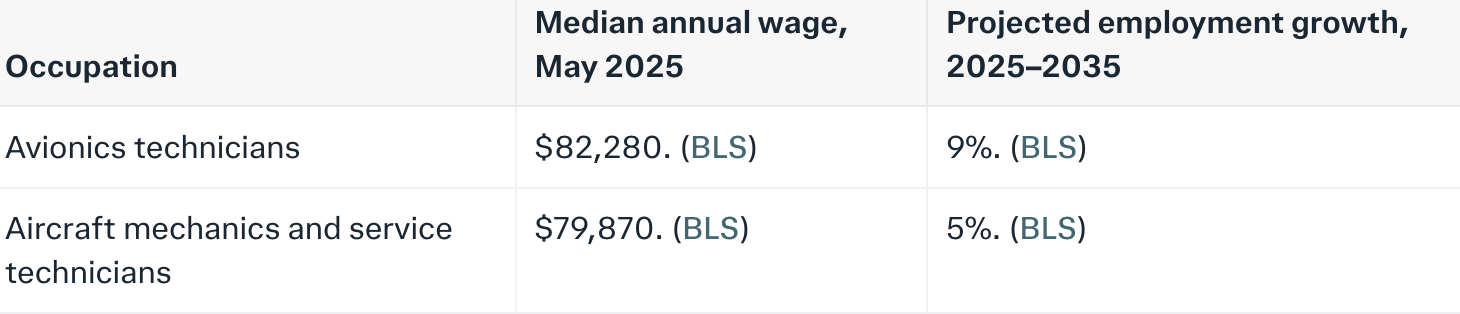
Although the national median is higher for avionics technicians, that does not mean an avionics role will always pay more than an aircraft mechanic role. BLS data show substantial differences by industry and a wide earnings range within each occupation. (U.S. Bureau of Labor Statistics)
The BLS projects about 13,100 openings annually across the two occupations combined, including openings created when workers leave the occupations or retire. That combined figure should not be described as 13,100 new avionics jobs or as net annual employment growth. (U.S. Bureau of Labor Statistics)
When evaluating offers, compare the entire package rather than the hourly rate alone. Review guaranteed hours, overtime, benefits, shift differentials, relocation costs, paid training, and any contract terms in writing.
Career Development and Choosing Your Direction
Aircraft mechanics may advance into lead mechanic, inspector, or shop supervisor positions as their experience grows. An Inspection Authorization, or IA, is a separate qualification available to eligible A&P mechanics who meet additional regulatory requirements; it is not automatically included with an A&P certificate. (BLS; 14 CFR § 65.91)
For avionics professionals, continued learning is especially relevant as aircraft electronics and computer-based systems evolve. The FAA highlights computer hardware, software, databases, integration, and networking as important knowledge areas for future avionics work. (FAA)
Use the following questions to guide your decision:
- Technical interests: Do you prefer electronic fault isolation and system integration, or a broader mix of mechanical and electrical maintenance?
- Training objective: Do you want to pursue an Airframe rating, both A&P ratings, an electronics-focused program, or a staged combination?
- Preferred workplace: Which setting appeals to you, and what does a normal shift actually involve?
- Career flexibility: Which qualifications would support the jobs you want now and the positions you may want later?
- Financial fit: How do tuition, tools, examination costs, relocation, and time away from paid work affect your plan?
Neither path is inherently the better career. Choose the route that fits your interests, financial circumstances, and willingness to keep developing technical skills, then confirm that the training supports your target jobs.
For Employers: Define the Role Before Recruiting
If you are hiring, specify whether the opening calls for broad A&P maintenance capability, specialized avionics experience, or both. The FAA notes that employers often establish additional avionics qualification requirements because a mechanic certificate alone does not demonstrate task-specific competence. (FAA)
Define the systems involved, required credentials, aircraft experience, shift pattern, training expectations, and approval responsibilities before starting the search. Employers seeking recruiting support can explore OSI Recruit’s aviation recruitment services, which include maintenance technicians and avionics specialists, or contact OSI Recruit to discuss staffing requirements. (OSI Recruit)
Take the Next Step With AllAviationJob.com
Turn your career research into a focused job search. Whether you are preparing for your first aviation maintenance position or considering a more specialized role, start by comparing opportunities that match your current qualifications and long-term goals.
- Explore avionics opportunities: Browse avionics technician jobs and identify roles aligned with your electronics background.
- Compare maintenance careers: Search aircraft technician opportunities and review employers’ A&P and experience requirements.
- Build your candidate profile: Create your AllAviationJob.com job-seeker profile and present your certificates, aircraft experience, technical skills, and career goals clearly.
Your next aviation career move starts with action: explore jobs and create your profile on AllAviationJob.com today. Choose opportunities that match your qualifications, tailor your application, and take the next step toward the work you want to do.
Sources
- U.S. Bureau of Labor Statistics: Aircraft and Avionics Equipment Mechanics and Technicians, Occupational Outlook Handbook. Occupational duties, training, working conditions, May 2025 wages, and 2025–2035 employment projections.
- Federal Aviation Administration: Become an Aviation Mechanic. Mechanic ratings, eligibility, testing, avionics qualifications, supervision, and return-to-service guidance.
- Federal Aviation Administration: How to Become an Aviation Maintenance or Avionics Technician. Avionics training routes, technical skills, and evolving technology.
- Electronic Code of Federal Regulations: 14 CFR Part 65, Subpart D: Mechanics. Eligibility, experience, examinations, mechanic privileges and limitations, and Inspection Authorization requirements.
- Federal Communications Commission: Commercial Radio Operator Types of Licenses. General Radiotelephone Operator License scope and requirements.
This article focuses on U.S. civilian aviation careers and was researched on October 29, 2026. It is educational guidance, not a substitute for current regulations, FAA determinations, or an employer’s approved maintenance procedures.