Choosing between a corporate pilot career and an airline pilot career is less about deciding which job is “better” and more about choosing the operating environment, lifestyle, compensation structure, and professional identity that fit you best. Both paths can lead to rewarding, technically demanding flying careers, but they differ substantially in schedule predictability, aircraft types, passenger interaction, advancement, and the way pilots build long-term stability.
For pilots evaluating their next move—or aspiring aviators planning their training path—the right answer begins with a clear understanding of how each sector actually operates.
The Core Difference
An airline pilot typically flies scheduled passenger or cargo routes for a regional, major, low-cost, or cargo airline. The operation is structured around published schedules, seniority systems, standardized procedures, union agreements at many carriers, and multi-pilot crews.
A corporate pilot flies business aircraft for a company flight department, private owner, charter operator, fractional provider, management company, or Part 135 operator. These jobs may involve anything from short executive trips in a light jet to international missions in ultra-long-range aircraft. The work is often more personalized and operationally varied.
In the United States, “corporate pilot” is a broad industry label rather than a single FAA operating category. A corporate pilot may fly under Part 91 for a company or aircraft owner, while charter and on-demand operations commonly fly under Part 135. That distinction matters because the applicable operating rules, scheduling practices, and duty/rest frameworks can differ.ecfr+1
Side-by-Side Career Comparison
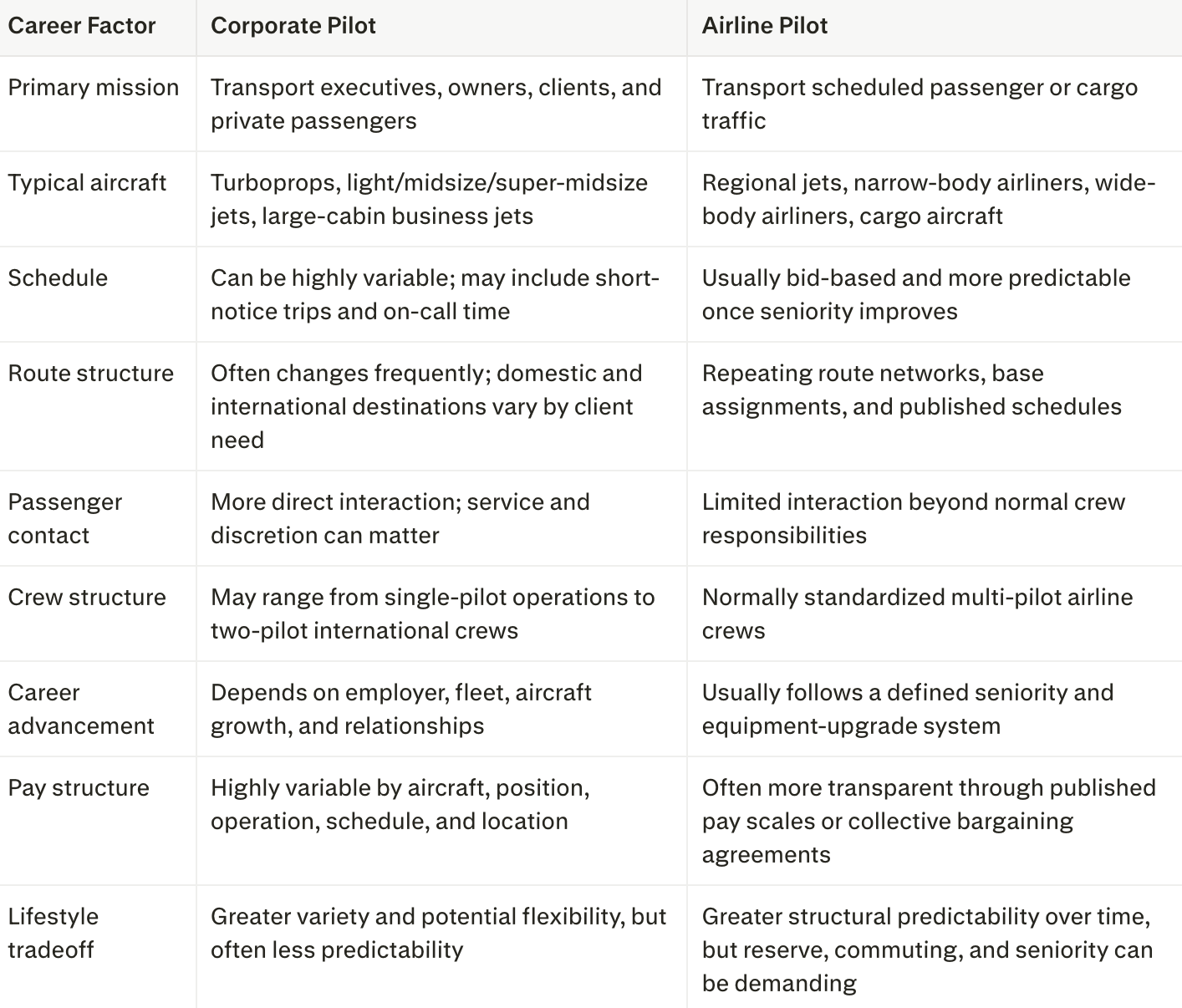
Neither path is universally superior. A pilot who enjoys routine, defined progression, and a large-team operational environment may thrive at an airline. A pilot who values mission variety, premium aircraft, close client relationships, and a smaller-team culture may prefer corporate or business aviation.
What Airline Pilot Life Is Really Like
Airline flying appeals to pilots who want a structured professional path. At many carriers, seniority affects bidding priority for schedules, vacations, crew bases, aircraft assignments, and upgrades. That structure can make career planning clearer over the long run, especially once a pilot has accumulated seniority at a stable airline.
Advantages of the airline path
- Defined progression. Pilots commonly move from first officer to captain based on qualification, company need, and seniority. Fleet changes and wide-body opportunities may create additional advancement routes.
- Operational standardization. Airlines rely on highly standardized procedures, dispatch support, maintenance control, crew scheduling, and formal training programs.
- Transparent compensation. At unionized airlines in particular, pay rates, per diem, retirement provisions, and work rules are often documented and easier to compare before accepting a position.
- Long-term schedule control. Early-career airline pilots may spend time on reserve or hold less desirable trips, but seniority can eventually improve schedule control substantially.
- Large-network career options. Airline pilots may have opportunities to move between bases, fleets, domestic operations, international flying, passenger service, and cargo work.
The regulatory route is also well established. For most pilots seeking to serve as a first officer in U.S. Part 121 airline operations, an airline transport pilot certificate—or a restricted ATP where eligible—is central to the path. The FAA notes that restricted-privileges ATP holders may serve as co-pilots before reaching the standard ATP threshold, while the standard airplane ATP route generally requires at least 1,500 total flight hours plus specified experience categories.faa+2
Airline lifestyle considerations
The airline lifestyle is not automatically predictable from day one. New hires may be on reserve, commute to a crew base, fly weekends and holidays, or have limited control over monthly schedules. A pilot’s quality of life can change dramatically based on:
- Seniority number.
- Assigned domicile or base.
- Fleet type.
- Whether the pilot commutes.
- Passenger versus cargo operation.
- Short-haul versus long-haul flying.
- Company growth, mergers, and equipment changes.
For pilots willing to work within a seniority-based system, the payoff can be significant. But anyone considering this route should understand that changing airlines can mean restarting at the bottom of another seniority list.
What Corporate Pilot Life Is Really Like
Corporate aviation can offer an exceptionally broad range of work. One position may involve recurring day trips with the same executive team; another may include international missions, luxury travel logistics, owner-specific preferences, trip planning, and high-touch passenger service.
The job is often more than flying the airplane. Corporate pilots may coordinate with flight attendants, maintenance personnel, dispatch providers, fixed-base operators, catering vendors, customs agencies, and aircraft-management teams. On smaller flight departments, they may also handle budgeting, vendor coordination, manuals, hangar logistics, scheduling support, and aircraft presentation.
Advantages of the corporate path
- Variety of missions. Corporate pilots may visit a wider range of airports and destinations than pilots flying a fixed airline network.
- Aircraft specialization. Business aviation provides access to sophisticated aircraft, including Citation, Challenger, Falcon, Gulfstream, Bombardier, Embraer, and Airbus Corporate Jet platforms.
- Smaller-team environment. Pilots can work closely with a consistent chief pilot, director of aviation, owner, or executive team.
- Direct client impact. Reliability, professionalism, discretion, and service can directly influence a client’s confidence in the flight department.
- Potentially strong niche opportunities. Experienced captains on high-demand business jets, especially with international operational experience and strong customer-service skills, can be highly valuable to operators and aircraft owners.
OSI Recruit’s aviation staffing practice specifically covers pilot, cabin crew, ground operations, and maintenance positions, including recruitment for international clients and private jet owners. That makes specialist recruiters useful when pilots are seeking positions that may not be advertised through broad airline-style hiring channels.
Corporate lifestyle considerations
Corporate flying can create a lifestyle that is either excellent or highly unpredictable, depending on the employer and operating model.
A Fortune 500 flight department with a mature crew, multiple aircraft, dedicated dispatch, scheduled rotations, and strong benefits may offer outstanding quality of life. A single-aircraft operation with an owner who travels on short notice can create frequent changes, weekend work, extended trips, and pressure to remain available.
Before accepting a corporate role, ask detailed questions about:
- How far ahead trips are normally scheduled.
- Whether pilots are formally on call and how callouts are handled.
- Expected days worked, days away from home, and holiday coverage.
- Whether the role is home-based, rotational, or requires relocation.
- Aircraft ownership structure and management company involvement.
- Domestic versus international mission mix.
- Whether the position requires non-flying responsibilities.
- The operator’s maintenance, training, insurance, and safety culture.
- Crew size and realistic staffing coverage.
For Part 135 operators, duty and rest rules apply, but the exact limitations depend on the type of operation and regulatory section involved. For example, the rules address flight-time caps and required rest, including scheduled-operation limits under §135.265 and other commercial-flying limitations under §135.267.ecfr+1
Training and Entry Requirements
Both career paths require strong foundational qualifications: pilot certificates, instrument proficiency, medical certification, multi-engine experience where relevant, professional judgment, and a consistent record of safe operations.
Airline preparation
The airline path generally emphasizes:
- Building flight time toward ATP or restricted ATP eligibility.
- Developing multi-engine and instrument experience.
- Preparing for airline-style technical interviews, simulator evaluations, and behavioral interviews.
- Demonstrating crew resource management, checklist discipline, SOP compliance, and decision-making.
- Building experience in roles such as flight instructor, charter pilot, cargo pilot, military aviator, or regional airline first officer.
The Bureau of Labor Statistics projects 7% employment growth for airline and commercial pilots from 2025 to 2035, faster than the average for all occupations. That outlook does not guarantee a specific airline’s hiring pace, but it reinforces that the broader pilot labor market remains an important long-term career field.
Corporate preparation
Corporate employers often look beyond minimum certificate requirements. Depending on the role, they may prioritize:
- Turbine time and multi-engine experience.
- Type ratings or experience in a specific aircraft family.
- International experience, including oceanic and North Atlantic operations.
- High-level customer service and executive presence.
- Clean training and safety records.
- Strong communication, discretion, flexibility, and professional appearance.
- Familiarity with Part 91, Part 135, IS-BAO, SMS, and managed-aircraft operations.
- Ability to represent the flight department directly to executives, owners, and vendors.
A new pilot does not need to begin in a major corporate flight department to build toward that goal. Charter, fractional, air ambulance, cargo, turboprop, flight instruction, regional airline, and aviation-management roles can all develop transferable skills.
Compensation: Look Beyond the Headline Salary
Compensation comparisons can be misleading because both sectors vary substantially by experience, aircraft, company, schedule, location, and benefits.
Airline compensation tends to be easier to benchmark because many airlines publish contractual pay rates, and pay is often tied to aircraft, seat, longevity, and guarantee. Corporate compensation can be less standardized: a light-jet co-pilot role, a rotational Gulfstream captain position, a Part 135 charter job, and a Fortune 500 flight-department captain role may have very different salary, bonus, retirement, training, and schedule profiles.
When comparing offers, evaluate the total package, not only annual salary:
- Base pay and expected flight pay.
- Daily guarantee or minimum monthly pay.
- Per diem and international pay provisions.
- Retirement match, profit sharing, and deferred compensation.
- Health insurance and disability coverage.
- Paid training and recurrency.
- Vacation, sick leave, and reserve/on-call policies.
- Commuting support or home-basing.
- Hotel standards and crew-rest policies.
- Upgrade opportunities and aircraft progression.
- Contractual protections or employment-at-will status.
A role with a slightly lower base salary but a stable rotation, employer-paid training, robust retirement benefits, and minimal commute may be a better long-term choice than a higher-salary role with constant availability expectations.
How to Decide Which Path Fits You
Use the following questions to make the decision more personal and practical.
Choose the airline path if you value:
- A structured advancement system.
- Clear seniority-based progression.
- Standardized operating procedures and large-team support.
- More predictable scheduling potential as seniority grows.
- A defined path toward larger aircraft and international airline flying.
- A career built around scheduled commercial operations.
Choose the corporate path if you value:
- A varied mission profile and changing destinations.
- Working in smaller, relationship-driven flight teams.
- Direct interaction with executives, owners, or premium clients.
- Business-jet aircraft and private-aviation operations.
- A role that combines flying with operational, customer-service, and logistical responsibilities.
- Flexibility to pursue specialized positions rather than a single seniority ladder.
Consider a hybrid strategy
You do not have to choose permanently at the beginning of your career. Many pilots transition between airlines, charter, fractional operations, aircraft management, corporate flight departments, and contract flying as their priorities change.
For example, a pilot may build turbine time in Part 135 charter, join an airline to gain structured experience and stability, then later move into a corporate captain role for schedule, location, aircraft, or lifestyle reasons. Another pilot may begin in a corporate flight department, then move to an airline when they want the clarity of a seniority-based career path.
The key is to keep your records current: logbook accuracy, training history, medical status, certificates, type ratings, professional references, and a polished résumé all make future transitions easier.
Find Your Next Pilot Opportunity
Whether you are pursuing an airline first-officer position, a corporate captain role, a charter opportunity, a fractional operator position, or a specialized business-aviation assignment, your search should be active and targeted.
Create a professional profile on AllAviationJob.com, explore the platform’s current aviation job listings, and set up job alerts so relevant pilot opportunities come to you as they are posted. All Aviation Jobs connects job seekers with aviation and aerospace employers and provides job-alert functionality for matching opportunities.
For pilots seeking tailored representation in business aviation, private jet, international, or specialty staffing roles, review OSI Recruit’s aviation staffing services. OSI Recruit works across aviation staffing and recruits for pilots, cabin crew, maintenance, and ground-operations talent, including private-jet and international client needs.o
Ready to move your pilot career forward? Build your profile, upload your résumé, and start applying today through AllAviationJob.com. The best aviation opportunities are often filled by candidates who are visible, prepared, and ready to respond when the right role appears.
Sources
- Federal Aviation Administration, Pilot Training and ATP information.faa
- Electronic Code of Federal Regulations, 14 CFR Part 61, Subpart G: Airline Transport Pilots.ecfr
- Electronic Code of Federal Regulations, 14 CFR § 61.159: Aeronautical Experience.ecfr
- Electronic Code of Federal Regulations, 14 CFR Part 135, Subpart F: Crewmember Flight Time and Duty Period Limitations.ecfr
- U.S. Bureau of Labor Statistics, Airline and Commercial Pilots Occupational Outlook Handbook.bls
- All Aviation Jobs.allaviationjob
- OSI Recruit.