Earning a commercial pilot certificate is a major professional milestone—but it is not, by itself, a guaranteed airline or turbine-flight job. For most new commercial pilots, the next phase is about building legitimate experience, developing professional habits, documenting qualifications accurately, and targeting entry-level opportunities that match their certificates, ratings, flight time, and long-term goals.
The key is to treat your first aviation job as a strategic stepping stone. Whether you begin as a certified flight instructor, survey pilot, aerial-tour pilot, pipeline patrol pilot, banner-tow pilot, charter support pilot, or in another early-career role, each position should help you build safe, relevant, and marketable experience.
Understand Where You Are
Under FAA Part 61 rules, a commercial pilot certificate generally requires at least 250 hours of flight time, along with specific experience in areas such as pilot-in-command time, cross-country flying, instrument training, and solo or supervised PIC operations. That certificate allows a pilot to be compensated for certain flying operations, but it does not mean every commercial flying job will be available at 250 hours.
This distinction matters. Employers establish their own hiring minimums based on insurance requirements, aircraft type, operating environment, customer expectations, and regulatory obligations. A commercial certificate qualifies you for commercial privileges within the limits of your ratings and the applicable regulations; an employer may still seek substantially more total time, multi-engine time, instrument experience, turbine exposure, or prior operational experience.
For pilots pursuing the airline path, the usual destination is an Airline Transport Pilot, or ATP, certificate. In the standard pathway, pilots generally need 1,500 total hours to qualify for an unrestricted ATP certificate, although certain restricted ATP pathways may be available to eligible applicants with qualifying aviation education or military experience. The FAA notes that a restricted-privileges ATP can allow a pilot to serve as a co-pilot while building toward the experience required for full ATP privileges.
That gap between commercial pilot minimums and ATP-level employment is why career planning matters immediately after flight school.
Build a Career Plan First
Before applying broadly, define the type of flying you want to pursue. Your answer will influence which ratings, flight-time categories, relationships, and early jobs are most valuable.
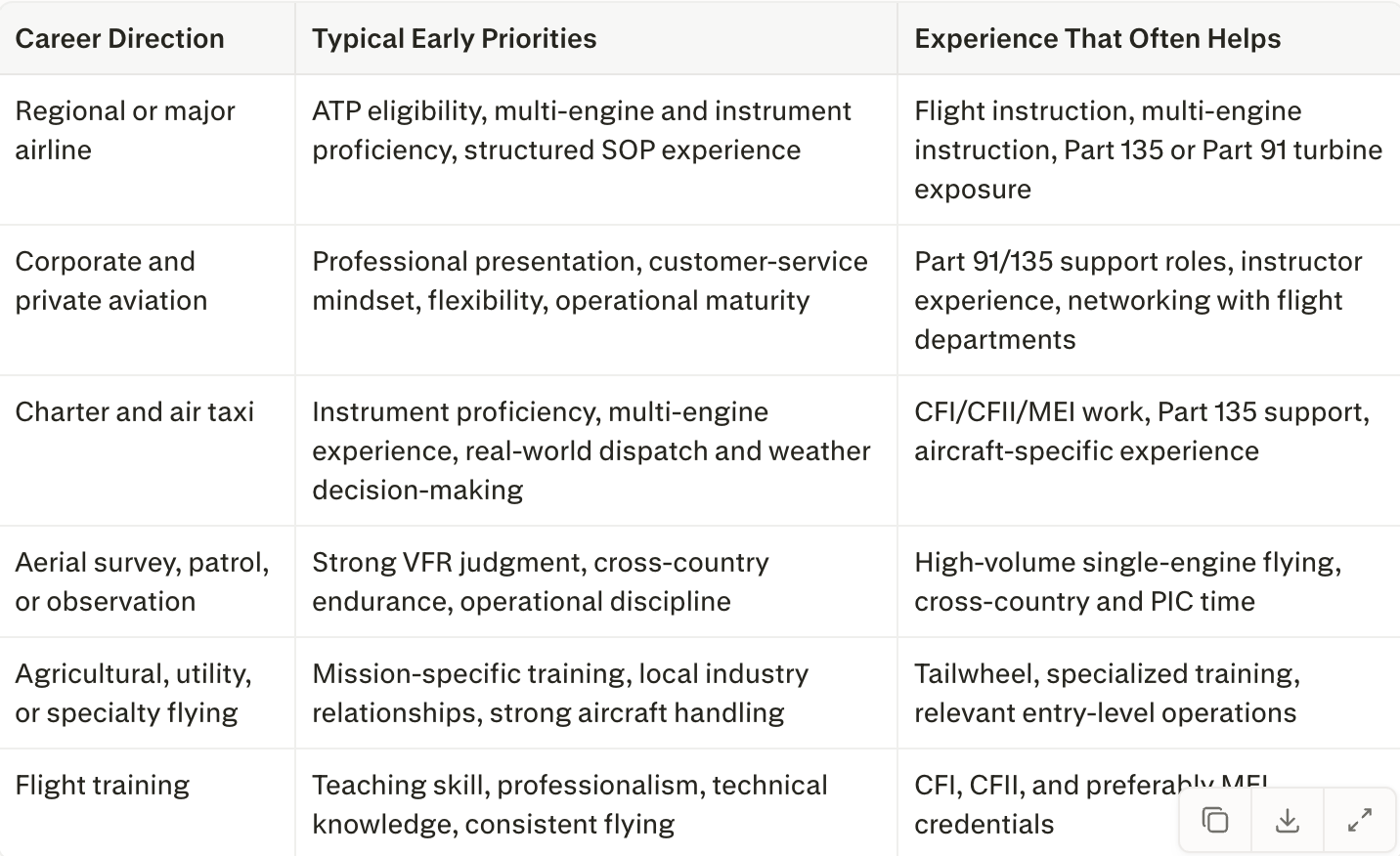
A new pilot does not need a career plan that is permanent. Aviation careers change with hiring cycles, family priorities, aircraft opportunities, and economic conditions. However, a clear 12- to 24-month plan keeps you from collecting flight time without purpose.
For example, a pilot aiming for a regional airline may prioritize a CFI, CFII, and multi-engine instructor certificate to build total time, instrument experience, and multi-engine exposure. A pilot aiming for business aviation may benefit from building a professional network around local FBOs, managed aircraft, charter companies, and corporate flight departments while gaining credible operational experience.
Earn the Ratings That Expand Options
A commercial certificate becomes far more marketable when paired with the right additional qualifications.
Instrument rating
An instrument rating is essential for most professional pilot pathways. It demonstrates that you have trained to operate in the National Airspace System under IFR, manage instrument procedures, interpret weather information, and make decisions in more complex operating environments.
Even when an entry-level job is primarily VFR, employers often value instrument proficiency because it indicates broader training and readiness for advanced roles.
Certified flight instructor
For many new commercial pilots, becoming a CFI is the most direct and practical route to paid flying. Instructing gives pilots an opportunity to build time while improving their own technical knowledge, communication skills, aeronautical decision-making, and cockpit discipline.
Teaching also develops habits that employers value:
- Thorough preflight planning
- Clear communication
- Consistent checklist use
- Sound weather judgment
- Accurate logbook practices
- Professional interaction with students, instructors, examiners, and customers
A CFI certificate is not mandatory for every pilot career, but it opens one of the broadest pools of low-time flying opportunities.
CFII and MEI
A Certified Flight Instructor–Instrument, or CFII, can increase a new instructor’s employability and help build instrument-related experience. A Multi-Engine Instructor, or MEI, can be especially valuable because multi-engine instruction often provides access to multi-engine time that is difficult and expensive to acquire otherwise.
The right path depends on your budget, local flight-school demand, and career objective. Do not pursue ratings simply to collect credentials; pursue them because they improve the jobs you can realistically obtain.
Build Flight Time Intentionally
Not all hours carry the same career value. Total time matters, but employers also look at how that time was earned and what it says about your readiness.
Maintain an accurate and well-organized logbook—electronic, paper, or both—and ensure that time is categorized correctly. Common categories employers may review include:
- Total time
- Pilot-in-command time
- Cross-country time
- Night time
- Instrument time, actual and simulated
- Multi-engine time
- Turbine time
- Complex or technically advanced aircraft time
- Flight instructor time
- Time in type, where applicable
A pilot with 1,000 hours of meaningful instruction, cross-country, instrument, and multi-engine experience may present differently from a pilot with the same total time concentrated in a narrow operating profile. Neither background is automatically better, but each supports different roles.
The objective is not to “hour-build” at any cost. The goal is to gain safe, legal, insurable, well-documented experience that moves you closer to the type of position you want next.
Target Realistic First Jobs
At the commercial-pilot stage, focus on employers whose requirements align with your current qualifications. Applying to jobs far above your experience level can be useful for learning the market, but it should not replace targeted applications to realistic opportunities.
Potential first-job pathways can include:
- Flight instructor positions
- Instrument or multi-engine instructor roles
- Aerial survey and mapping operations
- Banner towing
- Pipeline or powerline patrol
- Scenic or aerial-tour operations
- Skydive operations
- Ferry or repositioning work, when properly qualified
- Part 91 support or right-seat opportunities, where lawful and available
- Aviation operations, dispatch, FBO, or customer-service positions that build industry relationships while you continue flying
Each opportunity has different operational risks, insurance restrictions, seasonal patterns, and hiring minimums. Read every job posting carefully. Never assume that holding a commercial certificate meets an employer’s qualifications.
On AllAviationJob.com, pilots can browse aviation employment by category, including a dedicated pilot jobs section, while also exploring flight department, FBO, scheduling and dispatch, customer service, and aviation-management opportunities. The platform is useful not only for applying to current openings, but also for studying what employers request at different experience levels.
Create a Job-Ready Pilot Profile
Your résumé and online profile should make it easy for a recruiter or chief pilot to understand whether you meet the role’s minimums.
Include the following information clearly:
- Certificate level and ratings
- FAA medical class and expiration date, when appropriate
- Total flight time and key breakdowns
- Current flight experience and recency
- CFI, CFII, and MEI credentials, if applicable
- Aircraft flown, especially multi-engine, turbine, complex, or TAA aircraft
- Education and aviation training
- Work authorization and geographic availability
- Professional references, with permission
- Safety record and relevant operational experience
Avoid vague descriptions such as “experienced commercial pilot” when your flight-time breakdown tells a more useful story. A recruiter should be able to identify your qualifications in seconds.
For example:
Commercial Pilot, Airplane Single-Engine Land and Multi-Engine Land; Instrument Airplane; CFI/CFII. FAA Second-Class Medical. 720 total hours, 510 PIC, 95 multi-engine, 110 instrument, 240 dual given.
That format is clear, factual, and easy to compare with a job posting.
Apply Like a Professional
Aviation is a small industry. Your reputation begins before your first interview, and it follows you from flight school to your first job and beyond.
When applying:
- Customize your résumé to the position.
- Match your stated flight times to your logbook.
- Use a professional email address and voicemail greeting.
- Read the complete job description before applying.
- Be honest about minimums you do and do not meet.
- Follow application instructions precisely.
- Research the operator, aircraft, routes, and operating environment.
- Prepare for questions about weather, IFR procedures, risk management, professionalism, and decision-making.
- Follow up respectfully—not repeatedly.
- Keep applying while you continue improving your qualifications.
If a role requires 500 hours total time and you have 300, it may still be worth monitoring the employer, connecting professionally, and building toward that benchmark. Do not misrepresent your experience to get past an application screen. A discrepancy between an application, résumé, and logbook can end an opportunity immediately and damage trust.
Network Beyond the Cockpit
Many aviation jobs are found through relationships. Networking does not mean asking strangers for a job in your first message. It means consistently becoming known as a safe, prepared, respectful professional.
Useful places to build relationships include:
- Local airports and FBOs
- Flight schools and aviation colleges
- Aircraft-management companies
- Charter operators
- Aviation association meetings
- Career fairs and industry events
- Airport authority events
- Professional LinkedIn communities
- Online aviation job platforms
Approach networking with curiosity. Ask pilots, instructors, recruiters, and operations professionals what qualifications they look for, what hiring trends they are seeing, and what advice they would give to someone building toward their sector.
OSI Recruit works with aviation organizations across roles that include pilots, cabin crew, ground operations, and maintenance personnel. Reviewing the company’s aviation staffing services can help candidates understand how specialized recruiters position aviation talent and what employers often value in a competitive candidate market.
Prepare for the Interview
A first pilot interview may evaluate more than your stick-and-rudder ability. Employers often assess whether you can operate professionally within a team, follow procedures, communicate effectively, and make conservative decisions under pressure.
Prepare to discuss:
- A weather-related go/no-go decision
- A time you identified and managed risk
- A challenging instructional or flight situation
- Your approach to checklists and standard operating procedures
- A mistake you learned from
- How you would handle a disagreement in the cockpit
- Your understanding of fatigue, currency, and personal minimums
- Why you want to work for that specific operator
Be ready to explain every number in your logbook. Know your total time, PIC, cross-country, night, instrument, multi-engine, and recent experience without guessing.
Avoid Common Mistakes
New commercial pilots often slow their progress by making avoidable decisions.
- Waiting for the “perfect” job instead of building relevant experience now
- Failing to earn an instrument instructor or multi-engine instructor certificate when it fits the career plan
- Letting instrument proficiency or medical eligibility lapse
- Logging time inaccurately or inconsistently
- Applying with a generic résumé to every role
- Underestimating the importance of customer service and communication
- Ignoring operations, dispatch, and FBO roles that can create valuable industry connections
- Treating online applications as the only job-search strategy
- Accepting unsafe, questionable, or poorly documented flying arrangements
No first job is worth compromising safety, regulatory compliance, insurance requirements, or your professional reputation.
Your Next Move
The journey from flight school to a professional cockpit is rarely a straight line. The pilots who progress steadily are usually the ones who remain current, teachable, organized, and intentional about their next 500 hours—not just their final career destination.
Start by reviewing your certificates, ratings, medical status, logbook totals, and target career path. Then build a focused application package, set alerts, apply consistently, and continue gaining experience that supports the role you want next.
Ready to Launch Your Pilot Career?
Do not wait for opportunities to find you. Create a complete profile, upload a polished aviation résumé, and begin exploring pilot openings today on AllAviationJob.com.
Whether you are a newly certificated commercial pilot, a CFI building toward ATP minimums, or an experienced aviator ready for your next cockpit, AllAviationJob.com connects aviation professionals with employers across the industry.
For employers seeking qualified pilots and aviation professionals, learn more about OSI Recruit’s aviation staffing solutions.osirecruit
Sources
- Federal Aviation Administration, “How do I get a commercial pilot license (certificate)?” — FAA commercial certificate flight-time baseline.faa
- Federal Aviation Administration, “Pilot Training: ATP” — FAA information on restricted-privileges ATP certification.faa
- Aircraft Owners and Pilots Association, “Commercial Pilot Certificate” — overview of Part 61 commercial certificate experience requirements.aopa
- Aircraft Owners and Pilots Association, “Airline Transport Pilot” — overview of ATP eligibility and flight-experience requirements.aopa
- AllAviationJob.com — aviation job categories, pilot opportunities, and job-seeker resources.allaviationjob
- OSI Recruit — aviation staffing and recruitment services.