A flight dispatcher—formally known in the United States as an aircraft dispatcher—is a certified aviation professional who helps plan, monitor, and support commercial flight operations. Dispatchers work closely with pilots, meteorologists, maintenance teams, air traffic services, and airline operations control centers to help ensure flights operate safely, legally, and efficiently.
For professionals who enjoy aviation, weather analysis, route planning, fast-paced operational decision-making, and teamwork—but do not necessarily want to become pilots—flight dispatch can be a rewarding career path. It is also a role with real responsibility: under applicable airline operating rules, dispatchers and pilots share operational-control responsibilities for dispatched flights.
What Does a Flight Dispatcher Do?
Flight dispatchers support each flight from pre-departure planning through arrival. Their work combines regulatory compliance, operational judgment, technical planning, and continuous communication.
Typical responsibilities include:
- Reviewing weather conditions at the departure airport, destination, alternate airports, and along the route.
- Creating and analyzing flight plans, including routing, fuel requirements, alternates, airport restrictions, and aircraft performance considerations.
- Monitoring NOTAMs, airspace restrictions, runway closures, airport conditions, and other operational notices.
- Coordinating with pilots before departure and providing updated information as conditions change.
- Tracking active flights and responding to disruptions such as thunderstorms, turbulence, diversions, delays, mechanical events, airport congestion, or airspace constraints.
- Working with maintenance, crew scheduling, customer-service, cargo, and ground-operations teams when a flight plan must change.
- Maintaining records and ensuring that flight releases and operational decisions meet company procedures and FAA regulations.
The role is sometimes described as an airline operations career, but dispatch professionals can also work with cargo carriers, regional airlines, charter operators, business-aviation organizations, and aviation service providers. Job titles may vary by company and can include aircraft dispatcher, flight dispatcher, operations controller, operations coordinator, or flight operations specialist. Applicants should always read the job description carefully to determine whether FAA dispatcher certification is required.
FAA Certification Requirements
In the United States, an applicant seeking an FAA Aircraft Dispatcher Certificate must meet the eligibility, knowledge, training or experience, and practical-testing requirements found in 14 CFR Part 65, Subpart C.
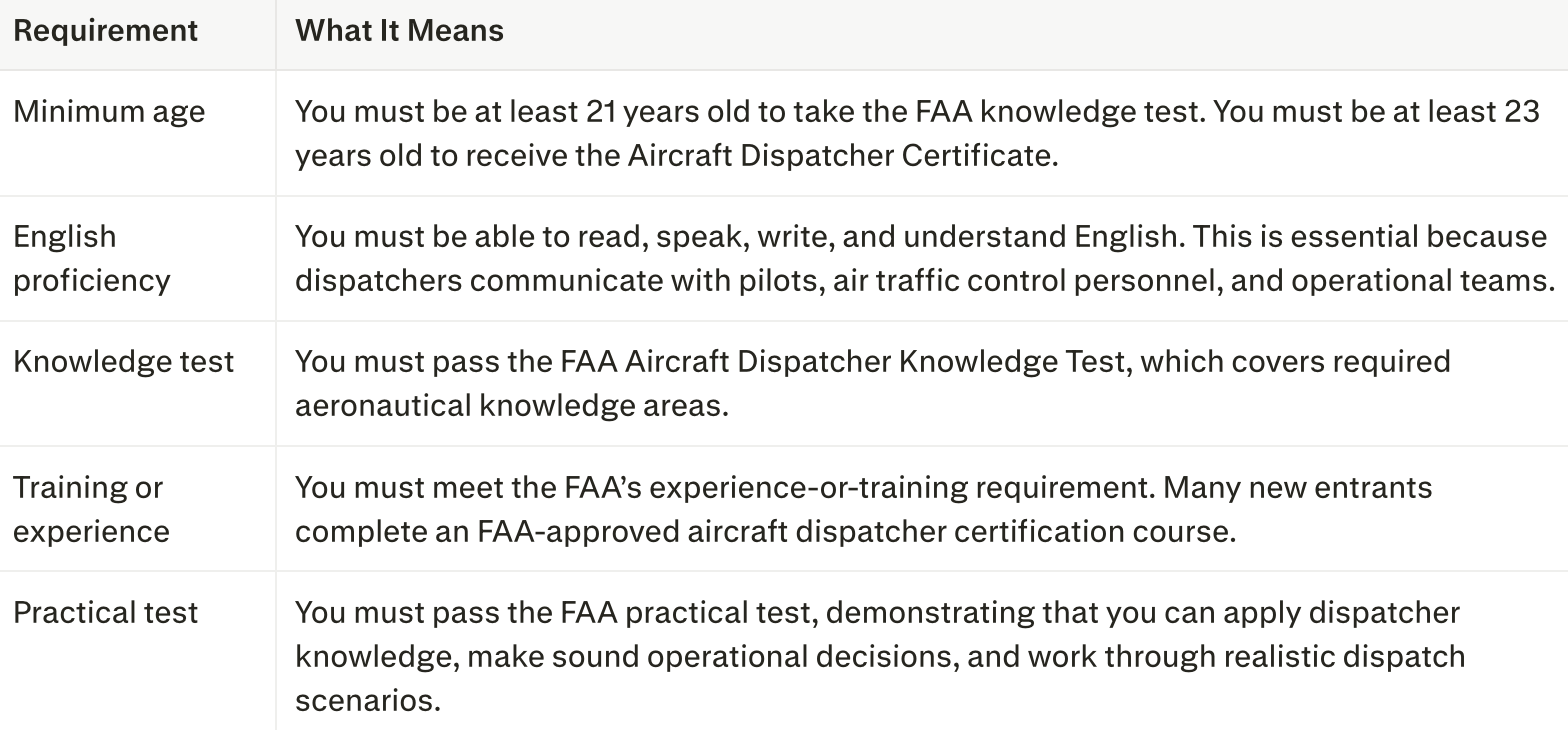
Applicants who complete the practical test before their 23rd birthday may be issued a Letter of Aeronautical Competency rather than the full certificate. Once they meet the age requirement and other applicable conditions, they can pursue certificate issuance under FAA procedures. The FAA’s Aircraft Dispatcher Practical Test Standards emphasize not only technical knowledge, but also sound judgment, aeronautical decision-making, normal and abnormal procedures, and dispatch resource management.
Experience or Training Pathways
Most people entering the profession use the approved-training route. FAA-approved aircraft dispatcher certification courses are structured to cover the knowledge and practical skills required for certification. Under 14 CFR § 65.61, an approved dispatcher course must include at least 200 hours of instruction, although prior qualifying experience or training may be credited in some situations at the course operator’s discretion.
Alternatively, certain applicants may qualify based on prior relevant aviation experience. The FAA regulations should be reviewed closely before selecting this path, because eligibility depends on the type, duration, and relevance of the experience. For most career changers and entry-level aviation professionals, completing an FAA-approved course is the clearest and most direct option.
What Dispatcher Training Covers
Dispatcher school is not simply a weather course or a flight-planning class. A quality FAA-approved program prepares candidates to make operational decisions under time pressure while balancing safety, compliance, aircraft capability, weather, and commercial realities.
Core subject areas generally include:
- Federal Aviation Regulations relevant to airline and flight operations.
- Aviation weather theory, forecasts, radar products, icing, convection, wind, turbulence, and decision-making in hazardous weather.
- Flight planning, route selection, fuel planning, alternates, airport analysis, and dispatch releases.
- Aircraft systems, limitations, performance, and weight-and-balance principles.
- Navigation, charts, airspace, NOTAM interpretation, and airport data.
- Airline operational control and crew-dispatcher coordination.
- Emergency procedures, abnormal situations, diversions, and contingency planning.
- Communication, documentation, professional judgment, and dispatch resource management.
The FAA maintains a list of Part 65 Aircraft Dispatcher Certification Courses, which candidates can use as a starting point when evaluating training options. Before enrolling, confirm directly with the provider that the course is currently FAA-approved, understand whether training is classroom-based, hybrid, or online with an in-person practical component, and ask about the testing process, scheduling, course length, total cost, and retest policies.
Step-by-Step Path to Becoming a Flight Dispatcher
1. Confirm That the Career Fits You
Flight dispatch is a strong fit for people who enjoy solving operational problems, interpreting technical information, staying calm during disruption, and communicating clearly with multiple stakeholders.
You do not need to be a pilot to become a dispatcher. However, you should be comfortable learning aviation terminology, weather concepts, regulations, maps, aircraft performance principles, and structured decision-making processes.
The work environment can be demanding. Airline and flight-operations centers often operate around the clock, so early mornings, evenings, weekends, holidays, and rotating shifts are common—particularly at the beginning of a career.
2. Meet the Basic FAA Eligibility Standards
Before investing in training, verify that you can meet the baseline requirements:
- Be at least 21 years old before taking the FAA knowledge test.
- Be able to read, speak, write, and understand English.
- Plan to be at least 23 years old before certificate issuance.
- Be prepared to pass both knowledge and practical examinations.
- Determine whether you will qualify through approved training or documented aviation experience.
A bachelor’s degree is not an FAA requirement for certification. Nevertheless, employers may value education or prior experience in aviation, operations, logistics, meteorology, airline customer service, military operations, maintenance coordination, or related fields.
3. Complete FAA-Approved Dispatcher Training
For most aspiring dispatchers, the next step is completing an FAA-approved aircraft dispatcher certification course. These programs provide the foundation needed for the FAA knowledge test and practical examination.
When comparing programs, evaluate more than tuition. Ask whether the school offers:
- Current FAA approval and a clear certificate-completion process.
- Training aligned with the FAA knowledge and practical-test standards.
- Instructor access and scenario-based dispatch exercises.
- Weather, flight-planning, and operations-control simulations.
- FAA knowledge-test preparation.
- Practical-test preparation with a qualified examiner process.
- Career guidance, résumé support, and employer connections.
- Transparent policies on attendance, course completion, test fees, and retesting.
Training intensity varies. Some programs are full-time and condensed, while others use hybrid or extended schedules. The best choice depends on your availability, learning style, budget, and ability to attend any required in-person sessions.
4. Pass the FAA Knowledge Test
The FAA knowledge test assesses whether you understand the aeronautical information needed to perform dispatcher duties. Required knowledge areas include relevant aviation regulations, meteorology, navigation, aircraft systems and performance, flight planning, air traffic procedures, emergency operations, and decision-making.
Preparation should go beyond memorizing test questions. Employers expect dispatchers to understand why a weather system, alternate-airport requirement, route restriction, fuel policy, or aircraft limitation matters operationally.
A practical study routine includes:
- Reviewing material consistently throughout your course.
- Practicing calculations, chart interpretation, weather decoding, and flight-planning logic.
- Completing practice exams to identify weak areas.
- Revisiting missed concepts rather than merely memorizing correct answers.
- Building confidence with real-world dispatch scenarios.
5. Pass the Practical Test
The FAA practical test is where candidates demonstrate that they can apply their training. According to the FAA’s practical-test standards, examiners evaluate knowledge, skill, judgment, aeronautical decision-making, and dispatch resource management—not just rote recall.
A practical test may require you to work through a realistic operational scenario involving items such as:
- Analyzing weather at the departure airport, destination, and alternates.
- Identifying hazardous conditions and determining their operational impact.
- Reviewing aircraft performance and operational limitations.
- Developing or evaluating a flight plan and fuel strategy.
- Responding to a changing weather situation, delay, diversion, or irregular operation.
- Explaining your reasoning and communicating clearly.
The strongest candidates approach the practical test as an operations exercise: gather facts, identify risks, apply regulations and company-style procedures, communicate a defensible plan, and adjust when conditions change.
6. Apply for Dispatcher and Operations Roles
After earning certification, begin targeting positions that match your experience level. Entry opportunities may appear under several job titles, including:
- Aircraft Dispatcher.
- Flight Dispatcher.
- Assistant Dispatcher.
- Flight Operations Coordinator.
- Operations Controller.
- Operations Specialist.
- Crew or Dispatch Support Coordinator.
- Charter Operations Coordinator.
- Aviation Operations Specialist.
Use tailored application materials. Your résumé should clearly state your FAA Aircraft Dispatcher Certificate, testing status if applicable, dispatcher-school completion, relevant aviation training, shift flexibility, operational software experience, and customer-service or logistics background.
Ready to turn your certification into an aviation career? Create your profile on AllAviationJob.com, upload a dispatcher-focused résumé, set job alerts, and search aviation opportunities in one place. The platform connects aviation professionals with employers and includes job alerts designed to help candidates hear about matching roles as they are posted.
Skills Employers Look For
FAA certification is essential for many dispatcher positions, but certification alone does not guarantee a job offer. Employers also look for people who can perform well in a high-accountability operations environment.
Technical Skills
- Flight planning and fuel-planning fundamentals.
- Aviation weather analysis and forecast interpretation.
- Knowledge of aviation regulations and operational procedures.
- Familiarity with NOTAMs, charts, airport information, and airspace.
- Understanding of aircraft performance and limitations.
- Comfort with dispatch, scheduling, tracking, and communication systems.
- Strong computer literacy and attention to documentation.
Professional Skills
- Clear, concise communication.
- Sound judgment under pressure.
- Attention to detail without losing awareness of the larger operation.
- Ability to prioritize multiple flights, alerts, and deadlines.
- Teamwork across pilots, maintenance, customer service, crew scheduling, and leadership.
- Adaptability when weather, aircraft availability, staffing, or airport conditions change.
- Professional composure during irregular operations.
For candidates interested in broader aviation career opportunities, OSI Recruit provides aviation staffing services across roles such as pilots, cabin crew, ground operations, and maintenance personnel, as well as international recruitment support. This can be useful for professionals exploring dispatcher-adjacent operations careers or building a longer-term aviation career strategy.
Career Outlook and Advancement
The career outlook for aircraft dispatchers is best understood through the needs of airline and flight operations rather than a single, precise national forecast. The U.S. Bureau of Labor Statistics groups aircraft dispatchers within the broader “Dispatchers, Except Police, Fire, and Ambulance” occupational category, which includes many non-aviation dispatch roles. As a result, broad BLS employment or wage figures should not be treated as a dispatcher-specific forecast for airline operations.
That said, certificated dispatchers remain important to commercial flight operations. Airlines, cargo carriers, regional operators, charter companies, and flight departments need operations professionals who can support safe, compliant decision-making. Career opportunities can be affected by airline growth, fleet changes, route expansion, retirements, operational turnover, staffing cycles, and the overall health of the aviation industry.
Potential Career Progression
A dispatcher’s career may develop into roles such as:
- Senior Aircraft Dispatcher.
- Lead Dispatcher or Dispatch Supervisor.
- Operations Control Center Supervisor.
- Manager of Dispatch or Flight Operations.
- System Operations Control Manager.
- Crew Scheduling or Network Operations Leadership.
- Safety Management System or operational-risk roles.
- Charter, cargo, corporate-flight-department, or international operations positions.
Experience at a Part 121 airline can be particularly valuable because it exposes dispatchers to structured operational-control systems, complex network operations, regulated procedures, and high-volume decision-making. However, regional, cargo, charter, and business-aviation positions can also offer meaningful experience and may provide different schedules, aircraft types, or operational responsibilities.
How to Improve Your Job Prospects
Once you have completed training, focus on positioning yourself as operationally ready—not merely certificated.
- Build a résumé that highlights your FAA certificate, practical skills, aviation coursework, and relevant operations experience.
- Use aviation-specific job boards and set alerts for dispatcher, operations-control, and flight-operations roles.
- Be flexible on location and shift schedules, especially for a first dispatch position.
- Research each operator before applying, including fleet type, route structure, operating certificate, dispatch center location, and operational scale.
- Practice interview responses about weather, alternates, fuel, decision-making, teamwork, fatigue, pressure, and irregular operations.
- Network professionally with dispatch graduates, aviation recruiters, airline employees, and professional aviation groups.
- Consider related aviation operations roles if dispatcher openings are limited in your preferred market.
AllAviationJob.com is a practical place to begin that search. Build a professional candidate profile, upload your aviation résumé, and activate job alerts so you can respond quickly when relevant dispatch or operations opportunities appear. Visit AllAviationJob.com now to take the next step toward your aviation operations career.
Final Thoughts
Becoming a flight dispatcher requires more than passing an exam. It requires disciplined training, aviation knowledge, good judgment, and the ability to make sound operational decisions when the situation is changing quickly.
The most direct path is usually to meet the FAA eligibility standards, complete an FAA-approved dispatcher course, pass the FAA knowledge and practical tests, and then pursue airline or aviation-operations roles with a focused, professional application strategy. For people drawn to aviation operations, dispatch offers a career at the center of the decision-making process that keeps flights moving safely and efficiently.
Sources
- Federal Aviation Administration, Aircraft Dispatcher Practical Test Standards
- Electronic Code of Federal Regulations, 14 CFR Part 65, Subpart C—Aircraft Dispatchers
- Federal Aviation Administration, Part 65 Aircraft Dispatcher Certification Courses
- U.S. Bureau of Labor Statistics, Dispatchers, Except Police, Fire, and Ambulance
- AllAviationJob.com, aviation job-search platform and candidate job-alert resources.
- OSI Recruit, aviation staffing and recruitment services.