Limited flight time does not mean you have limited value to an aviation employer. A well-built aviation resume can show that you are trained, safety-minded, dependable, and prepared to grow—even if you are early in your flying career.
For pilots, dispatchers, maintenance professionals, cabin crew, airport operations candidates, and other aviation job seekers, the goal is not to disguise a lack of experience. The goal is to present your credentials, transferable strengths, operational exposure, and career direction clearly and honestly.
Ready to put your resume to work? Create your candidate profile and explore aviation opportunities at AllAviationJob.com. The platform lists roles across pilot, avionics, technician, engineering, FBO, customer service, flight department, management, dispatch, and other aviation specialties.
Start With a Clear Aviation Target
One of the most common mistakes early-career candidates make is sending the same general resume to every aviation employer. Aviation hiring is highly role-specific. A resume for a first officer opening should not look identical to a resume for an FBO customer-service position, an aircraft maintenance apprenticeship, or an aviation operations coordinator role.
Before writing, identify the job family you are targeting:
- Entry-level pilot, time-building, survey, charter support, or SIC opportunities.
- Flight operations, dispatch, scheduling, or crew coordination roles.
- Line service, FBO, ramp, customer-service, or airport operations positions.
- Aircraft maintenance, avionics, interiors, parts, or quality-assurance roles.
- Aviation administration, sales, recruiting, safety, or flight-department support positions.
Your headline and professional summary should reflect that direction. An employer should understand your goal within the first few seconds of reading.
Example headline:
Commercial Pilot | Instrument-Rated | 275 Total Hours | Safety-Focused Aviation Professional
Example for a broader aviation role:
Early-Career Aviation Professional | Flight Operations, Customer Service, and Ramp Experience | FAA Part 107 Certified
This approach works because it leads with facts. It tells the employer what you are qualified to do now, rather than making a vague claim such as “seeking an opportunity in aviation.”
Use a Strong Resume Structure
For candidates with limited flight experience, resume organization matters as much as the content itself. Put the information most relevant to the role near the top of the document.
A practical aviation resume format usually includes:
- Contact information and professional headline.
- Short professional summary.
- Certificates, ratings, licenses, and qualifications.
- Flight-time breakdown or technical qualifications.
- Aviation experience and relevant employment history.
- Education and formal training.
- Skills, systems, memberships, and volunteer involvement.
Keep the resume readable, typically one page for an early-career candidate and no more than two pages if you have substantial technical, military, leadership, maintenance, or operational experience. Use consistent dates, simple headings, and standard fonts. Avoid graphics, excessive color, skill bars, and unusual formatting that can make the document harder to scan or upload to an applicant tracking system.
Put Certifications and Ratings Near the Top
For pilots and other certificated aviation professionals, credentials should be prominent. When your logged experience is still developing, employers need to see what formal training and permissions you have already earned.
The FAA’s certification framework covers different aircraft categories and pilot certificate levels, from student pilot through airline transport pilot, with requirements depending on the type of aircraft and intended operation. Present only qualifications you actually hold, and ensure your resume, logbook, application, and interview answers all match.faa
Pilot credential section example
Certificates and Ratings
- FAA Commercial Pilot Certificate — Airplane Single-Engine Land
- Instrument Airplane Rating
- FAA First-Class Medical Certificate, if applicable
- FAA Part 107 Remote Pilot Certificate, if applicable
- Complex, high-performance, tailwheel, or multiengine endorsement, if applicable
- FCC Restricted Radiotelephone Operator Permit, if applicable
- Valid passport and eligibility to work in the United States, if applicable
Do not list a rating as complete if you are only training toward it. Instead, state it accurately:
- “Multi-Engine Add-On Training in Progress — Expected Completion: Month Year”
- “CFI Training in Progress”
- “Instrument Proficiency Training: Current”
For aviation maintenance candidates, use a similar section for FAA A&P certification, inspection authorization, avionics training, manufacturer coursework, airframe or powerplant specialization, NDT credentials, OSHA training, or relevant repair-station experience.
Present Flight Time Clearly and Honestly
A flight-time section is important for pilot candidates, but it should be concise and easy to verify. Do not inflate totals, round aggressively, or use a format that confuses logged time with projected time.
A good flight-time summary might look like this:
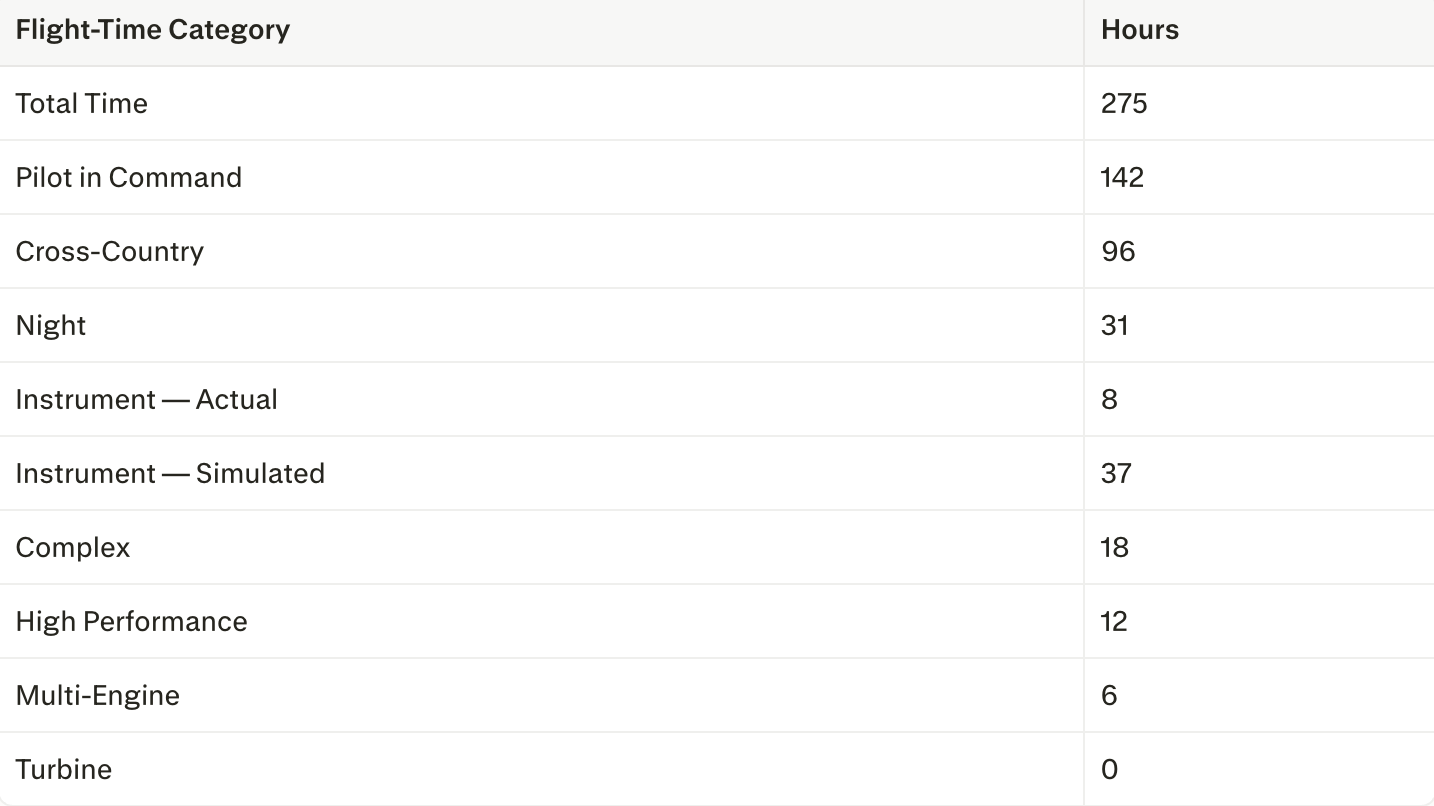
Only include categories that are relevant to the jobs you are pursuing and that can be substantiated by your logbook. If you have no turbine, jet, multiengine, or Part 135 experience, do not try to bury that fact. Focus on the quality of the experience you do have: disciplined cross-country planning, instrument procedures, night operations, weather decision-making, airport familiarity, crew coordination, safety training, and consistency in your flight activity.
For many early-career roles, employers are also evaluating judgment, communication, professionalism, reliability, and willingness to learn. Your resume should make those traits visible through real examples.
Turn Non-Flying Experience Into Aviation Value
Aviation employers hire people, not only flight-hour totals. If you have worked in hospitality, logistics, customer service, the military, operations, sales, maintenance, construction, emergency services, administration, or another field, identify the abilities that transfer directly to aviation.
Relevant transferable strengths can include:
- Following detailed procedures and checklists.
- Working safely in time-sensitive or regulated environments.
- Communicating with customers, crew members, vendors, and supervisors.
- Handling schedules, dispatching, routing, inventory, records, or compliance documentation.
- Working outdoors, around aircraft, on ramps, or during irregular hours.
- Maintaining situational awareness and making sound decisions under pressure.
- Supporting teams where professionalism and reliability are non-negotiable.
- Using scheduling, maintenance, CRM, dispatch, or data-management systems.
Weak versus stronger experience bullet
Weak:
Worked at a hotel and assisted guests.
Stronger:
Delivered professional, time-sensitive service to high-volume guests; resolved schedule changes and service issues while maintaining accurate records and a safety-conscious, customer-first standard.
The stronger version still tells the truth, but it highlights capabilities that can matter in an FBO, private aviation, airline support, flight operations, or customer-facing aviation role.
Whenever possible, use results or scope. State the number of customers served, assets supported, shifts covered, team members coordinated, records processed, projects completed, or safety procedures followed. Specificity is more persuasive than generic phrases such as “hard worker,” “team player,” or “motivated self-starter.”
Highlight Aviation Exposure Beyond Flight Hours
Limited flight time can be offset—not replaced, but meaningfully supported—by credible aviation involvement. Employers often value proof that you understand the industry and have consistently invested in your development.
Consider including relevant involvement such as:
- Flight-school employment, front-desk support, dispatch assistance, or aircraft scheduling.
- Line service, fueling, towing, hangar coordination, and ramp operations.
- Aircraft washing, detailing, interior support, or maintenance-shop assistance.
- Aviation internships, airport internships, or manufacturer programs.
- Volunteer work with aviation organizations, museums, youth programs, or airshows.
- Civil Air Patrol, collegiate aviation groups, EAA chapters, AOPA events, or airport advisory groups.
- Simulator instruction support, safety seminars, ground-school tutoring, or aviation mentorship.
- Aviation-related coursework, unmanned aircraft operations, safety-management exposure, or technical projects.
Include these experiences in an “Aviation Experience,” “Relevant Experience,” or “Leadership and Involvement” section. Avoid listing organizations without explaining your contribution.
For example:
Volunteer, Local EAA Chapter
Assisted with aircraft-event setup, visitor coordination, and youth aviation outreach; developed familiarity with airport operations, aviation safety culture, and professional communication with pilots, owners, and community members.
Write a Professional Summary That Adds Evidence
A resume summary should not be a list of personality traits. Use three to four lines to connect your qualifications to the role you want.
Example: early-career pilot
Commercial, instrument-rated pilot with 275 total hours and experience in cross-country, night, complex-aircraft, and instrument flight operations. Known for disciplined preflight planning, sound weather decisions, and clear communication. Seeking an entry-level aviation role where strong safety habits, customer service, and operational reliability can support continued professional development.
Example: aviation operations candidate
Aviation operations candidate with hands-on ramp and customer-service experience, strong schedule coordination skills, and a demonstrated commitment to safe, professional aircraft support. Comfortable working in fast-paced environments, coordinating with multiple stakeholders, and maintaining accurate operational records. Pursuing an FBO, flight-operations, or airport-services opportunity.
The summary should match the posting. If the employer emphasizes passenger experience, operational accuracy, night shifts, Part 135 support, maintenance coordination, or scheduling, mirror that language only when it accurately reflects your background.
Tailor Every Resume to the Posting
Aviation employers frequently receive resumes from candidates who meet some, but not all, of the listed requirements. Tailoring helps you show why you are still a practical candidate.
Read the job description and identify:
- Minimum certificates, ratings, or licenses.
- Required flight hours or technical qualifications.
- Preferred aircraft, operational, software, or industry experience.
- Work-schedule requirements.
- Physical, travel, passport, drug-testing, or background-check requirements.
- Core job responsibilities and customer-service expectations.
Then adjust your headline, summary, credential order, skill section, and experience bullets. If the job requires experience you do not yet have, do not claim it. Instead, make the closest relevant experience clear.
For example, if a company seeks an entry-level charter or flight-operations professional and you do not have Part 135 experience, you might state:
Familiar with operational discipline, weather evaluation, flight planning, passenger-service expectations, and aviation safety culture through commercial and instrument training, FBO exposure, and structured cross-country operations.
That is much stronger—and more credible—than implying you have worked under a regulation or operation you have never supported.
Avoid These Resume Mistakes
Early-career applicants can improve their chances simply by avoiding preventable issues.
- Do not exaggerate flight hours, ratings, aircraft time, job titles, or responsibilities.
- Do not use a generic objective such as “to obtain a challenging position.”
- Do not include irrelevant personal information, photographs, age, marital status, or Social Security details.
- Do not place your education ahead of relevant aviation credentials if the job is aviation-specific.
- Do not use unexplained acronyms that a recruiter outside your exact niche may not recognize.
- Do not overload the resume with every lesson, local flight, or nonessential logbook category.
- Do not submit a resume with inconsistent dates, inaccurate totals, spelling errors, or mismatched certificate information.
- Do not rely on the resume alone; maintain an accurate logbook, keep certificates and medical documentation current where required, and prepare to discuss your experience confidently in an interview.
The FAA provides access to airman certification information, application resources, designee and Flight Standards District Office tools, and regulatory guidance. Candidates should use official sources to keep their documentation and certification information accurate.faa
Add a Focused Cover Letter
A brief, tailored cover letter can help explain why you are applying for a role despite limited experience. It should never apologize for your flight time. Instead, explain your preparation, interest in the operation, relevant strengths, and commitment to development.
Example cover-letter opening
Dear Hiring Manager,
I am applying for the First Officer opportunity with [Company Name]. As a commercial, instrument-rated pilot with [X] total hours, I offer a disciplined approach to safety, strong cross-country and instrument-training experience, and a professional customer-service background. I am particularly interested in your operation because of [specific, factual reason], and I would welcome the opportunity to contribute as a dependable, coachable member of your team.
Keep it personal, factual, and concise. One focused page is more effective than a long letter that repeats the resume.
Build Experience While You Apply
Your resume is a living document. Continue improving it while you search.
Depending on your career objective and available resources, productive steps may include:
- Flying consistently to maintain proficiency and build recent experience.
- Completing ratings or endorsements that align with your target role.
- Pursuing CFI training if instructing is part of your time-building strategy.
- Taking an aviation operations, ramp, customer-service, dispatch, or scheduling role.
- Volunteering through recognized aviation organizations or airport programs.
- Attending aviation job fairs, safety seminars, airport events, and industry networking opportunities.
- Building relationships with instructors, chief pilots, FBO managers, maintenance leaders, recruiters, and aviation professionals.
- Keeping your LinkedIn profile and job-board profile consistent with your resume.
Aviation careers rarely follow one identical path. A line-service role can lead to an FBO or flight-department network. Dispatch or scheduling work can develop operational expertise. Flight instruction can build time, teaching ability, and technical confidence. Maintenance, avionics, interiors, and customer-service experience can create equally valuable aviation career paths.
Find Your Next Aviation Opportunity
Your resume should make one clear case: you may be early in your aviation career, but you are qualified, prepared, professional, and committed to earning the next opportunity.
Do not wait until your resume feels perfect to begin applying. Build a complete profile, upload a clean and tailored resume, and search roles that fit your current qualifications and career direction.
Take the next step
- Explore current openings across aviation and aerospace at AllAviationJob.com.
- Browse aviation roles by category, including Pilots, Aircraft Technician, FBO, Customer Service, Flight Department, and Schedulers & Dispatchers.allaviationjob
- Create your job-seeker profile on AllAviationJob.com to showcase your credentials, skills, and experience to aviation employers.allaviationjob
- For specialized aviation recruitment support, learn about OSI Recruit’s aviation staffing services. OSI Recruit works across pilot, cabin crew, ground operations, maintenance, and other aviation staffing needs.osirecruit
Sources
- Federal Aviation Administration, Become a Pilot.faa
- Federal Aviation Administration, Airmen Certification.faa
- All Aviation Jobs, aviation and aerospace job categories and job-seeker resources.allaviationjob
- OSI Recruit, aviation staffing services and candidate-employer recruitment support.