Breaking into aviation without prior industry experience is absolutely possible. The key is to target roles that value transferable skills, understand which positions require credentials versus employer training, and use a focused application strategy that shows employers you are dependable, safety-minded, customer-focused, and ready to learn.
Aviation is much broader than pilots and aircraft mechanics. Airports, airlines, fixed-base operators (FBOs), ground-handling companies, charter operators, maintenance organizations, manufacturers, and aviation recruiters all employ people in customer service, operations, administration, logistics, safety support, security, ramp services, and more. Your first aviation job does not need to be your final aviation career destination—it needs to be a credible entry point.
Start With the Right Roles
If you have no aviation background, focus first on positions where employers commonly provide structured onboarding or on-the-job training. Read each posting carefully: “entry level,” “training provided,” “no experience required,” “customer service experience preferred,” and “must be able to work shifts” are valuable signals.
Here are practical entry-level paths to consider:
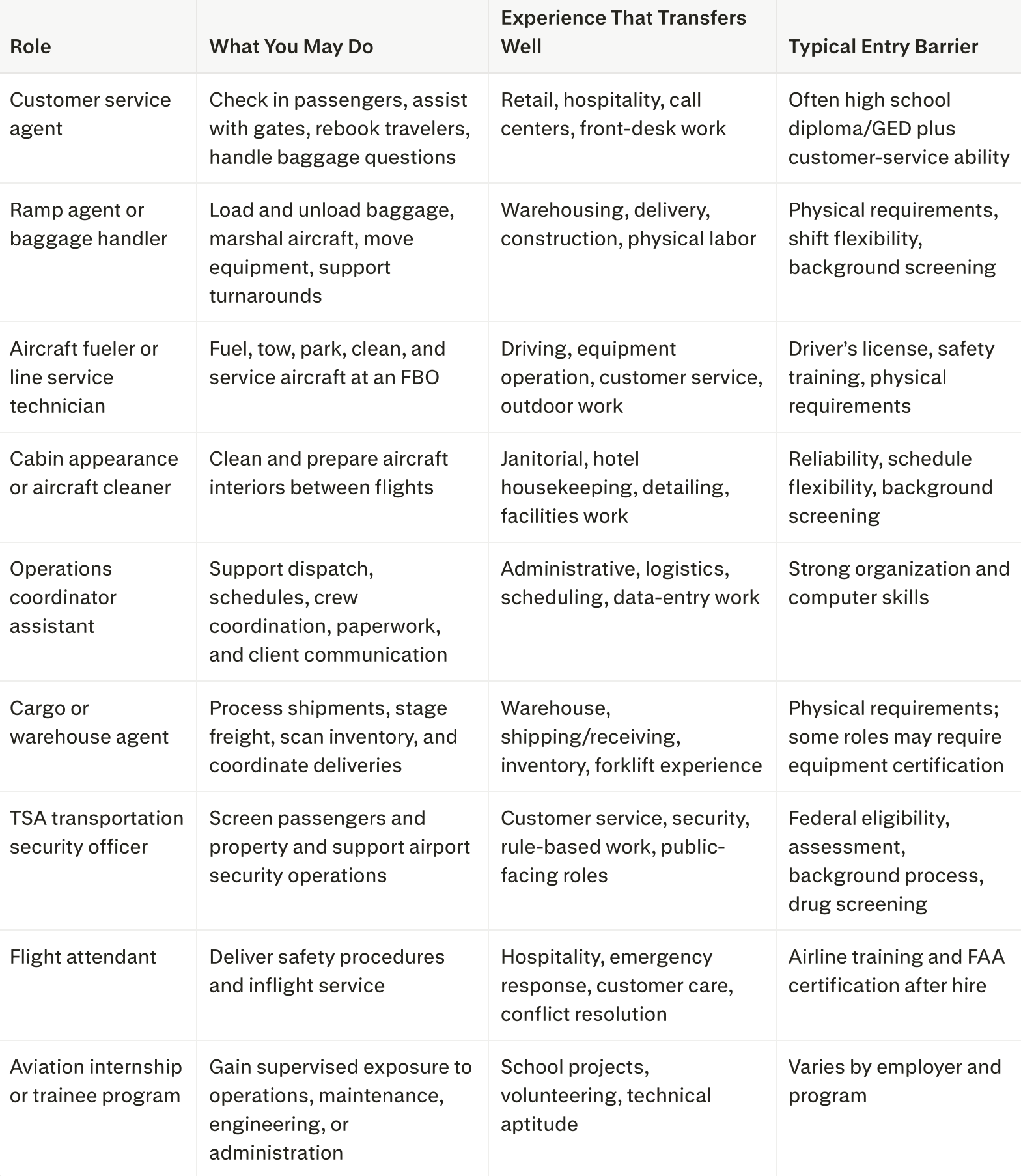
For example, the current All Aviation Jobs marketplace includes roles such as customer service agent, staff assistant, flight attendant, internships, and other aviation-adjacent opportunities. That range matters because it shows that an aviation career can begin in passenger service, operations, support, or training—not only in a cockpit or hangar. www.allaviationjob.com lists current openings across aviation and aerospace employers.
Know What Requires Credentials
One of the biggest mistakes new candidates make is applying broadly without separating jobs that are open to beginners from jobs that require regulated qualifications.
Some jobs are realistic first steps with no industry experience, while others require a certification, flight time, technical training, or a specific license before an employer can hire you into that function.
Roles that may train you after hiring
Employers often provide job-specific training for passenger-service, ramp, cabin-cleaning, security-support, airline operations-support, and flight-attendant roles. For example, flight attendants typically receive employer-provided training and must obtain FAA certification after completing that program. The U.S. Bureau of Labor Statistics projects flight-attendant employment to grow 9% from 2025 to 2035, with about 18,500 openings per year on average during that period.
TSA also outlines a hiring process for Transportation Security Officer and Security Support Assistant roles. Applicants may need to complete testing and an airport assessment, while basic federal-hiring eligibility includes being at least 18, a U.S. citizen, holding a high school diploma/GED or equivalent, and completing drug-screening requirements.
Roles that need a defined pathway
Aircraft maintenance is an excellent long-term aviation career, but it is not usually an immediate no-experience mechanic role. To become an FAA-certificated Aviation Maintenance Technician, candidates generally qualify through an FAA-approved Aviation Maintenance Technician School or documented practical on-the-job experience. FAA guidance states that applicants for the mechanic certificate must be at least 18, be able to read, write, speak, and understand English, and meet testing and experience requirements.
For the A&P pathway, FAA guidance describes two primary ways to obtain qualifying training and experience: FAA-certificated school training or practical on-the-job training. An approved school program may take roughly 18 to 24 months, while the experience route can involve 18 months for an individual rating or 30 months of concurrent practical experience for both airframe and powerplant.
That does not mean maintenance is inaccessible. It means the right entry move may be enrolling in a program, seeking a maintenance-helper or shop-support opportunity, or pursuing an employer pathway that builds documented hands-on experience.
Translate Your Existing Experience
“No aviation experience” does not mean “no relevant experience.” Employers still need people who can communicate clearly, follow procedures, work safely, arrive on time, handle pressure, and represent the organization professionally.
Reframe previous work around aviation-relevant capabilities:
- Retail or hospitality: Customer service, conflict resolution, point-of-sale accuracy, handling busy periods, professional communication.
- Warehouse or delivery work: Time-sensitive operations, equipment handling, lifting, inventory control, safety compliance, shift work.
- Military, public safety, or security: Procedures, accountability, situational awareness, teamwork, security culture, documentation.
- Office or administrative work: Scheduling, data accuracy, records management, phone professionalism, coordination, Microsoft Office or CRM skills.
- Automotive, industrial, or technical work: Tool familiarity, troubleshooting, preventative-maintenance mindset, quality control, attention to detail.
- Restaurant work: Fast-paced teamwork, service recovery, sanitation, managing customer expectations, working irregular hours.
Instead of writing, “Worked in retail for three years,” use a result-oriented description such as:
“Delivered high-volume customer service in a fast-paced environment, resolved customer concerns professionally, maintained accurate transactions, and consistently followed company safety and operating procedures.”
That language makes the connection between your past work and aviation more obvious to a recruiter or hiring manager.
Build an Aviation-Ready Resume
A strong entry-level aviation resume should be clear, factual, easy to scan, and tailored to the role. Avoid overloading it with generic objectives or unrelated details.
Include these sections
- A short professional summary that identifies the aviation path you are targeting.
- Relevant transferable skills, especially safety, customer service, teamwork, scheduling, equipment use, documentation, and shift availability.
- Work experience with measurable responsibilities and achievements.
- Education, certifications, and training.
- Valid driver’s license, where relevant and appropriate.
- Availability for early mornings, nights, weekends, holidays, overtime, or travel—if you genuinely have that flexibility.
- Languages spoken, especially for passenger-facing or international airport roles.
Use a targeted summary
Here is an example for a customer-service or airport-operations applicant:
Dependable customer-service professional seeking an entry-level aviation opportunity in airport or airline operations. Experienced in assisting customers in fast-paced environments, following established procedures, maintaining accurate records, and working flexible schedules. Known for clear communication, professionalism, and a safety-conscious approach.
For a ramp or line-service candidate, emphasize physical work, equipment awareness, outdoor work, punctuality, and safe execution. For an operations role, lead with scheduling, logistics, communication, and organizational skills.
Search More Strategically
Aviation hiring is decentralized. A job may be posted by an airline, an airport contractor, an FBO, a ground handler, a maintenance provider, or a staffing partner rather than under a single “aviation jobs” category.
Use several targeted searches rather than only searching “aviation jobs near me.” Try:
- Entry-level airport jobs
- Airline customer service agent
- Ramp agent jobs
- Airport operations assistant
- Aircraft cleaner jobs
- Cabin appearance agent
- Line service technician trainee
- FBO customer service representative
- Aviation operations coordinator
- Aviation internship
- Flight attendant trainee
- Cargo agent
- Ground handling agent
- Airport security jobs
Then add your city, airport code, or region. Candidates in Florida, for example, may search by nearby aviation hubs, business-aviation airports, airline stations, FBOs, charter operators, and maintenance facilities—not just one major airport.
Aviation schedules commonly include early mornings, evenings, weekends, and holidays. If that is workable for you, make it visible in your resume and application. In many entry-level airport roles, schedule flexibility can distinguish an otherwise similarly qualified applicant.
Use All Aviation Jobs Effectively
A specialized job board can save time because it concentrates aviation and aerospace roles in one place. At AllAviationJob.com candidates can create a profile, browse current aviation openings, and set job alerts so relevant roles can arrive on a schedule that matches their search.
Do not simply upload a resume and wait. Create a complete profile and treat it as a professional introduction to aviation employers.
Your profile should show
- The exact job families you want, such as airport customer service, ramp operations, FBO line service, flight operations support, or aviation administration.
- Your location and relocation preferences.
- Whether you can work shifts, weekends, or holidays.
- Your relevant transferable skills.
- Certifications such as CPR/first aid, forklift training, customer-service training, OSHA-related coursework, security experience, or technical education.
- A clean, professional resume tailored to the type of role you want.
Strong CTA
Ready to start your aviation career? Create your candidate profile on AllAviationJob.com, upload a targeted resume, activate job alerts, and apply consistently to entry-level airport, airline, FBO, aviation-support, and aerospace opportunities. Your first role can create the industry experience, contacts, and operational knowledge that lead to bigger aviation opportunities.
Network Before You Need a Job
Networking in aviation does not require asking strangers for a job. Start by learning how local employers operate and making yourself recognizable as a serious, prepared candidate.
Practical ways to build early aviation connections include:
- Attend airport open houses, career fairs, aviation association meetings, and school events.
- Follow airlines, FBOs, MROs, airport authorities, ground handlers, and aviation staffing firms on LinkedIn.
- Connect with recruiters who specialize in aviation staffing.
- Ask professionals for a brief informational conversation about how they entered the industry.
- Volunteer with aviation museums, youth aviation organizations, airport events, or aviation nonprofit programs where opportunities are available.
- Enroll in short, job-relevant training only when it supports your target role.
Keep outreach concise and professional. For example:
Hello [Name], I am transitioning into aviation and am currently targeting entry-level airport operations and customer-service opportunities. My background includes fast-paced customer support, scheduling, and procedural compliance. I would appreciate the opportunity to learn what qualities your organization values most in entry-level candidates.
Recruitment firms can also be useful when you have a clear target role and a polished profile. OSI Recruit, specializes in aviation staffing across roles including pilots, cabin crew, ground operations, and maintenance personnel, and works with aviation organizations and private-jet clients. Review its aviation-staffing information and available opportunities, then approach recruiters with a focused, honest account of your skills and career goals.
Prepare for Aviation Interviews
Aviation employers are often evaluating more than technical knowledge. They need evidence that you can be trusted in a regulated, safety-sensitive, time-critical environment.
Prepare examples that demonstrate:
- Following a procedure exactly, even when busy.
- Working effectively as part of a team.
- Responding calmly to an upset customer or unexpected issue.
- Showing up reliably for early, late, or changing shifts.
- Recognizing a safety concern and escalating it appropriately.
- Learning a new system or process quickly.
- Maintaining professionalism under pressure.
Use the STAR method—Situation, Task, Action, Result—to keep answers concrete.
For example, if asked, “Tell me about a time you had to follow strict procedures,” discuss a real situation from retail, warehouse work, food service, security, healthcare, military service, or another environment. Explain the procedure, why it mattered, what you did, and the outcome. Do not pretend past work was aviation-related. Instead, show that the discipline required in aviation is already part of how you work.
Avoid Common Mistakes
Aviation hiring can move quickly, but it also involves screening, background processes, security requirements, and safety standards. Avoid these common errors:
- Applying only for pilot, mechanic, or high-level corporate roles without required qualifications.
- Using one generic resume for every job.
- Hiding schedule restrictions until late in the process.
- Overstating aviation knowledge, certificates, licenses, or experience.
- Ignoring small details in applications, names, dates, grammar, and employment history.
- Failing to answer recruiter calls, emails, or interview invitations promptly.
- Treating entry-level airport work as temporary or unimportant during an interview.
Every airline, airport, FBO, and maintenance organization depends on reliable frontline employees. An entry-level job can lead to training, internal promotion, recommendations, and exposure to roles you may not have known existed.
Build a Practical 30-Day Plan
A structured plan makes the transition less overwhelming:
- Choose two or three target job categories, such as customer service, ramp operations, line service, or operations support.
- Rewrite your resume to highlight transferable skills and schedule flexibility.
- Create a complete candidate profile on AllAviationJob.com
- and activate job alerts for your chosen job categories.
- Apply to a set number of relevant jobs each week, prioritizing positions that explicitly mention training, entry-level hiring, or transferable customer-service and operations experience.
- Identify local airports, FBOs, aviation service companies, ground-handling organizations, and airlines with operations in your area.
- Follow up professionally on applications when appropriate, particularly with smaller aviation employers and local operators.
- Practice interview stories that demonstrate safety awareness, teamwork, reliability, customer service, and learning ability.
- Decide whether a longer-term credential—such as flight training, FAA-approved maintenance training, dispatch training, or a degree—fits your ultimate career path.
Final Takeaway
You do not need to arrive with an aviation title on your resume to begin an aviation career. You need a realistic target role, a resume that connects your existing strengths to aviation, a willingness to work within the industry’s safety and schedule expectations, and a consistent application process.
Start with the roles that hire and train motivated people. Build credibility through reliability and performance. Then use that first aviation job as the foundation for advancement into operations, corporate aviation, maintenance, dispatch, inflight service, recruiting, management, or other specialized career paths.
Take the first step today: visit AllAviationJob.com
Create your profile, search current openings, and set job alerts for the aviation career path you want to build.
Sources
- All Aviation Jobs - aviation and aerospace job listings, candidate profiles, and job-alert information.
- OSI Recruit - aviation staffing and recruitment services, including ground operations, cabin crew, pilots, and maintenance staffing.
- U.S. Bureau of Labor Statistics: Flight Attendants - training, certification, and employment-projection information.
- Federal Aviation Administration: Become an Aviation Mechanic - eligibility, training, experience, and certification requirements for Aviation Maintenance Technicians.
- Federal Aviation Administration: Experience Requirements to Become an Aircraft Mechanic - school and on-the-job pathways to qualifying maintenance experience.
- Transportation Security Administration: Transportation Security Officers and Federal Hiring Process, hiring steps and baseline eligibility information.