Earning an FAA Airframe and Powerplant (A&P) certificate is a major professional milestone, but it is only the first step toward building a successful aircraft-maintenance career. To get hired, you need to turn that credential into a clear value proposition for employers: documented technical capability, safety discipline, aircraft-specific familiarity, dependable work habits, and an organized job-search strategy.
Aircraft mechanics and service technicians inspect, troubleshoot, repair, adjust, and overhaul aircraft systems and components. Depending on the employer, the work may involve turbine engines, piston aircraft, structures, hydraulics, landing gear, electrical systems, environmental systems, flight controls, or scheduled inspections. The strongest candidates demonstrate not only that they hold an A&P certificate, but also that they can perform maintenance accurately, follow approved data, complete compliant documentation, and contribute effectively to a safety-focused team.
Understand What Employers Hire For
An A&P certificate shows that you meet FAA certification requirements for mechanic privileges in the Airframe and/or Powerplant ratings. However, employers typically evaluate candidates on a wider set of factors before making a hiring decision.
Hiring managers commonly look for:
- A current FAA A&P certificate, preferably with both Airframe and Powerplant ratings.
- Relevant hands-on experience, including school projects, internships, military maintenance, general aviation, airline, MRO, corporate, rotorcraft, or manufacturing work.
- Familiarity with maintenance manuals, illustrated parts catalogs, wiring diagrams, service bulletins, airworthiness directives, and task cards.
- A consistent record of safety awareness, tool accountability, foreign object debris prevention, and procedural compliance.
- Strong documentation habits, including accurate logbook entries and work-order signoffs.
- Willingness to work shifts, overtime, weekends, holidays, travel assignments, or on-call schedules when the operation requires it.
- Professional communication and the ability to work with lead mechanics, inspectors, avionics technicians, pilots, operations personnel, and quality teams.
Aircraft maintenance is a regulated, detail-driven profession. Employers need technicians who understand that the job is not simply repairing an aircraft—it is returning it to service in accordance with approved procedures and applicable regulations.
The FAA states that mechanics must meet requirements relating to age, English-language ability, practical experience or approved training, and prescribed testing under 14 CFR Part 65, Subpart D. Applicants may qualify by graduating from an FAA-approved Aviation Maintenance Technician School or through qualifying practical experience.
Build a Resume That Proves Capability
A generic resume that says “A&P Mechanic” will rarely stand out. Your resume should make it easy for a recruiter or maintenance manager to see what aircraft, systems, tools, environments, and maintenance activities you have actually worked with.
Start with a concise professional summary. For example:
FAA-certified A&P mechanic with hands-on experience in scheduled and unscheduled maintenance, aircraft inspections, troubleshooting, and technical documentation. Safety-focused technician experienced in interpreting maintenance manuals, using calibrated tooling, and supporting airworthy return-to-service decisions under supervisory and regulatory requirements.
Then create a dedicated certifications section near the top of the document:
- FAA Airframe and Powerplant Certificate.
- Inspection Authorization, if applicable.
- FCC General Radiotelephone Operator License, if applicable.
- OSHA, hazardous-materials, engine-run, fuel-tank, fall-protection, or manufacturer training.
- Military maintenance qualifications or certificates.
- NDT, avionics, composite, welding, sheet-metal, or specialized maintenance credentials where relevant.
Your technical-skills section should be specific. Avoid listing every task you learned in school. Instead, identify the skills that match the jobs you want.
Examples include:
- Scheduled inspections: 100-hour, annual, phase, progressive, transit, A-check, C-check, or heavy-maintenance support.
- Airframe systems: flight controls, landing gear, hydraulic systems, pneumatics, environmental control systems, fuel systems, and structures.
- Powerplant systems: turbine engines, reciprocating engines, ignition, lubrication, fuel control, propellers, engine removals, and borescope inspections.
- Troubleshooting: electrical, mechanical, hydraulic, pneumatic, and engine-performance discrepancies.
- Documentation: maintenance log entries, work cards, discrepancy correction, parts traceability, and compliance records.
- Tools and software: calibrated precision tools, borescopes, torque equipment, maintenance tracking systems, electronic task cards, and digital technical publications.
Where possible, quantify your work. Instead of writing “Performed inspections,” write:
- Completed scheduled inspections and discrepancy corrections under lead-technician supervision while maintaining on-time task completion.
- Assisted with aircraft turn maintenance, troubleshooting, component replacement, and return-to-service documentation.
- Supported maintenance of turbine-powered aircraft, including servicing, operational checks, and compliance with manufacturer maintenance data.
Do not exaggerate your experience. Aviation employers value honesty because the work carries substantial safety and regulatory responsibility. If you supported a job under supervision, say so. If you performed a task independently under company authorization, identify that accurately.
Choose Your Maintenance Path
An A&P can open doors across several aviation sectors. The best place to begin depends on your experience, desired lifestyle, location, compensation goals, and interest in a particular aircraft category.
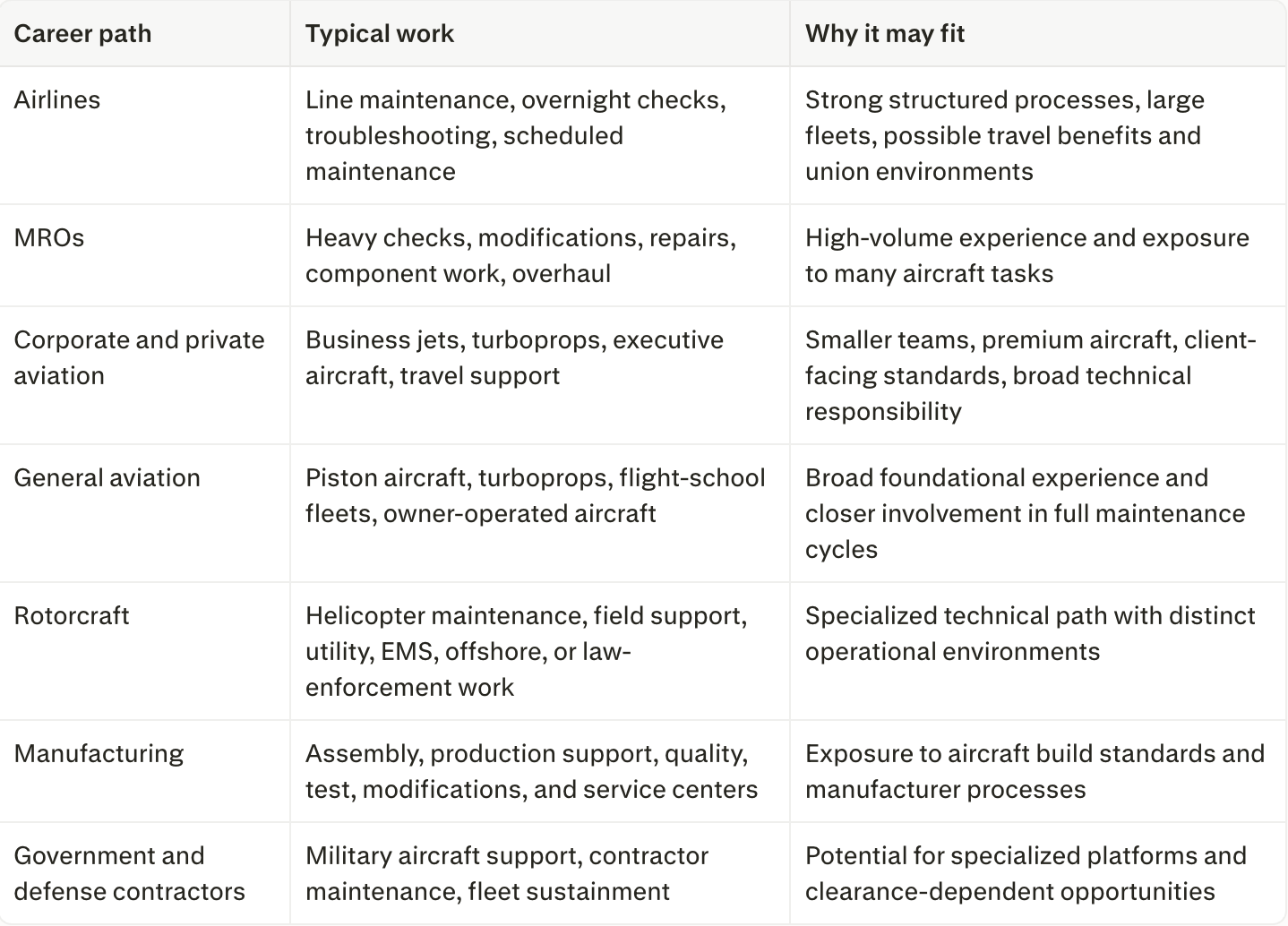
The FAA notes that aviation maintenance technicians work across maintenance and repair organizations, airlines, and commercial, corporate, and general aviation settings. That range makes it important to tailor your application to the employer’s specific operation rather than applying with the same resume everywhere.
For example, a corporate-flight-department employer may place greater emphasis on flexibility, customer service, clean work habits, and experience with a specific business-jet platform. An MRO may prioritize heavy-maintenance exposure, production pace, structural work, and the ability to complete task cards efficiently. An airline may focus on line-maintenance readiness, shift flexibility, troubleshooting, and compliance within a large, standardized maintenance system.
Get Experience When You Are New
Many newly certificated mechanics face the same challenge: employers want experience, but you need an employer to gain it. The practical solution is to target entry points that value trainability, safety mindset, attendance, and mechanical aptitude alongside the A&P certificate.
Consider applying for:
- Entry-level A&P mechanic or aircraft technician roles.
- Mechanic helper, trainee, or junior technician positions.
- Line-service maintenance support roles with a clear path into maintenance.
- MRO production positions.
- General aviation shop roles.
- Aircraft-paint, interiors, structures, or component-shop jobs that build transferable experience.
- Contract or travel-maintenance assignments, if you are comfortable with the schedule and location changes.
- Apprentice pathways offered by airlines, repair stations, or manufacturers.
A school internship, externship, volunteer restoration project, or supervised maintenance work can also strengthen your application. Keep records of aircraft types, systems, tasks, and tools used. That information becomes valuable when you update your resume and prepare for interviews.
If you have military maintenance experience, translate it into civilian aviation language. Include the airframe or powerplant systems you worked on, maintenance levels performed, inspection responsibilities, technical-publication use, quality procedures, and any documentation or leadership responsibilities. Also verify your eligibility pathway with the FAA if you are pursuing civilian certification based on military experience.
Search Strategically for A&P Jobs
A strong job search combines targeted applications, an optimized profile, alerts, networking, and follow-up. Do not rely solely on one job board or wait for the “perfect” posting.
Begin by creating a complete candidate profile on AllAviationJob.com. The platform provides aviation and aerospace job categories, including an Aircraft Mechanic job category, and allows job seekers to create profiles, connect with employers, and set job alerts for matching opportunities.
When setting job alerts and search filters, use several related job titles:
- A&P Mechanic
- Aircraft Mechanic
- Aircraft Technician
- Aviation Maintenance Technician
- AMT
- Maintenance Technician
- Line Maintenance Technician
- MRO Technician
- Powerplant Mechanic
- Airframe Mechanic
- Structures Mechanic
- Corporate Aircraft Technician
Also search by aircraft type if you have relevant experience or training. Examples may include Gulfstream, Bombardier, Dassault Falcon, Embraer, Cessna, Beechcraft, Boeing, Airbus, Cirrus, Piper, Bell, Leonardo, Sikorsky, or Robinson. Even if a posting requires a type-specific background that you do not yet have, review it to understand the employer’s preferred experience, shift structure, benefits, and skill requirements.
For candidates seeking opportunities in private aviation, business jets, maintenance operations, or aviation staffing support, OSI Recruit’s aviation staffing services focus on connecting skilled aviation professionals with reputable aviation companies across maintenance, ground operations, pilots, and cabin crew.
Prepare for the Interview
Aircraft-maintenance interviews often assess your technical foundation, your approach to safety, and your reliability as a team member. You may be asked technical questions, behavioral questions, and scenario-based questions.
Prepare to explain:
- The aircraft types and maintenance environments you have worked in.
- Your most relevant systems experience.
- How you use maintenance manuals and approved technical data.
- A troubleshooting process you have followed.
- A time you identified a safety concern or stopped work to clarify a discrepancy.
- How you maintain tool control and prevent foreign object damage.
- Your experience with inspections, logbook entries, work cards, and discrepancy documentation.
- Your availability for shift work, overtime, travel, or relocation.
A strong answer to a troubleshooting question should show a logical, compliant process:
“I begin by reviewing the discrepancy and applicable maintenance data. I verify the reported condition, inspect the related system, isolate likely causes using the manufacturer’s troubleshooting procedures, and document the work performed. If the task is outside my authorization, experience, or the available approved data, I stop and involve the appropriate lead, inspector, or technical support resource.”
This type of answer shows employers that you understand the limits of your authority and that you prioritize approved procedures over assumptions.
Bring the following to an in-person interview when requested:
- A current resume.
- A copy of your A&P certificate.
- Government-issued identification and work-authorization documents, if appropriate.
- Training certificates and relevant records.
- A concise aircraft-and-systems experience list.
- Professional references who can speak to your reliability, technical aptitude, and safety mindset.
Avoid Common Job-Search Mistakes
A&P mechanics can improve their hiring chances by avoiding a few common errors:
- Applying without tailoring the resume to the role, aircraft category, or maintenance environment.
- Listing an A&P certificate but failing to explain hands-on skills or relevant work experience.
- Claiming experience with aircraft or tasks that cannot be discussed confidently in an interview.
- Ignoring shift, travel, overtime, relocation, or tool requirements in the job posting.
- Using an unprofessional email address, voicemail greeting, or social-media presence.
- Failing to respond quickly to recruiter outreach.
- Not following up after submitting an application or interview.
- Treating documentation as an administrative task rather than a core safety and compliance responsibility.
Employers can teach aircraft-specific procedures, company software, and local processes. It is harder to teach professional integrity, accountability, attention to detail, and a dependable safety culture. Make those qualities visible throughout your resume, profile, communication, and interview answers.
Take the Next Step
Your A&P certificate gives you a recognized FAA credential; your job-search execution determines how quickly you turn it into a long-term aviation career. Build a targeted resume, document your technical strengths, remain flexible about your first role, and apply consistently to opportunities that match your maintenance interests.
Ready to put your A&P certificate to work?
Create your job-seeker profile on AllAviationJob.com, upload a targeted aircraft-mechanic resume, and activate job alerts so you can be among the first candidates to see new aviation-maintenance opportunities. Whether you are a newly certificated technician or an experienced A&P ready for a better role, AllAviationJob.com is built to help connect aviation professionals with employers seeking qualified talent.
Sources
- Federal Aviation Administration, Become an Aviation Mechanic
- . FAA eligibility, experience, training, and testing information for mechanic certification.
- Electronic Code of Federal Regulations / Cornell Law School, 14 CFR Part 65, Subpart D—Mechanics
- .
- U.S. Bureau of Labor Statistics, Aircraft and Avionics Equipment Mechanics and Technicians
- .
- All Aviation Jobs. Aviation job categories, candidate profiles, and job-alert information.
- OSI Recruit. Aviation staffing and recruitment services.

