For many pilots, the simulator evaluation is the most stressful part of the hiring process. Résumés can be polished and interview answers rehearsed, but a sim ride shows how you fly, how you think, and how you work with another pilot when the workload rises. The good news is that a simulator interview is very predictable, and you can prepare for it in a structured way.
This guide explains what a pilot simulator interview usually involves, what evaluators look for, the standards they tend to use as a reference, and a step-by-step plan to help you walk into the sim prepared, calm, and ready to show you can be trained.
Quick note: Formats vary by employer. Airlines, regional carriers, cargo operators, fractional programs, and corporate flight departments all run their evaluations differently. Always treat the briefing material from your prospective employer as the final authority.
What Is a Pilot Simulator Interview?
A pilot simulator interview, often called a "sim eval," "sim check," or "sim assessment," is a scored flying session that is part of the hiring process. It is not a type-rating checkride. Its purpose is to show the employer whether you have solid basic instrument skills, follow procedures, communicate well, and can adapt quickly to an unfamiliar aircraft.
Typical characteristics include:
- Length: Most evaluations last 30 to 60 minutes of flying, and some programs run 45 minutes to two hours when the briefing and debriefing are included.
- Device: It may be a fixed-base flight training device, a generic jet simulator, or a Level D full flight simulator. An Airbus A320 or Boeing 737 is common at many airlines.
- Crew setup: You may fly with another candidate, a company pilot, or an evaluator acting as pilot monitoring (PM).
- Structure: The session usually starts with a brief and ends with a debrief, and many candidates are asked to assess their own performance.
Some carriers also use a line-oriented scenario. This is a realistic departure, cruise, and arrival with scripted events, such as a system malfunction, a weather diversion, or a crew-communication challenge. Instead of grading isolated maneuvers, the evaluators watch how you manage the whole flight.
What Evaluators Are Really Looking For
The most important point is this: evaluators are not expecting a perfect flight. Many airline training resources say the sim assesses trainability, composure, and crew resource management (CRM), not flawless stick-and-rudder skill on an aircraft you have never flown.
Most assessments score observable behaviors that fit into these competency areas:
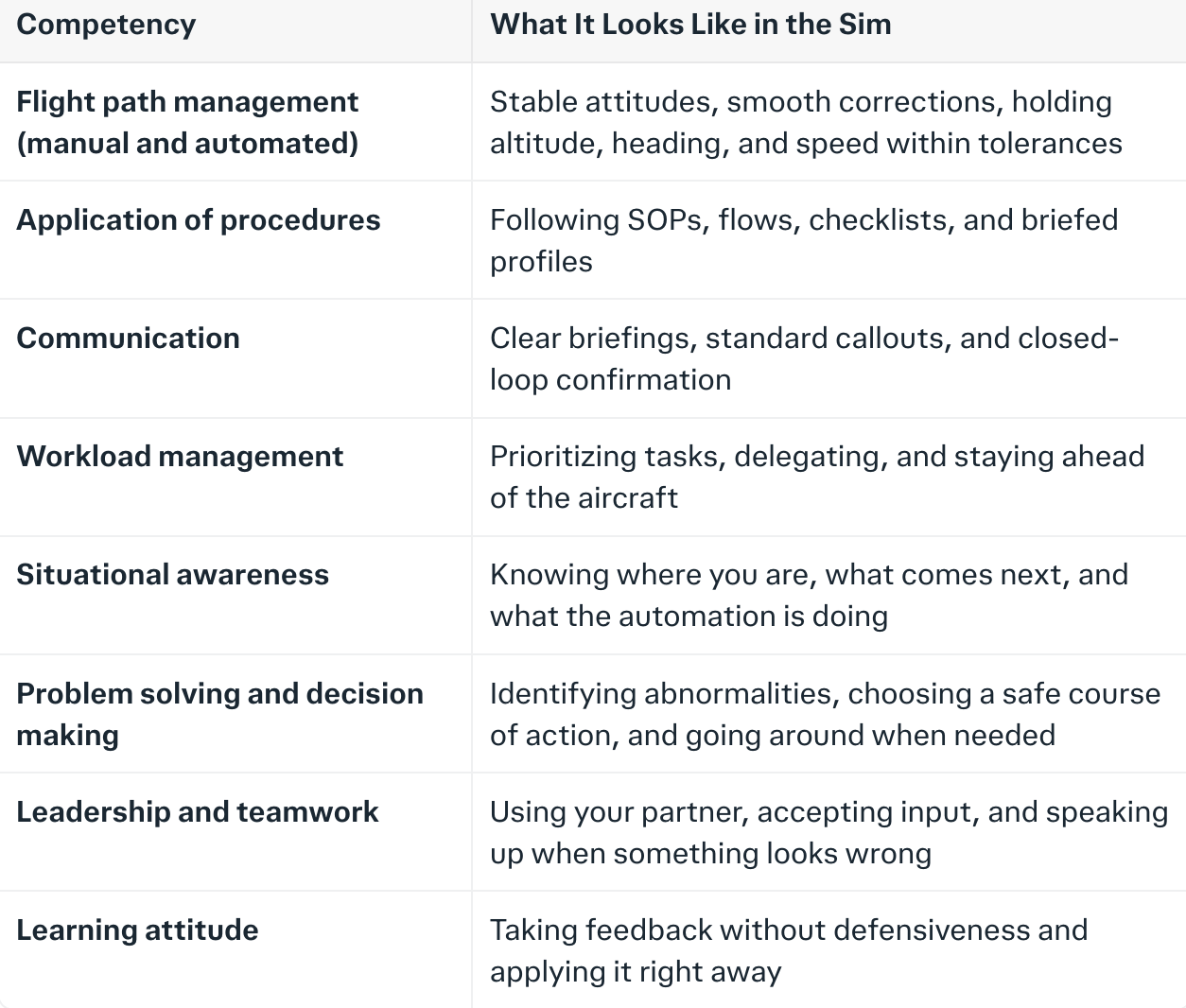
Candidates often lose points for silence in the cockpit, unprepared pitch and power references, continuing an unstable approach instead of going around, and giving a vague self-debrief.
The Standards Behind the Evaluation
Every employer sets its own grading criteria. However, many evaluators use familiar FAA and industry benchmarks as a frame of reference. Knowing these standards gives you a clear, objective target.
FAA ATP Airman Certification Standards (ACS)
The FAA's Airline Transport Pilot and Type Rating for Airplane Category ACS (FAA-S-ACS-11A) became effective on May 31, 2024. It covers the tasks and tolerances used for ATP and type-rating practical tests. Examples relevant to a sim evaluation include:
- Steep turns: Maintain the entry altitude within ±100 feet, airspeed within ±10 knots, bank within ±5°, and roll out on the specified heading within ±10°.
- Precision approach: Before the final approach segment, maintain altitude within ±100 feet, heading within ±5°, and airspeed within ±10 knots. From the final approach fix to the DA/DH, allow no more than ¼-scale deflection of the vertical or lateral guidance and hold airspeed within ±5 knots.
- At DA/DH: Immediately begin the missed approach if the required visual references are not distinctly visible and identifiable.
A hiring sim is not an ATP checkride. Still, flying to these tolerances shows evaluators that you understand professional standards.
Stabilized Approach Criteria
The Flight Safety Foundation's Approach-and-Landing Accident Reduction (ALAR) guidance recommends that all flights be stabilized by 1,000 feet above airport elevation in IMC and 500 feet in VMC. A stabilized approach includes being on the correct flight path, flying at no more than VREF + 20 knots and no less than VREF, being in landing configuration, keeping the sink rate at or below 1,000 feet per minute (unless specially briefed), staying within one dot on an ILS, and completing all briefings and checklists. An approach that becomes unstabilized below those heights requires an immediate go-around.
In a sim evaluation, a well-called, well-flown go-around from an unstable approach is a strong sign of good judgment. It is not a failure.
Holding Procedures
According to the FAA's Aeronautical Information Manual (AIM), maximum holding airspeeds are 200 KIAS from MHA to 6,000 feet MSL, 230 KIAS from 6,001 to 14,000 feet, and 265 KIAS at 14,001 feet and above. The inbound leg is 1 minute at or below 14,000 feet MSL and 1½ minutes above. You should be able to quickly identify direct, teardrop, and parallel entries.
Common Simulator Interview Profiles
Profiles differ by employer, but most draw from a familiar set of maneuvers. Expect some combination of the following:
- Instrument departure: Often a SID or vectors departure with an early turn, sometimes hand-flown on raw data.
- Climbs, descents, and turns at set speeds: These test your basic attitude instrument flying and power control.
- Steep turns: Usually at 45° of bank, while holding altitude and airspeed.
- Approach to stall or stall recovery: Recovery according to the briefed procedure.
- Unusual attitude recovery: Nose-high and nose-low recoveries.
- Holding: Entry, timing, and wind correction.
- Raw-data ILS: Flown with the flight director off. Many candidates lose points here by depending too much on automation.
- Non-precision approach (RNAV or VOR): Includes descent planning and MDA or DA management.
- Engine failure: At or after V1 on takeoff, or during the approach, often followed by a single-engine ILS or go-around.
- Missed approach or go-around: Usually from minimums, with proper callouts and configuration changes.
- Abnormal or emergency event: For example, a pressurization problem, hydraulic issue, or diversion scenario that tests checklist use and decision making.
How to Prepare: A Step-by-Step Plan
Step 1: Gather Every Detail You Can
Read your interview invitation and any briefing package closely. Find out or confirm:
- The aircraft or simulator type, and whether it is fixed-base or full motion
- Whether you will fly as pilot flying (PF), PM, or both
- Whether you will fly with another candidate or a company pilot
- The expected profile, call-out standards, and any provided SOPs
- The pitch and power settings for each phase of flight
Talk to pilots who have recently interviewed with the same employer, and use reliable interview-preparation communities. If the employer does not provide pitch and power numbers, ask for them during the brief.
Step 2: Memorize Pitch and Power Numbers
Pitch and power are the foundation of a good sim ride. Know the target pitch attitude and thrust or N1 setting for:
- Climb
- Level cruise at the profile speed
- Descent
- Clean and configured holding or maneuvering
- ILS final with the gear down and landing flaps
- Single-engine climb and approach
When you set the known pitch and power first and then make small corrections, you avoid chasing the instruments. FAA guidance also tells pilot monitoring to continuously compare known pitch and power settings to the airplane's actual flight path.
Step 3: Sharpen Your Instrument Scan
The FAA's Instrument Flying Handbook calls cross-checking a fundamental skill. It also identifies three common scan errors:
- Fixation: Staring at one instrument while the airplane drifts elsewhere
- Omission: Leaving an instrument out of the scan
- Emphasis: Relying on one instrument instead of confirming it against others
Practice a scan that keeps returning to the attitude indicator. Then check the performance instruments and make small, deliberate adjustments. If you have access to a home simulator such as X-Plane or Microsoft Flight Simulator, use it to hand-fly ILS approaches, steep turns, and holds. Focus on keeping your scan consistent, not on perfect numbers.
Step 4: Rehearse Flows, Callouts, and Briefings Out Loud
Silent procedures earn no CRM credit. Practice saying each item aloud:
- Takeoff briefing: Runway, departure, initial altitude, the plan for an engine failure, and the return or alternate plan
- Approach briefing: Approach type, frequencies, courses, altitudes, minimums, missed approach procedure, and threats
- Standard callouts: For example, "Positive rate," "Gear up," "Set missed approach altitude," "1,000 feet, stable," "100 above," and "Minimums"
- Transfer of control: "My aircraft" and "Your aircraft," with a clear acknowledgment
FAA Advisory Circular 120-71B explains that one pilot is always PF and one is always PM. The PM monitors the flight path, calls out deviations, and intervenes when necessary. The AC also recommends that a pilot who is "heads down" make a callout so both pilots are not looking down at the same time.
Step 5: Master Memory Items and Abnormal Procedures
Know the immediate-action items for engine failure, fire, rejected takeoff, and other likely events. Then practice saying them aloud while you keep flying the airplane. Use a simple priority order:
- Aviate: Control the airplane.
- Navigate: Keep it on a safe path.
- Communicate: Talk to ATC and your crew.
- Manage: Run the checklist and make the plan.
Step 6: Practice Threat and Error Management (TEM)
Before each phase of flight, identify the likely threats, such as terrain, weather, an unfamiliar aircraft, or a tight clearance, and say how you will handle them. If you make an error, say so, fix it, and keep going. As FAA AC 120-51E explains, CRM training focuses on situational awareness, communication skills, teamwork, task allocation, and decision making within a complete framework of SOPs. Evaluators want to see those skills in action.
Step 7: Book a Practice Sim Session
If your budget allows, book one or two practice sessions in a device similar to the one used in the evaluation. Many training providers offer interview-prep profiles. Even one session can help you get used to the control feel, the trim behavior, and the cockpit layout.
Step 8: Prepare Your Self-Debrief
Many evaluations end by asking how you think you did. Prepare an honest, specific answer that names one issue and its root cause. For example: "I over-controlled heading on the ILS by using large aileron inputs. Next time I'll make smaller corrections and let the airplane settle." That answer is much stronger than "My scan was a little off."
A Four-Week Preparation Timeline
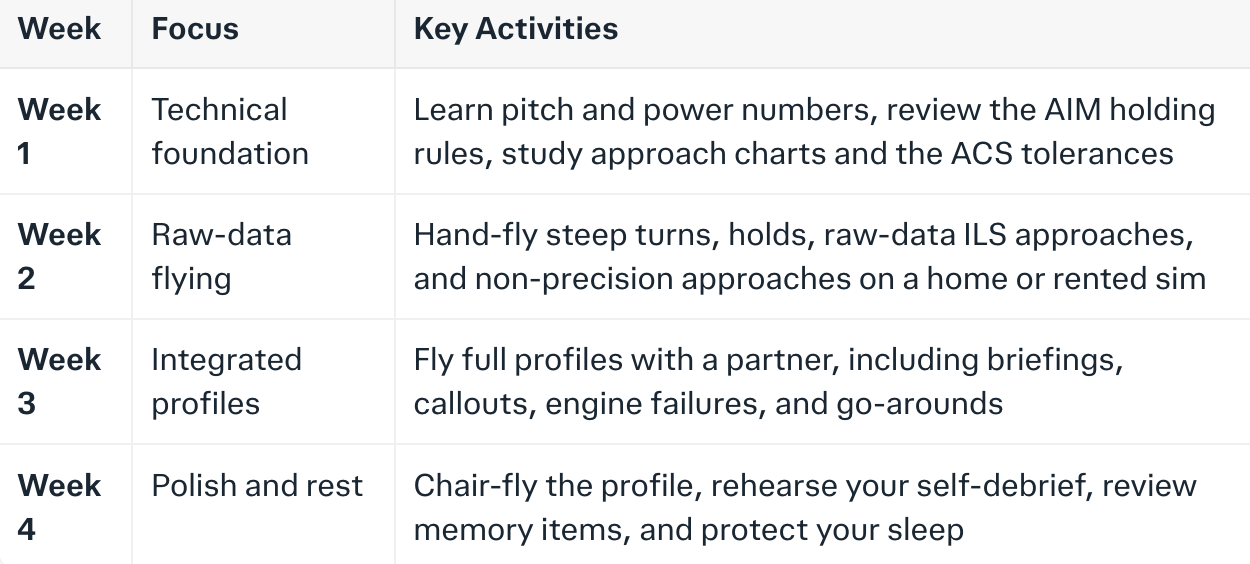
Chair flying costs nothing and works well. Sit in a quiet room, picture the cockpit, and walk through every phase: before-start flows, takeoff, the V1 cut, the ILS, and the missed approach. Touch imaginary switches and say each callout aloud.
Day-of-Evaluation Tips
- Arrive early and rested. Fatigue reduces scan quality and decision making more than nerves do.
- Dress professionally. First impressions matter, even when the evaluation happens in a sim.
- Listen carefully during the brief. Write down speeds, pitch and power targets, and any special instructions.
- Ask clarifying questions. Asking good questions is a positive sign of a professional mindset.
- Brief every approach, even if you feel confident about it.
- Fly the airplane first. If you get behind, slow down, use the autopilot if it is allowed, and ask your partner for help.
- Go around when it's not right. A timely go-around shows good judgment.
- Don't dwell on a mistake. Acknowledge it, correct it, and focus on the next task. Evaluators are watching how you recover.
- Support your sim partner. When you are PM, monitor actively and help your partner succeed. Teamwork is part of the grade.
Common Mistakes to Avoid
- Flying without pitch and power references, which leads to chasing the needles
- Staying quiet and failing to brief, call out, or verbalize decisions
- Over-relying on automation when hand-flying is expected
- Continuing an unstable approach instead of going around
- Fixating on one instrument, especially the altimeter during steep turns
- Being defensive when the evaluator gives feedback
- Giving a vague self-debrief without a specific root cause and correction
- Ignoring the PM role and treating your partner as a passenger
Beyond the Sim: The Full Interview Picture
The simulator is usually one part of a broader selection process. That process may also include an HR screen, a records and background review, a technical oral, a behavioral interview, and sometimes a chief-pilot or panel conversation. Prepare for every stage:
- Keep your logbook and records organized, and be ready to discuss any flight.
- Prepare five to ten real stories that show leadership, error management, and decisions made under pressure. Structure each story using the STAR method: Situation, Task, Action, Result.
- Research the employer's fleet, routes, values, and recent news.
For more help with interviews, read the OSI Recruit interview preparation tips and use the free aviation résumé samples to make sure your application gets you to the sim. You can also browse the AllAviationJob.com résumé templates and review the aviation salary report before discussing compensation.
Employers: If your operation needs pilots who are already screened for technical skill, CRM, and safety culture, OSI Recruit's aviation recruitment services can help you build a reliable hiring pipeline. Learn more on the OSI Recruit employer page.
Frequently Asked Questions
Do I need a type rating to pass a pilot simulator interview?
Usually not. Most hiring sims are designed for pilots who have not flown that type before. Evaluators know the aircraft is unfamiliar to you, so they focus on fundamentals, procedures, and crew coordination.
Is the sim evaluation pass/fail?
It often is, but the scoring method depends on the employer. Some airlines grade individual competencies, while others give a single overall result.
Can I use the autopilot?
Only if the evaluator says you can. Many profiles require hand-flying, especially raw-data approaches. Ask during the brief.
What if I make a mistake?
Say what happened, correct it, and keep flying. How you recover is often more important than the mistake itself.
How far in advance should I start preparing?
About four weeks is enough for most pilots. If you have not flown instruments recently, start earlier.
Ready for Your Next Flight Deck? Start on AllAviationJob.com
Preparation gets you through the sim, and the right opportunity gets you to it. AllAviationJob.com connects pilots with airlines, charter operators, corporate flight departments, and aviation employers around the world. Searching is free.
- Browse open pilot jobs from employers who are hiring now
- Explore flight department jobs in corporate and private aviation
- Create your free job-seeker profile so employers can find you
- Research aviation companies before your interview
- Keep learning with more career guides on the AllAviationJob.com blog
- Still building hours? Compare training options in the flight school directory
Your next sim invitation could be one application away. Register on AllAviationJob.com today and take the next step in your pilot career.
Sources
- Federal Aviation Administration. Airman Certification Standards (ACS list, including FAA-S-ACS-11A). https://www.faa.gov/training_testing/testing/acs
- Federal Aviation Administration. Airline Transport Pilot and Type Rating for Airplane Category ACS (FAA-S-ACS-11A). https://www.faa.gov/training_testing/testing/acs/atp_airplane_acs_11.pdf
- Federal Aviation Administration. Advisory Circular 120-71B: Standard Operating Procedures and Pilot Monitoring Duties for Flight Deck Crewmembers. https://www.faa.gov/documentLibrary/media/Advisory_Circular/AC_120-71B.pdf
- Federal Aviation Administration. Advisory Circular 120-51E: Crew Resource Management Training. https://www.faa.gov/documentLibrary/media/Advisory_Circular/AC_120-51E.pdf
- Federal Aviation Administration. Aeronautical Information Manual, Chapter 5, Section 3 (Holding). https://www.faa.gov/air_traffic/publications/atpubs/aim_html/chap5_section_3.html
- Federal Aviation Administration. Instrument Flying Handbook (FAA-H-8083-15B). https://www.faa.gov/sites/faa.gov/files/regulations_policies/handbooks_manuals/aviation/FAA-H-8083-15B.pdf
- Flight Safety Foundation. ALAR Briefing Note 7.1: Stabilized Approach. https://flightsafety.org/wp-content/uploads/2016/09/alar_bn7-1stablizedappr.pdf
- IATA. Examining Unstable Approaches: Risk Mitigating Efforts. https://www.iata.org/contentassets/7a5cd514de9c4c63ba0a7ac21547477a/examining-unstable-approaches_risk-mitigating-efforts.pdf
- EAS Barcelona. Airline Pilot Selection Process. https://easbcn.com/en/airline-pilot-selection-process/
- V1 Prep. Airline Pilot Recruitment and Selection. https://v1prep.com/library/airline-pilot-recruitment-and-selection.html
- Simulator Center Training. 7 Drills Evaluators Want in Airline Interview Sim Profiles. https://simulatorcentertraining.com/blog/airline-interview-sim-profile/
- Simulator Center Training. Map Drills to ICAO Competencies for Airline Sim Success. https://simulatorcentertraining.com/blog/airline-sim-assessment-prep/
- Simulator Center Training. Airline Assessment Day: 6 Stages and What Pilots Must Know. https://simulatorcentertraining.com/blog/airline-assessment-day-format/
- Las Vegas Flight Academy. Airline Pilot Interview Preparation Guide. https://www.lasvegasflightacademy.com/airline-pilot-interview-preparation-guide/
- Rotate Pilot. Airline Pilot Interview Guide. https://rotatepilot.com/guides/airline-pilot-interview-guide
- Vectors to Hired. Airline Simulator Evaluation Guide. https://vectorstohired.com/guides/airline-sim-eval-guide
This article is for educational purposes only. Simulator evaluation formats, profiles, and grading criteria vary by employer. Always follow the briefing materials and procedures provided by your prospective employer.