A technical aerospace engineering interview is rarely just a test of whether you remember equations. It is an assessment of how you define a problem, choose reasonable assumptions, apply engineering fundamentals, communicate tradeoffs, and connect your past work to the specific aircraft, spacecraft, subsystem, or certification challenge the employer is solving.
The strongest candidates prepare in two parallel tracks: they rebuild the technical knowledge most relevant to the role and learn to explain their design, analysis, test, or manufacturing experience with the clarity expected in a design review. Whether you are interviewing for an entry-level structures role, a propulsion position, an avionics opening, or a senior systems engineering job, this guide can help you walk in prepared.
Start With the Job Description
Do not prepare for “aerospace engineering” in the abstract. Prepare for the exact discipline, product, seniority level, and business environment described in the posting.
A flight-controls engineer, for example, may need to discuss dynamic systems, stability, control laws, sensor behavior, actuator limitations, MATLAB/Simulink, and verification. A structural engineer may be questioned on loads, stress, strain, fatigue, buckling, composites, finite element analysis, joints, and damage tolerance. A propulsion role may emphasize thermodynamics, compressible flow, combustion, heat transfer, engine cycles, testing, or turbomachinery.
Create a one-page preparation matrix before you start studying:
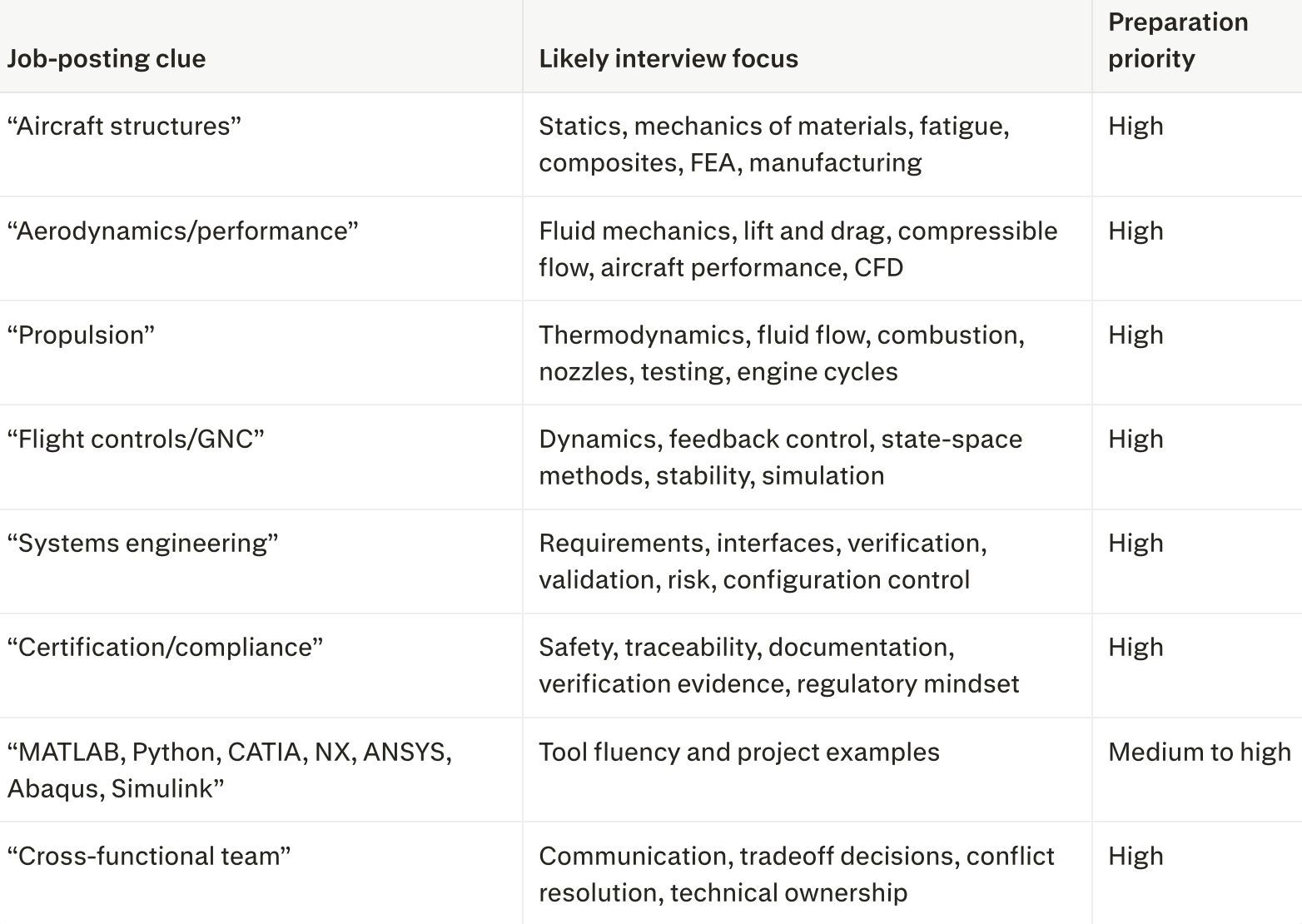
Then identify the five to eight technical themes that appear most often. Use those themes to guide the majority of your study time.
For a broader look at the roles, skills, and career paths available in the field, see AllAviationJob.com’s aerospace engineer career guide. It is also helpful to browse aviation and aerospace job openings to see which qualifications employers repeatedly request.
Rebuild the Fundamentals That Matter
Technical interviewers generally care less about perfect recall than about whether you can reason from first principles. You should be able to identify the governing physics, establish assumptions, choose an appropriate model, make a reasonable estimate, check units, and explain where the model may break down.
A practical method is to study by discipline rather than trying to review every topic you encountered in school.
Aerodynamics and Flight Performance
For aerodynamics-oriented jobs, be comfortable discussing:
- The four forces of flight: lift, weight, thrust, and drag.
- The difference between induced, parasite, profile, and wave drag.
- Lift generation, angle of attack, stall behavior, and boundary-layer effects.
- Reynolds number, Mach number, and the difference between incompressible and compressible flow assumptions.
- Subsonic, transonic, supersonic, and hypersonic flow regimes.
- Basic aircraft performance concepts, including climb, range, endurance, takeoff, landing, and turn performance.
- The role of wing loading, aspect ratio, sweep, and high-lift devices.
- CFD limitations, mesh quality, turbulence models, convergence, and validation against test data.
A common question may sound simple: “Why does a swept wing help at high speed?” A strong answer explains that sweep reduces the velocity component normal to the leading edge, which delays compressibility effects and can raise the effective critical Mach number. An excellent answer also acknowledges the tradeoffs, such as reduced low-speed performance, structural implications, and potential handling or manufacturing complexity.
Structures, Materials, and Manufacturing
For aerospace structures roles, review:
- Free-body diagrams, equilibrium, shear force, bending moment, torsion, and deflection.
- Stress and strain relationships, including elastic and plastic behavior.
- Buckling, crippling, fatigue, fracture mechanics, and damage tolerance.
- Load paths and why efficient load transfer matters in lightweight structures.
- Metallic versus composite material behavior, including anisotropy, layups, delamination, and environmental considerations.
- Fasteners, bonded joints, joints, tolerances, and manufacturability.
- Finite element analysis assumptions, boundary conditions, meshing, convergence, and correlation with test results.
- The difference between static strength, fatigue life, durability, and damage tolerance.
Be ready to explain a technical project at the component level. Rather than stating, “I ran FEA on a bracket,” explain the requirement, applied loads, constraints, material choice, safety factor, stress concentration, mesh-convergence approach, result interpretation, and the design action you recommended.
Propulsion, Thermodynamics, and Thermal Systems
For propulsion or thermal roles, focus on:
- The first and second laws of thermodynamics.
- Brayton-cycle fundamentals for gas turbines.
- Differences among turbojet, turbofan, turboprop, ramjet, and rocket propulsion.
- Thrust, specific impulse, thrust-specific fuel consumption, and engine efficiency concepts.
- Compressible flow, choked flow, nozzles, shocks, and expansion behavior.
- Heat transfer through conduction, convection, and radiation.
- Cooling methods, materials at elevated temperature, and thermal expansion.
- Combustion fundamentals, test instrumentation, and uncertainty in measured data.
If asked to compare a turbojet and turbofan, avoid stopping at “a turbofan has a fan.” Explain bypass ratio and how higher-bypass turbofans generally accelerate a larger mass of air by a smaller velocity change, which supports improved propulsive efficiency and lower noise for many subsonic applications. Then tie the explanation to the type of aircraft or mission.
Flight Controls, Avionics, and GNC
For controls, avionics, or guidance-navigation-and-control positions, prepare to discuss:
- Open-loop versus closed-loop systems.
- Stability, controllability, feedback, gain, overshoot, settling time, and bandwidth.
- PID control, state-space models, transfer functions, and actuator/sensor limits.
- Coordinate frames, inertial measurement units, GPS, sensor fusion, and filtering concepts.
- Fault detection, redundancy, fail-safe design, and graceful degradation.
- Simulation, hardware-in-the-loop testing, model validation, and verification planning.
- Embedded software fundamentals if the posting includes C, C++, Python, or real-time systems.
A good controls candidate communicates both the mathematics and the real-world limitation. For instance, a controller that works well in simulation may behave differently in hardware because of sensor noise, actuator saturation, timing delays, nonlinear behavior, or an inaccurate plant model.
Systems Engineering, Safety, and Verification
Systems engineering interviews often evaluate whether you can see the full system rather than only one engineering discipline. NASA describes systems engineering as a methodical, multidisciplinary approach that encompasses a system’s design, realization, technical management, operations, and retirement.nasa
Review the following areas:
- Stakeholder needs and system requirements.
- Requirement quality: clear, measurable, feasible, traceable, and verifiable.
- Functional decomposition and system architecture.
- Interfaces between hardware, software, aircraft systems, suppliers, and operators.
- Verification versus validation.
- Test, analysis, inspection, and demonstration as verification methods.
- Risk management, failure modes, redundancy, and safety considerations.
- Configuration management, change control, and technical documentation.
- Trade studies that balance cost, schedule, performance, safety, weight, and reliability.
A useful interview distinction is this:
- Verification asks whether the system was built correctly against its specified requirements.
- Validation asks whether the right system was built for the user’s operational need.
Candidates who can articulate this distinction and give a project-based example often stand out in systems, integration, test, and certification interviews.
Master Your Project Stories
Your resume is an interview study guide. Every bullet point can become the basis of a deep technical discussion, so do not include tools, methods, or results you cannot explain.
Prepare three to five project stories that cover different strengths, such as:
- A design or analysis project.
- A difficult technical failure or unexpected test result.
- A collaboration challenge involving multiple disciplines.
- A situation where you improved a process, model, test method, or design.
- A case where you worked within constraints involving weight, cost, schedule, safety, certification, or manufacturability.
Use a structured format that goes beyond a basic STAR answer:
- Situation: What product, subsystem, or engineering problem were you working on?
- Requirement: What performance, cost, schedule, safety, or technical requirement had to be met?
- Technical approach: What analysis, model, test plan, simulation, or design method did you use?
- Assumptions and constraints: What did you assume, and what limited the available solution?
- Your contribution: Be precise about your individual role, decisions, and deliverables.
- Result: Quantify the outcome where possible.
- What you learned: Explain how you would improve the work, test plan, model, or decision next time.
For example:
“During a student aircraft-design project, I was responsible for preliminary wing structural sizing. The objective was to meet the maneuver and gust load requirements while maintaining a strict mass target. I created the load cases, developed simplified beam models to estimate shear and bending distributions, and then used FEA to evaluate local stress concentrations around attachment points. After mesh convergence and a review of the load path, I modified the spar-cap geometry and added local reinforcement near the fittings. The revised concept reduced peak stress while adding minimal weight. The experience taught me the importance of checking simplified hand calculations against simulation and validating boundary conditions before relying on detailed FEA results.”
That answer demonstrates technical depth, judgment, ownership, and awareness of model limitations.
Practice Solving Problems Aloud
Aerospace technical interviews often include conceptual questions, whiteboard problems, case-style scenarios, or questions designed to assess your engineering process. Interviewers want to hear your reasoning—not just your final number.
Use this repeatable structure:
- Clarify the problem and the required output.
- Draw a diagram, free-body diagram, control volume, block diagram, or system architecture.
- State assumptions clearly.
- Identify governing equations or first principles.
- Estimate the expected scale or trend before calculating.
- Work through the analysis in a logical sequence.
- Check dimensions, units, signs, limiting cases, and physical realism.
- Explain what additional data, test evidence, or model refinement you would need for a production decision.
For example, if asked how increased aircraft weight affects takeoff performance, start by defining the assumptions: same runway, atmospheric condition, aircraft configuration, thrust setting, and safety margins. Explain that additional weight increases the lift required, generally increases required takeoff speed, and can lengthen the takeoff roll. Then note that actual performance depends on factors such as thrust available, wing configuration, density altitude, runway condition, and certification limits.
This kind of structured reasoning is more valuable than rushing toward an equation.
Interview guidance for aerospace roles consistently emphasizes application of core engineering principles, technical problem solving, design processes, and communication—not merely factual recall. A productive practice method is to work unfamiliar problems from a blank page and verbalize your assumptions, governing model, unit checks, and engineering judgment.indeed+2
Prepare for Likely Questions
Below are examples of questions you may encounter. Do not memorize scripts. Instead, develop concise, technically sound frameworks and connect them to your own work.
General Technical Questions
- Walk me through a technically challenging project on your resume.
- How do you validate that your analysis or simulation is credible?
- What assumptions did you make in your last engineering model, and when would they no longer be valid?
- How do you approach an engineering problem when the available data is incomplete?
- Describe a technical decision in which performance, cost, schedule, or weight were in conflict.
- How do you document engineering decisions so another engineer can review or reproduce your work?
- Tell me about a design, test, or analysis result that did not match expectations.
Aerodynamics Questions
- What causes an aircraft to stall?
- How does increasing aspect ratio affect induced drag?
- What is the significance of Mach number?
- When would an incompressible-flow assumption become unreliable?
- How would you improve a wing design for a specified mission profile?
- What would you review before accepting a CFD result?
Structures Questions
- Explain the difference between yield strength, ultimate strength, and fatigue strength.
- How would you identify the critical load path in an aircraft component?
- What causes buckling, and how can a design reduce buckling risk?
- How would you investigate a crack found during inspection?
- How do boundary conditions affect an FEA result?
- What factors would influence your choice between aluminum, titanium, and composite material?
Propulsion Questions
- Compare a turbojet, turbofan, and turboprop.
- What does a nozzle do, and what is choked flow?
- How does bypass ratio influence turbofan performance?
- What factors affect thermal efficiency and propulsive efficiency?
- How would you investigate an unexpected temperature increase during an engine test?
Systems and Test Questions
- Explain the difference between verification and validation.
- How would you turn a stakeholder need into a testable requirement?
- What makes a requirement poorly written?
- How would you plan verification for a safety-critical function?
- Describe an interface risk between two subsystems.
- What would you do if test results did not meet a requirement?
Research the Employer and Product
Technical preparation should be tailored to the company’s actual work. Review the employer’s website, recent product announcements, engineering capabilities, job description, program portfolio, customers, and publicly available technical material.
Focus on questions such as:
- What does the company design, build, operate, repair, certify, or support?
- Is its work commercial, defense, space, advanced air mobility, MRO, business aviation, manufacturing, or unmanned systems?
- Which engineering discipline would the role support?
- Is the team developing new products, sustaining existing hardware, conducting testing, supporting production, or solving field-service problems?
- What technical constraints are central to the product: safety, reliability, weight, fuel efficiency, manufacturability, thermal environment, certification, schedule, or cost?
- Which tools, standards, processes, or interfaces appear in the job description?
This research lets you ask stronger questions, such as:
- “How does the team correlate structural-analysis results with test data before a design moves forward?”
- “At what point in the program does this role become involved in requirements allocation and verification planning?”
- “What are the most important technical challenges the engineering team expects this person to help solve in the first six months?”
- “How does engineering work with manufacturing and quality when a design change affects producibility or inspection requirements?”
Questions like these signal that you understand aerospace engineering as a disciplined, cross-functional process.
Do Not Neglect Behavioral Preparation
Aerospace engineering is collaborative. Employers need engineers who can communicate clearly with design, stress, manufacturing, test, quality, program management, suppliers, certification teams, technicians, and customers.
Prepare examples that demonstrate:
- Clear communication of complex technical information.
- Constructive disagreement during a design review.
- Ownership of an error, nonconformance, or failed test.
- Ability to work under schedule pressure without compromising safety or quality.
- Collaboration with people from different technical backgrounds.
- Respect for procedures, traceability, and documentation.
- Commitment to continuous learning.
The best answers are specific. Replace generic phrases like “I am a team player” with a brief example that shows how you handled a technical interface, communicated risk, or resolved a disagreement using data.
Create a Final Interview Checklist
Use this checklist during the final 48 hours before the interview:
- Re-read the job description and highlight each required skill.
- Review the company’s products, programs, and engineering focus.
- Prepare a concise “tell me about yourself” introduction tailored to the role.
- Review the technical fundamentals most relevant to the position.
- Practice three to five project stories at design-review depth.
- Revisit every technical item, tool, and accomplishment on your resume.
- Complete several timed practice problems without relying on notes.
- Prepare examples of technical setbacks, tradeoffs, and collaboration.
- Develop thoughtful questions for the hiring manager and engineering team.
- Confirm interview logistics, software access, presentation materials, portfolio links, and any clearance, work-authorization, or certification documentation relevant to the role.
If you are interviewing virtually, keep a clean sheet of paper, calculator if permitted, water, your resume, the job description, and a short list of project prompts nearby. Do not read scripted answers; use notes only to trigger clear, natural explanations.
Find Your Next Aerospace Role
Technical interview preparation matters most when it is paired with focused job searching. Aerospace employers look for candidates who can combine sound engineering fundamentals with practical problem solving, disciplined documentation, and effective collaboration.
Ready to put your preparation to work? Visit AllAviationJob.com to explore aviation and aerospace career opportunities, search current engineering and aviation job listings, and connect with employers seeking technical talent. Build a stronger career pipeline by applying to roles that match your engineering discipline, tools, and long-term goals.
For candidates seeking more targeted recruiting support in aviation and aerospace, OSI Recruit provides aviation-focused recruiting services and industry expertise. You can also review OSI Recruit’s aviation recruitment resources to learn more about working with a specialized recruiting partner.
Sources
- NASA, NASA Systems Engineering Handbook. NASA defines systems engineering as a multidisciplinary approach that spans design, realization, technical management, operations, and retirement.
- American Institute of Aeronautics and Astronautics, AIAA and AIAA Career Center. AIAA provides technical resources, professional development, networking, and aerospace career resources.
- Insight Global, Aerospace Engineer Interview Questions.insightglobal
- AllAviationJob.com, Aerospace Engineer Career Guide: Roles, Skills and Where to Apply.