A pilot interview is not simply a review of flight hours, certificates, and type ratings. Employers use the conversation to assess your technical foundation, aeronautical decision-making, professionalism, crew compatibility, safety mindset, and ability to represent the operation well.
Whether you are interviewing for an airline, charter, corporate flight department, Part 135 operator, helicopter operation, instruction role, or a private-flight position, preparation matters. The strongest candidates give specific, honest answers that show sound judgment—not rehearsed speeches or exaggerated claims.
What Interviewers Evaluate
Most pilot interview questions fall into four categories:
- Technical competence: Certificates, ratings, aircraft experience, instrument proficiency, systems knowledge, regulatory awareness, and operational background.
- Safety and judgment: How you assess risk, manage changing conditions, use checklists, communicate concerns, and make conservative decisions.
- Professionalism and teamwork: Your approach to CRM, communication, feedback, scheduling, passenger service, conflict resolution, and representing the company.
- Career fit: Why you want the position, what you know about the operator, whether your expectations align with the role, and whether you are likely to contribute long term.
For business aviation positions in particular, employers may evaluate how well you balance operational discipline with service, discretion, flexibility, and crew collaboration. NBAA advises candidates to research the organization, the people involved in the interview, and the broader roles that interact with the job before interviewing. NBAAnbaa
Common Pilot Interview Questions
1. “Tell me about yourself.”
This question is your opportunity to establish a clear professional narrative. Avoid reciting your entire résumé from the beginning. Instead, give a concise overview that connects your experience to the role.
A confident structure:
- Your current pilot role and flight background.
- The experience most relevant to this opening.
- The strengths you bring to a professional flight operation.
- Why this position is the logical next step.
Example answer:
“I am a commercially rated pilot with experience in turbine operations, instrument flying, and multi-crew environments. In my current role, I have built a strong foundation in flight planning, standard operating procedures, and crew communication. I am especially interested in this opportunity because your operation emphasizes safety, professionalism, and dependable service, which are the standards I aim to bring to every trip.”
Tailor the example to your actual qualifications. Do not claim expertise you cannot discuss in detail.
2. “Why do you want to work for us?”
A generic answer—such as “I have always wanted to fly for your company”—rarely differentiates you. Show that you have researched the operation.
Mention relevant facts such as:
- Fleet type and mission profile.
- Domestic, international, charter, cargo, medevac, airline, or private-flight operations.
- Safety culture and training philosophy.
- Growth, career path, schedule model, or operational reputation.
- The specific ways your experience aligns with the position.
Example answer:
“I am interested in this role because it combines the disciplined operational standards I value with the opportunity to support a diverse mission profile. I understand that the position requires flexibility, meticulous trip preparation, and strong passenger-facing professionalism. My background has prepared me to contribute in those areas while continuing to develop within a team-oriented flight department.”
Technical and Experience Questions
3. “Walk us through your flight experience.”
Be prepared to discuss more than total time. Organize your answer around the experience that directly affects your readiness for the job.
Include, where applicable:
- Total time and pilot-in-command time.
- Multi-engine, turbine, jet, and instrument experience.
- Time in type or comparable aircraft.
- Part 91, Part 135, Part 121, military, training, agricultural, EMS, or rotorcraft experience.
- International, high-altitude, oceanic, mountain, winter-weather, or high-density-airport exposure.
- Recent training events and recurrent training.
Keep your logbook, résumé, certificates, medical documentation, and training records organized and consistent. If an interviewer asks about a gap, a low-time area, or a transition between aircraft categories, answer directly and focus on how you have maintained or built competence.
4. “What aircraft systems are you most familiar with?”
Answer accurately and at the level your experience supports. Interviewers may use this question to assess whether you understand the systems behind procedures—not merely memorized checklist items.
A strong response can identify the aircraft, system, operational significance, normal indications, common abnormalities, and the appropriate reference materials or checklists you would use.
Example answer:
“In the [aircraft type], I am familiar with the electrical, fuel, hydraulic, pressurization, anti-ice, and avionics systems at the operational level required for my role. I focus on understanding how system failures affect dispatch decisions and in-flight workload. For any abnormality, I follow the approved checklist, coordinate with the other pilot or maintenance as appropriate, and avoid relying on memory when published procedures are available.”
Safety and Decision-Making Questions
5. “Tell us about a time you made a difficult go/no-go decision.”
This is one of the most important questions in a pilot interview. The interviewer wants evidence that you can identify risk, use available resources, communicate professionally, and make a safe decision even under schedule or customer pressure.
Use the STAR format:
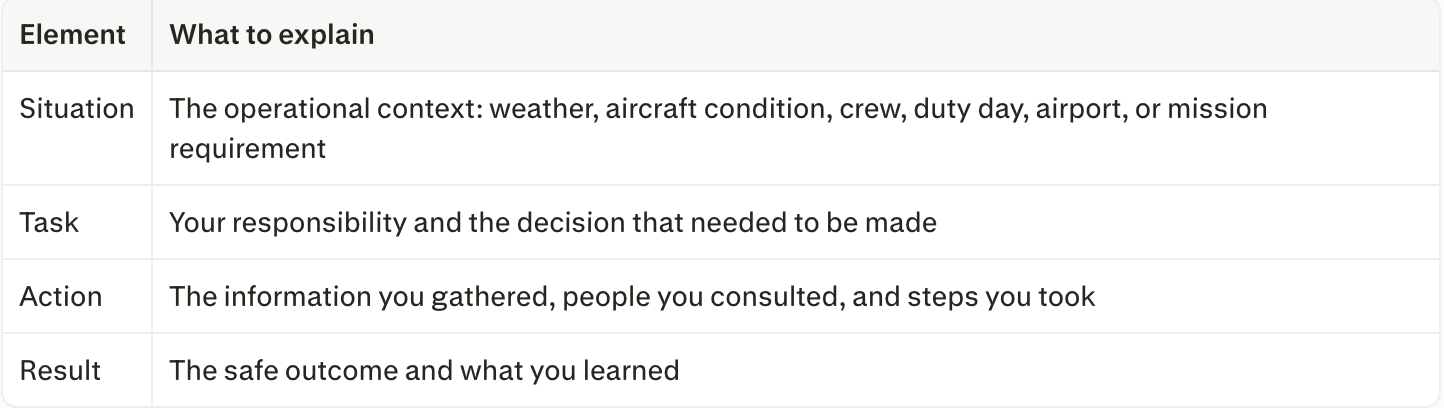
Example answer:
“I was scheduled for a flight where the forecast showed deteriorating weather at the destination near the time of arrival. Although the flight was technically possible at the time of planning, the margin was narrowing. I reviewed the updated weather, confirmed suitable alternates and fuel requirements, discussed options with the crew, and recommended delaying departure until conditions improved. The operation accepted the delay, and we completed the flight later with better margins. The experience reinforced that a legal flight is not always the same as a prudent one.”
The key distinction is important: safe pilots recognize that regulatory minimums are not automatically appropriate operating margins for every aircraft, crew, airport, or mission. CFI Notebook
6. “Describe a mistake you made in the cockpit.”
Do not say, “I have never made a mistake.” That answer can suggest limited self-awareness. Instead, choose an event that demonstrates accountability, corrective action, and learning—without revealing confidential information or presenting a serious safety issue casually.
A strong answer includes:
- What happened.
- How you recognized or addressed it.
- What procedures, habits, or cross-checks you improved afterward.
- How that learning has influenced your current cockpit discipline.
Example answer:
“Earlier in my career, I recognized that I had not communicated a change in my planned workflow as clearly as I should have. The issue was corrected promptly, but it reinforced the importance of verbalizing changes and confirming shared understanding. Since then, I have been deliberate about briefings, callouts, and closed-loop communication, especially during high-workload phases of flight.”
7. “How do you manage fatigue?”
Fatigue is both a safety and professionalism issue. Avoid answers that imply you will simply push through exhaustion for the operation.
Explain that you manage fatigue proactively through rest, schedule awareness, hydration, nutrition, reporting channels, and early communication with leadership or dispatch when you may not be fit for duty. The FAA identifies fatigue as a factor that can reduce cognitive performance and provides guidance on fatigue-management principles. FAA Advisory Circular AC 120-100faa
Example answer:
“I manage fatigue before it becomes an operational problem. I protect rest opportunities, plan for time-zone changes and early report times, and assess my fitness for duty honestly. If I believe fatigue could affect safety, I communicate early through the appropriate channels rather than waiting until the situation becomes more difficult to manage.”
CRM and Professionalism Questions
8. “How do you handle disagreement with another pilot?”
Interviewers are not looking for someone who avoids every disagreement. They want a pilot who can voice a safety concern respectfully, listen to input, and use SOPs and objective information to reach the safest decision.
Example answer:
“I approach disagreement professionally and focus on the operation rather than personalities. I state the concern clearly, explain the information supporting it, and invite the other pilot’s perspective. If the issue involves safety, I use the company’s procedures, available resources, and escalation process as necessary. My goal is always a shared, safe decision—not winning an argument.”
9. “What does good CRM mean to you?”
Good crew resource management means using all available resources—people, checklists, dispatch, maintenance, automation, weather data, ATC, and company procedures—to operate safely and efficiently.
Your answer should emphasize:
- Clear briefings and callouts.
- Mutual cross-checking.
- Respectful challenge and response.
- Task sharing during high workload.
- Situational awareness.
- Speaking up early when something does not look right.
10. “How would you handle a demanding passenger or client?”
This is especially common in charter and corporate aviation interviews. Show that you understand service expectations, but make clear that safety, regulations, company policy, and crew readiness are non-negotiable.
Example answer:
“I would remain calm, respectful, and solutions-oriented. I would listen to the request, explain any operational limitations clearly and professionally, and offer safe alternatives when possible. My responsibility is to provide excellent service without compromising safety, compliance, crew rest, or company standards.”
Questions to Ask the Employer
A pilot interview should also help you determine whether the operator is a good fit. Thoughtful questions demonstrate preparation and professionalism.
Ask about:
- The fleet, bases, route structure, and typical mission profile.
- The expected schedule, reserve requirements, and time away from home.
- Initial and recurrent training programs.
- CRM, safety reporting, and safety-management practices.
- Crew composition, upgrade path, and professional-development opportunities.
- Maintenance coordination, dispatch support, and international operations.
- Expectations outside flight duties, such as hangar responsibilities, catering coordination, trip support, or client interaction.
Avoid leading with compensation as your first question. Compensation is important, but the early interview should also show that you care about operational standards, crew culture, and long-term fit.
How to Prepare With Confidence
Research the operator
Review the company website, fleet, leadership, operating certificate or business model where publicly available, recent news, and job description. In business aviation, hiring often involves several stages rather than a single interview, potentially including a phone screening, in-person meeting, and interaction with flight-department personnel. NBAAnbaa
Build a personal “story bank”
Prepare five to seven true examples from your career that show:
- A sound safety decision.
- A challenging weather or operational situation.
- Effective teamwork or CRM.
- A mistake and the lesson learned.
- A conflict handled professionally.
- Excellent customer service or mission support.
- Adaptability during an unexpected event.
Practice each example until you can tell it clearly in about one to two minutes.
Review your records
Bring or have ready, as appropriate:
- Updated aviation résumé.
- Logbook and a clean flight-time summary.
- Pilot certificates and medical certificate.
- Training records, type ratings, and letters of recommendation.
- References who have agreed to speak on your behalf.
Practice aloud
Interview preparation is not just reading questions silently. Practice speaking your answers aloud. Record yourself, conduct a mock interview with a mentor, and reduce answers that sound vague, overly technical, defensive, or memorized.
Regular proficiency training also supports the confidence interviewers want to see. The FAA’s WINGS Pilot Proficiency Program is designed to help pilots build and maintain knowledge, skills, and safer decision-making habits. FAA Safety Teamfaasafety
Final Interview Reminders
- Be honest about your experience, limitations, and career history.
- Demonstrate judgment rather than trying to appear fearless or flawless.
- Use specific examples instead of broad statements such as “I am a safety-first pilot.”
- Explain how you communicate, prepare, cross-check, and learn.
- Maintain a professional appearance and arrive early.
- Send a concise thank-you message after the interview, reaffirming your interest and fit for the position.
Your credentials may earn the interview, but your communication, preparation, humility, and safety mindset often determine whether you receive the offer.
Find Your Next Pilot Opportunity
Ready to put your preparation to work? Create your profile and explore pilot, chief pilot, first officer, helicopter, flight instructor, and business aviation opportunities on AllAviationJob.com. The platform connects aviation professionals with employers across pilots, maintenance, avionics, flight departments, dispatch, management, and more.allaviationjob
For specialized aviation recruiting support and career opportunities, explore OSI Recruit’s aviation staffing services. OSI Recruit supports aviation organizations and professionals across pilot, cabin crew, maintenance, ground operations, and related positions.osirecruit
Take the next step today: Visit AllAviationJob.com, build a professional job-seeker profile, and start connecting with aviation employers actively seeking qualified talent.
Sources
- Federal Aviation Administration: WINGS Pilot Proficiency Program
- Federal Aviation Administration: Basics of Aviation Fatigue (AC 120-100)
- National Business Aviation Association: Nailing the Job Interview
- National Business Aviation Association: Looking at Pilot Hiring Through a New Lens
- All Aviation Jobs
- OSI Recruit