Flight hours are the currency of a professional pilot career. They determine which certificates you can earn, which regulations you can legally fly under, and which employers will consider your application. Yet "How many hours do I need?" rarely has a single answer. The answer depends on the job, the type of operation, the aircraft, and, increasingly, the employer's insurance carrier and hiring standards.
This guide breaks down the Federal Aviation Administration (FAA) minimums for each major pilot certificate and job type in the United States, then compares those legal minimums with what employers actually expect in today's market. Whether you are a student pilot planning your path or a working pilot weighing your next move, this overview will help you set realistic goals.
Quick note: Regulatory minimums are the floor, not the target. Most employers set their own requirements above the FAA minimum, and competitive candidates often exceed both.
Legal Minimums vs. Hiring Minimums
Before looking at specific jobs, it helps to understand three different "hour numbers" you will encounter:
- Certificate minimums: The aeronautical experience required by 14 CFR Part 61 (or Part 141) to take a checkride.
- Operational minimums: The experience required to act as a pilot under a specific operating rule, such as Part 135 (charter and on-demand) or Part 121 (airlines).
- Employer and insurance minimums: Company-specific requirements, often driven by insurance underwriters, aircraft type, and mission complexity.
A pilot can be legally certificated and still not be hireable for a specific role. Understanding all three layers is the key to planning a realistic career timeline.
At-a-Glance: Flight Hours by Pilot Job
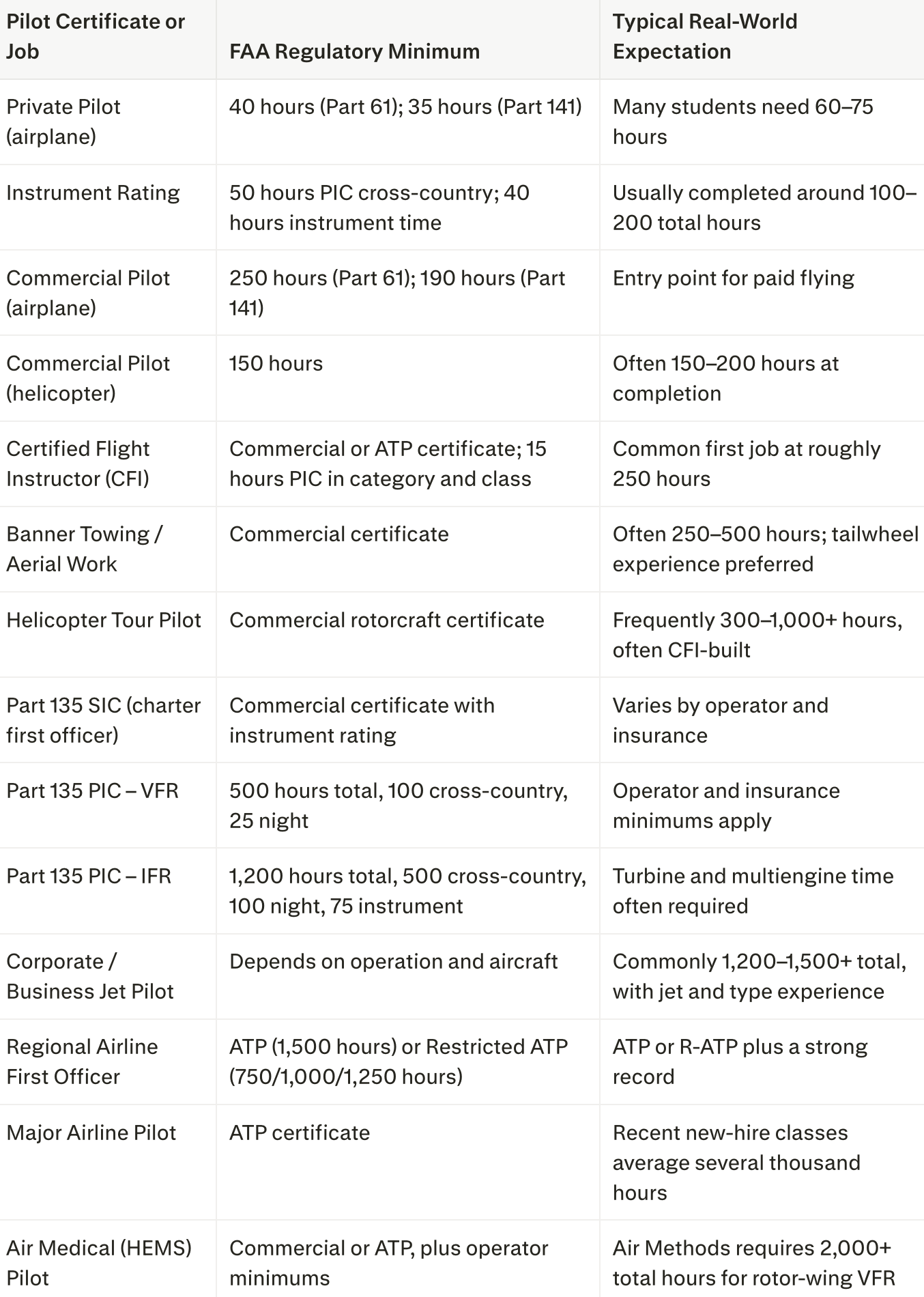
The sections below explain each category in more detail.
Private Pilot: The Foundation (40 Hours Minimum)
The private pilot certificate is not a professional job credential, because private pilots cannot be paid to fly. However, it is the first step for nearly every professional pilot.
Under 14 CFR 61.109, an applicant for a private pilot certificate with an airplane single-engine rating must log at least 40 hours of flight time, including at least 20 hours of flight training with an authorized instructor and 10 hours of solo flight. Training must include cross-country, night, and instrument-reference flight time.
Through an FAA-approved Part 141 pilot school, the minimum can be reduced to 35 hours. However, the FAA notes that most people require 60 to 75 hours of training, so the difference between the two paths may be insignificant for many students.
Instrument Rating: Essential for Professional Flying
An instrument rating is effectively mandatory for any serious professional pilot career. Under 14 CFR 61.65, an airplane instrument applicant needs:
- 50 hours of cross-country flight time as pilot in command (PIC), including at least 10 hours in airplanes.
- 40 hours of actual or simulated instrument time, including at least 15 hours of instrument training from an authorized instructor.
- One 250-nautical-mile IFR cross-country flight with an instructor, including three different types of instrument approaches.
The instrument rating is also required to fly as a second in command (SIC) under most Part 135 operations and is a prerequisite for the airplane CFI certificate.
Commercial Pilot: Where Paid Flying Begins (250 Hours)
The commercial pilot certificate is the legal threshold for being compensated as a pilot. According to 14 CFR 61.129, an applicant for a commercial certificate with an airplane single-engine rating must log at least 250 hours of total flight time, including:
- 100 hours in powered aircraft, of which 50 hours must be in airplanes.
- 100 hours as PIC, including 50 hours of cross-country time.
- 20 hours of training, including 10 hours of instrument training and 10 hours in a complex, turbine-powered, or technically advanced airplane.
- Day and night cross-country training flights, plus a long solo cross-country of at least 300 nautical miles.
Pilots who complete an FAA-approved Part 141 commercial course can qualify with as few as 190 total flight hours.
For helicopter pilots, the commercial rotorcraft-helicopter minimum is lower: 150 hours of total flight time, including 100 hours in powered aircraft (50 in helicopters) and 100 hours as PIC, as outlined in the same § 61.129.
Holding a commercial certificate does not mean you can fly for an airline or a charter company right away. It opens the door to entry-level aviation jobs where pilots build the experience required for more advanced roles.
Flight Instructor (CFI): The Most Common First Pilot Job
For many pilots, becoming a Certified Flight Instructor (CFI) is the first paid flying job and the most common way to build hours toward airline minimums.
Under 14 CFR 61.183, a flight instructor applicant must:
- Hold a commercial pilot certificate or an ATP certificate with the appropriate category and class rating.
- Hold an instrument rating for airplane single-engine, airplane multiengine, powered-lift, or instrument instructor ratings.
- Have logged at least 15 hours as PIC in the category and class of aircraft for the instructor rating sought.
Because the commercial certificate is a prerequisite, most new airplane CFIs begin instructing at roughly 250 total hours. Many add the CFII (instrument instructor) and MEI (multiengine instructor) ratings to increase their marketability and their access to multiengine time.
Explore opportunities: Browse current pilot jobs on AllAviationJob.com, or research training providers through the AllAviationJob.com Flight Schools page and the Aviation School Directory.
Entry-Level Commercial Jobs: Banner Towing, Aerial Work, and Tours
In addition to flight instruction, several commercial flying jobs are open to relatively low-time pilots. These roles require at least a commercial certificate, but employer and insurance minimums vary widely.
Banner Towing
Banner towing is a classic time-building job, particularly in coastal and tourist markets. Industry guides indicate that operators typically look for 250 to 500+ total hours with a commercial certificate, and tailwheel experience is often preferred or required.
Helicopter Tour Flying
For helicopter pilots, tour operators are a common next step after instructing. For example, one published seasonal tour pilot listing required a CFI certificate and a minimum of 301 flight hours, while another Florida operator required a minimum of 400 hours of rotorcraft PIC. Industry salary research notes that most good-paying helicopter jobs require at least 1,000 hours, and the highest-paying positions often require 2,500 or more.
Other Time-Building Roles
Other entry-level options include aerial survey and photography, pipeline patrol, skydiving operations, ferry flights, and glider towing. Each employer sets its own minimums, and insurance requirements are often the deciding factor.
Part 135 Charter and On-Demand Pilots
Part 135 governs commuter and on-demand operations, including air charter, air taxi, cargo feeders, and many fractional and air ambulance operations. The regulations set different minimums for pilots in command depending on the type of flight.
Second in Command (SIC)
Under 14 CFR 135.245, a Part 135 second in command must hold at least a commercial pilot certificate with the appropriate category and class ratings and an instrument rating. The regulation does not set a specific total-time minimum for SIC, but employer and insurance requirements apply.
Notably, the FAA allows commercial pilots in approved Part 135 SIC professional development programs to log certain SIC time toward ATP experience requirements, as described in § 61.159. This has become an important pathway for pilots building toward the airlines.
Pilot in Command – VFR
Under 14 CFR 135.243(b), a PIC in VFR operations must hold at least a commercial certificate and have:
- 500 hours of total pilot time
- 100 hours of cross-country time
- 25 hours of night flight time
Airplane PICs must also hold an instrument rating or an ATP certificate, with limited exceptions for certain operations in isolated areas.
Pilot in Command – IFR
For IFR operations under 14 CFR 135.243(c), the PIC requirements increase significantly:
- 1,200 hours of total pilot time
- 500 hours of cross-country time
- 100 hours of night flight time
- 75 hours of actual or simulated instrument time, at least 50 of which must be in actual flight
When an ATP Is Required in Part 135
§ 135.243(a) requires an ATP certificate for a PIC in passenger-carrying operations in a turbojet airplane, an airplane with 10 or more passenger seats, or a multiengine airplane in commuter operations. Because the ATP requires 1,500 hours for most pilots, PICs of charter jets typically have at least that much experience.
Corporate and Business Aviation Pilots
Corporate flight departments that operate under Part 91 are not bound by Part 135 or Part 121 hour minimums. In practice, however, insurance underwriters largely set the hiring bar. Requirements scale with the aircraft's value, complexity, and liability limits.
Industry sources commonly describe a pathway of 1,200 to 1,500 total flight hours plus turbine type ratings for corporate jet pilots. For larger and higher-value aircraft, insurers commonly expect 1,500+ total time and significant time in type, along with initial and recurrent training at an approved simulator training provider.
Corporate employers also value multiengine, turbine, and international experience, as well as professionalism, discretion, and customer service skills. If you are comparing aircraft that commonly serve as entry points into business aviation, OSI Recruit's Citation Mustang vs. Phenom 100EV comparison for new corporate pilots and HondaJet Elite career overview offer useful context.
Find your next role: Browse Flight Department jobs on AllAviationJob.com.
Airline Pilots: The 1,500-Hour Rule and the Restricted ATP
Regional and Major Airline First Officers
Under 14 CFR 121.436, both pilots on a Part 121 airline flight deck must hold an Airline Transport Pilot (ATP) certificate and an appropriate aircraft type rating. This is the origin of the widely discussed "1,500-hour rule."
Per 14 CFR 61.159, an unrestricted ATP with an airplane category rating requires:
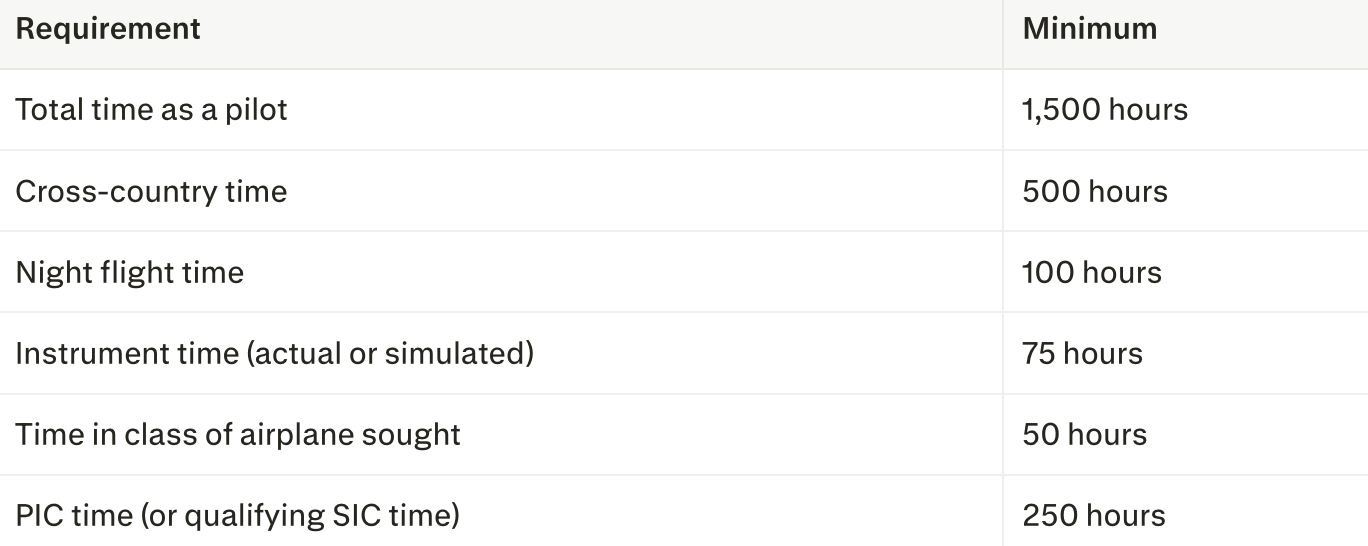
Applicants for an ATP with a multiengine rating must also complete the ATP Certification Training Program (ATP CTP) before taking the knowledge test.
The Restricted ATP (R-ATP)
The FAA allows reduced total-time minimums for certain applicants under 14 CFR 61.160. An R-ATP holder may serve as a first officer at a Part 121 airline, but not as captain, until meeting the full ATP requirements.
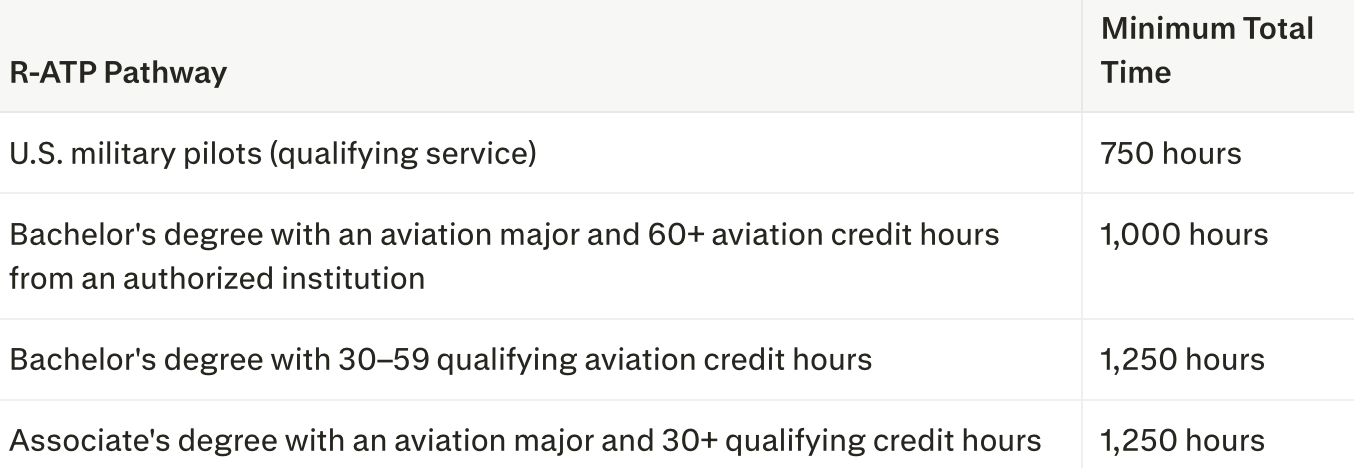
These pathways reward structured, university-based, or military training and can shorten the path to an airline first officer seat.
Airline Captain
To serve as a Part 121 PIC (captain), § 121.436 requires an ATP certificate not subject to R-ATP limitations, plus 1,000 hours in qualifying air carrier operations. These hours can come from Part 121 SIC time, certain Part 135 PIC time, or a combination.
What Airlines Actually Expect
Legal minimums and competitive minimums are two very different numbers at the major airlines. According to Road to the Flight Deck, a Delta new-hire class on June 2, 2026, consisted of 57 pilots with an average of 3,874 flight hours. The same analysis notes that reaching 1,500 hours does not automatically result in a major airline interview.
Hiring remains active. AOPA reported that through July 2026, the major airlines tracked by Future and Active Pilot Advisors (FAPA) had hired 3,863 pilots, with expectations of roughly 8,000 major-airline hires for the year. At the same time, AOPA described experience requirements as "creeping upward," with some regional airlines that once accepted 25 hours of multiengine time now preferring 50 or even 100 hours. Turbine experience, ATP CTP completion, and a four-year degree can help candidates stand out.
Helicopter Career Paths: ATP and Air Medical
Helicopter ATP
The rotorcraft-helicopter ATP under 14 CFR 61.161 requires 1,200 hours of total time, including 500 hours cross-country, 100 hours night (15 in helicopters), 200 hours in helicopters, and 75 hours of instrument time. An ATP is required for helicopter PICs in scheduled interstate air carrier operations within the 48 contiguous states under § 135.243(a).
Helicopter Air Ambulance (HEMS)
Air medical flying is among the most demanding helicopter missions, and minimums reflect that. Air Methods, one of the largest U.S. air medical operators, publishes the following minimums:
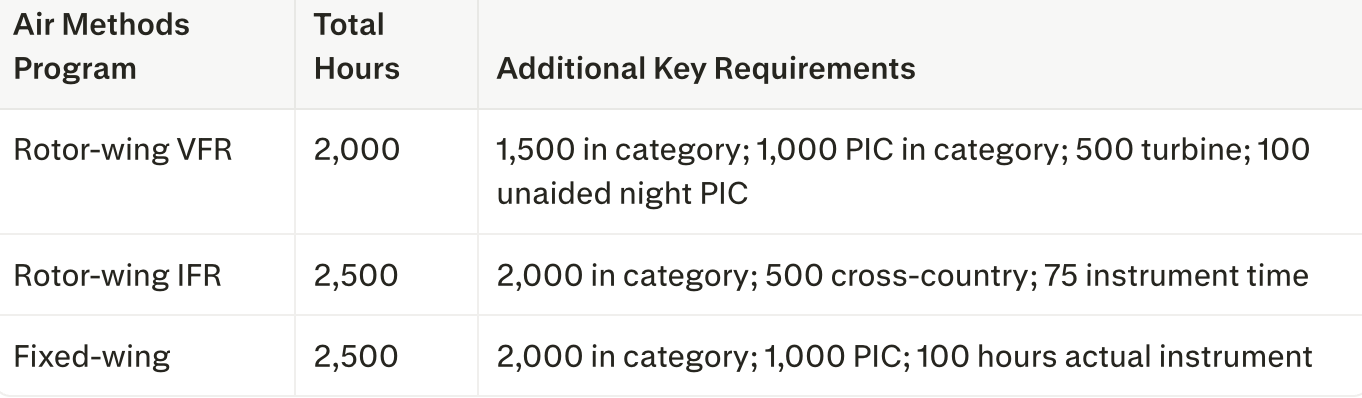
Helicopter pilots typically reach these levels by progressing from instructing to tours, utility, offshore, or law enforcement flying before moving into air medical roles.
How to Build Flight Hours Efficiently
Every pilot's timeline is different, but these strategies can help you build quality experience faster:
- Earn your instructor ratings early. CFI, CFII, and MEI certificates create the most consistent path to paid flight time.
- Prioritize quality time. Multiengine, turbine, night, instrument, and cross-country hours are often weighted more heavily than total time alone.
- Consider a Part 135 SIC program. Approved programs allow qualifying SIC time to count toward ATP experience.
- Explore R-ATP eligibility. A qualifying aviation degree or military experience can reduce the airline minimum.
- Keep accurate, professional logbooks. Employers and insurers will review your records closely.
- Maintain a strong record. Clean checkride history, training records, and references matter as much as hours.
- Network and stay visible. Keep your profile current and set job alerts so you see openings as soon as they post.
For more career-building guidance, read Five Certifications That Can Help Advance Your Aviation Career, How Military Veterans Can Launch Civilian Aviation Careers, and The Complete Guide to Aviation Job Alerts. You can also check pay benchmarks in the AllAviationJob.com Salary Report and polish your application with aviation resume templates.
For Employers: Hiring Pilots in a Tight Market
Rising experience expectations affect employers as much as candidates. Charter operators, corporate flight departments, and air medical providers must balance regulatory minimums, insurance requirements, and safety culture while competing with airlines for qualified pilots.
OSI Recruit specializes in aviation recruitment for operators and employers, helping identify pilots who meet the experience, type rating, and insurance requirements for each role.
Employers can learn more on the OSI Recruit Employers page or contact OSI Recruit to discuss pilot staffing needs.
Frequently Asked Questions
How many hours do you need to get paid as a pilot?
You need a commercial pilot certificate, which requires 250 hours under Part 61 or 190 hours through an approved Part 141 program for airplanes, and 150 hours for helicopters.
Can you fly for an airline with fewer than 1,500 hours?
Yes, if you qualify for a Restricted ATP. Qualifying military pilots need 750 hours, and graduates of qualifying aviation degree programs need 1,000 or 1,250 hours.
How many hours do you need to fly charter?
A Part 135 SIC needs a commercial certificate with an instrument rating. A PIC needs at least 500 hours for VFR operations or 1,200 hours for IFR operations, and an ATP for turbojet or 10+ passenger seat operations.
How long does it take to reach 1,500 hours?
It varies based on training path, instructing volume, and job availability. Full-time flight instructors and time-building pilots often take one to two years after earning their commercial certificate.
Do corporate jet jobs require 1,500 hours?
Not by Part 91 regulation, but insurance requirements and employer standards commonly place the bar around 1,200 to 1,500+ total hours with turbine and type experience.
Your Next Flight Hour Starts with the Right Job
Every logbook entry moves you closer to your goal. Whether you are a newly certificated CFI looking for your first instructing role, a time-builder searching for banner towing or tour work, or an experienced pilot ready for a corporate, charter, or airline seat, the right opportunity can accelerate your career.
AllAviationJob.com connects pilots with aviation employers across the industry, from flight schools and charter operators to major airlines and aerospace companies.
- Browse Pilot Jobs and find roles that match your hours and ratings.
- Create Your Free Job Seeker Profile so employers can find you.
- Explore Aviation Companies that are hiring now.
Do not wait for your logbook to hit the next milestone before you start looking. Visit AllAviationJob.com today, set up your job alerts, and take the next step in your pilot career.
Sources
- Electronic Code of Federal Regulations. "14 CFR 61.109 – Aeronautical Experience (Private Pilot)." https://www.ecfr.gov/current/title-14/chapter-I/subchapter-D/part-61/subpart-E/section-61.109
- Electronic Code of Federal Regulations. "14 CFR 61.65 – Instrument Rating Requirements." https://www.ecfr.gov/current/title-14/chapter-I/subchapter-D/part-61/subpart-B/section-61.65
- Electronic Code of Federal Regulations. "14 CFR 61.129 – Aeronautical Experience (Commercial Pilot)." https://www.ecfr.gov/current/title-14/chapter-I/subchapter-D/part-61/subpart-F/section-61.129
- Cornell Law School, Legal Information Institute. "14 CFR 61.183 – Flight Instructor Eligibility Requirements." https://www.law.cornell.edu/cfr/text/14/61.183
- Cornell Law School, Legal Information Institute. "14 CFR 61.159 – Aeronautical Experience: Airplane Category Rating (ATP)." https://www.law.cornell.edu/cfr/text/14/61.159
- Cornell Law School, Legal Information Institute. "14 CFR 61.160 – Aeronautical Experience: Airplane Category Restricted Privileges." https://www.law.cornell.edu/cfr/text/14/61.160
- Cornell Law School, Legal Information Institute. "14 CFR 61.161 – Aeronautical Experience: Rotorcraft Category and Helicopter Class Rating." https://www.law.cornell.edu/cfr/text/14/61.161
- Cornell Law School, Legal Information Institute. "14 CFR 121.436 – Pilot Qualification: Certificates and Experience Requirements." https://www.law.cornell.edu/cfr/text/14/121.436
- Cornell Law School, Legal Information Institute. "14 CFR 135.243 – Pilot in Command Qualifications." https://www.law.cornell.edu/cfr/text/14/135.243
- Cornell Law School, Legal Information Institute. "14 CFR 135.245 – Second in Command Qualifications." https://www.law.cornell.edu/cfr/text/14/135.245
- Federal Aviation Administration. "Pilot Schools Information." https://www.faa.gov/training_testing/training/pilot_schools
- Federal Aviation Administration. "AC 61-138A – Airline Transport Pilot Certification Training Program." https://www.faa.gov/documentLibrary/media/Advisory_Circular/AC_61-138A.pdf
- AOPA. "The Pipeline Squeeze" (August 25, 2026). https://www.aopa.org/news-and-media/all-news/2026/august/25/the-pipeline-squeeze
- Road to the Flight Deck. "What the Numbers Say About Pilot Hiring and the Next Five Years." https://roadtotheflightdeck.com/blog/the-pilot-hiring-outlook.html
- Air Methods. "Pilot Careers." https://www.airmethods.com/roles-at-air-methods/pilots/
- Pilot Institute. "Commercial Pilot Requirements (Part 61.129)." https://pilotinstitute.com/commercial-pilot-requirements/
- Pilot Institute. "Helicopter Pilot Salary Guide." https://pilotinstitute.com/helicopter-pilot-salary/
- Fly to 1500. "Banner Tow Pilot Jobs: Requirements, Pay & How to Get Started." https://flyto1500.com/pilot-jobs/banner-tow-pilot-jobs
- HeliJobs. "Seasonal R44/66 Tour Pilot – South Dakota." https://helijobs.net/2025/06/seasonal-r44-66-tour-pilot-south-dakota/
- Flyventure. "Employment." https://flyventure.com/employment/
- Avi-Go. "Career Roadmap for Corporate Jet Pilots: Hours, Ratings, and Requirements." https://avi-go.com/news/articles/1e05c07775962d4e8e079f97a5a49f94
- PilotPrivate. "Pilot Insurance Requirements: Hours, Ratings, Training." https://pilotprivate.com/insurance/pilot-insurance-requirements