In aviation hiring, timing matters. A captain seat at a Part 135 operator, an A&P technician opening at a busy FBO, or a scheduler role in a corporate flight department can attract a strong group of applicants within days of being posted. Candidates who learn about an opening early have more time to tailor a résumé, check requirements, and apply while the employer is still actively reviewing applications.
Job alerts are one of the simplest and most effective ways to close that gap. Instead of checking job boards manually each morning, you let the right openings come to you, filtered by role, certificate, aircraft type, and location. This guide explains how aviation job alerts work, why speed matters, how to build alerts that are accurate rather than noisy, and how to turn a notification into a strong application.
Why Speed Matters in Aviation Hiring
Aviation Demand Remains Strong
The long-term outlook for aviation careers remains strong. Boeing's 2025 Pilot and Technician Outlook projects that the global commercial aviation industry will need nearly 2.4 million new professionals through 2044: 660,000 pilots, 710,000 maintenance technicians, and 1,000,000 cabin crew members. North America alone accounts for an estimated 119,000 new pilots, 123,000 new technicians, and 193,000 new cabin crew members over that period. Boeing also notes that about two-thirds of this demand will come from replacing workers who retire or leave the industry.
In the United States, the Bureau of Labor Statistics (BLS) projects:
- Airline and commercial pilots: Employment is expected to grow 7 percent from 2025 to 2035, with about 16,400 openings per year on average. The May 2025 median annual wage was $232,140 for airline pilots, copilots, and flight engineers, and $123,220 for commercial pilots.
- Aircraft and avionics equipment mechanics and technicians: Employment is expected to grow 6 percent from 2025 to 2035, with about 13,100 openings per year on average. The 2025 median annual wage for the occupation was $80,180.
Strong demand does not mean every opening is easy to win. The most attractive roles, such as good schedules, desirable bases, preferred aircraft, strong pay, and quick-upgrade paths, still draw competition. That is where speed helps.
Most Applications Arrive Early
Research on online job applications shows how quickly applications gather after a posting goes live. A Federal Reserve Bank of St. Louis summary of research by economists Steven J. Davis and Brenda Samaniego de la Parra reported that, across nearly 80 million applications to almost 10 million online postings, 41 percent of applications arrived within the first 48 hours and 56 percent arrived within the first 96 hours. The average single-position posting stayed active for only 9.8 days.
The later working paper by the same researchers found a similar pattern: 45 percent of applications went to vacancies posted within the previous 48 hours and 60 percent went to vacancies posted within the previous 96 hours.
This research covered a professional job board, not aviation specifically, so it should be treated as a general labor-market pattern rather than an aviation-specific rule. Still, the lesson applies: many employers gather a batch of applications soon after posting and then move into screening and interviews. If you find a posting on day eight, you may be applying after the employer has already built its shortlist.
What Is an Aviation Job Alert?
An aviation job alert is an automated notification, usually by email or app, that tells you when a new job matching your saved criteria is posted. Most alerts are built from a combination of:
- Keywords: Job titles, certificates, ratings, or aircraft types, such as "A&P," "Citation," "Gulfstream," "Director of Maintenance," or "Part 135."
- Category: Pilots, maintenance, avionics, dispatch, customer service, engineering, and other departments.
- Location: A city, state, airport, or radius around your home.
- Employment type: Full-time, part-time, contract, or rotational.
- Frequency: Instant, daily, or weekly delivery.
A well-built alert acts like a personal recruiter that watches the market around the clock, as long as you set it up precisely.
Where to Set Up Aviation Job Alerts
Aviation-Specific Job Boards
General job sites can bury aviation roles among unrelated listings. A search for "technician," for example, may return HVAC, IT, and automotive openings. Aviation-specific boards reduce that noise because the employers, categories, and terminology already reflect the industry.
AllAviationJob.com is built for this purpose. You can browse all current aviation jobs or go directly to focused categories, including:
- Pilot jobs
- Aircraft maintenance technician jobs
- Aircraft mechanic jobs
- Avionics jobs
- Flight department jobs
- FBO jobs
- Scheduler and dispatcher jobs
- Flight attendant jobs
- Aerospace engineering jobs
Creating a free candidate account through AllAviationJob.com registration lets you save your search preferences and build a candidate profile so you are ready to act when the right role appears.
Employer Career Pages
If you have a short list of target employers, such as a specific airline, charter operator, or manufacturer, go directly to their career pages and sign up for their talent network or job notifications when available. You can also research employers through the AllAviationJob.com company directory, which includes employer profiles for organizations across airlines, aerospace, and private aviation.
Government and Federal Aviation Jobs
For federal aviation roles, such as FAA positions, USAJOBS lets you save a search and choose to receive email notifications when a matching job is posted. This matters because federal announcements often have fixed open and close dates. The FAA's air traffic controller hiring page, for example, strongly encourages applicants to apply early because waiting may result in the announcement closing before an application is submitted.
Recruiters and Staffing Partners
Many aviation roles, especially in private aviation, charter, and maintenance, are filled with help from specialized recruiters. Some openings are shared with a recruiter before they are widely advertised. Registering with an aviation recruiting firm adds a human alert system to your automated one. OSI Recruit's job seekers page explains how the firm works with aviation candidates, and its aviation recruitment services cover pilots, maintenance professionals, and operational support roles.
Professional Networks and Communities
Aviation remains a relationship-driven industry. Following employers on LinkedIn, joining aviation groups, and staying active in professional associations can surface opportunities that automated alerts miss. The AllAviationJob.com Facebook group is another place to follow new postings and industry conversations.
How to Build Job Alerts That Actually Work
The most common mistake is creating one broad alert, such as "aviation jobs, United States," and then ignoring the flood of irrelevant emails. Effective alerts are specific, layered, and reviewed regularly.
Step 1: Define Your Target Role Precisely
Before creating any alert, write down:
- Your target job titles, including common variations. For example, a maintenance professional might search for "A&P Mechanic," "Aircraft Maintenance Technician," "Line Technician," and "Aircraft Technician."
- Your certificates and ratings, such as ATP, commercial, CFI, A&P, IA, or FCC license.
- Your aircraft experience, including type ratings and airframes you know well.
- Your operating environment, such as Part 91 corporate, Part 135 charter, Part 121 airline, Part 145 repair station, MRO, or OEM.
- Your location limits, including the commute distance you will accept and whether you will relocate.
Step 2: Create Several Focused Alerts
Instead of one broad alert, build three to five narrow ones. For example:
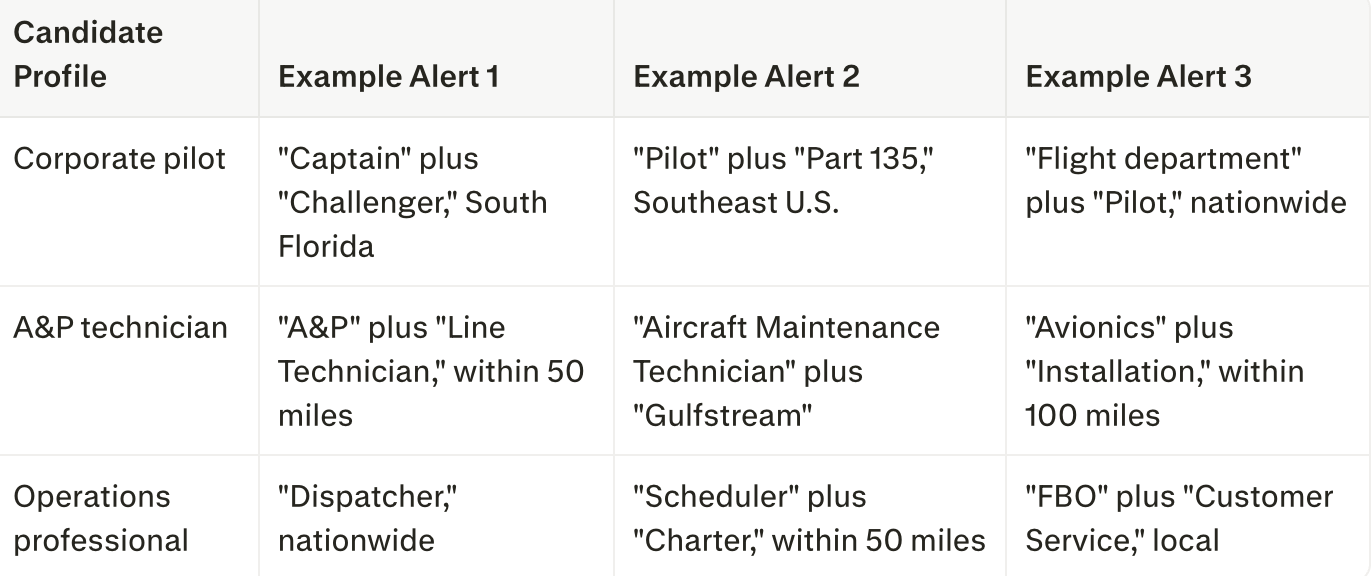
Focused alerts produce fewer emails, but each one is more likely to be worth reading.
Step 3: Use Keyword and Boolean Logic Where Supported
Many job boards and search engines support simple search operators. Where available, they can improve alert precision:
- Quotation marks keep a phrase together, such as "Director of Maintenance."
- OR broadens a search to include variations, such as A&P OR "Airframe and Powerplant."
- AND requires multiple terms, such as Pilot AND Citation.
- NOT or a minus sign excludes unwanted results, such as Technician NOT HVAC.
Support for these operators varies by platform, so test each alert and review the first few results before relying on it.
Step 4: Choose the Right Alert Frequency
- Instant or daily alerts are best for high-competition roles, such as desirable pilot positions, quick-upgrade captain seats, and roles at well-known operators.
- Daily alerts work well for most maintenance, avionics, and operations searches.
- Weekly alerts suit passive candidates who are employed and watching the market without urgency.
If you are actively searching, daily or instant alerts are usually the right choice, given how quickly applications tend to arrive after a posting goes live.
Step 5: Refine Alerts Every Few Weeks
Treat alerts as a living tool. If an alert sends mostly irrelevant jobs, tighten the keywords. If it sends nothing for weeks, broaden the location or add title variations. As you earn new ratings, add type ratings, or change your relocation plans, update your alerts to match.
Role-Specific Alert Tips
Pilots
- Include both aircraft types and the operating rule, such as "Part 135" or "Part 91," because many postings mention both.
- Add alerts for terms such as "quick upgrade," "SIC," and "PIC" if they match your career stage. For example, AllAviationJob.com has listed roles such as a Quick Upgrade Captain position in Opa-locka, Florida.
- Keep your medical certificate current. Under FAA rules, pilots exercising airline transport pilot privileges must hold a first-class medical certificate, while commercial pilots need at least a second-class medical certificate. An expired medical can delay an application even after you find the right job.
Maintenance and Avionics Technicians
- Search for both "A&P" and "Airframe and Powerplant," because employers use both terms.
- Create separate alerts for line maintenance, heavy maintenance, avionics, and inspection roles, because they often use different titles.
- If you hold an Inspection Authorization (IA) or FCC license, include it as a keyword. BLS notes that avionics technicians who work on communications equipment may need an FCC license, which can set candidates apart.
- Browse aircraft technician jobs and aerospace maintenance jobs to see how employers currently phrase these roles.
Operations, Administrative, and Support Roles
- Include airport codes or airport names in your keywords, such as TEB, OPF, or Teterboro, because many aviation jobs are tied to a specific field.
- Watch categories such as customer service, aviation management, and FAA documentation and compliance.
Location-Based Searches
If you are committed to a specific market, location pages can serve as a manual alert that you check regularly. AllAviationJob.com offers location pages such as aviation jobs in Miami, Florida, aviation jobs in Teterboro, New Jersey, and aviation jobs in Houston, Texas.
Turning an Alert Into an Application
A job alert only creates value if you are ready to act on it. Speed without preparation can lead to rushed, generic applications. Preparation allows you to be fast and strong.
Keep an Application-Ready Toolkit
Before your alerts start arriving, prepare:
- A current master résumé listing total time, PIC time, type ratings, and recent aircraft for pilots, or certificates, airframes, systems, and inspection experience for technicians. OSI Recruit's free résumé samples can help you structure an aviation résumé.
- Scanned copies of certificates and medicals, stored securely and ready to share when an employer legitimately requests them.
- A short cover letter template you can personalize in a few minutes.
- A list of professional references who have agreed to be contacted.
- Interview preparation notes. OSI Recruit's interview prep tips cover common questions and how to present your experience clearly.
Use a 24-Hour Response Goal
When a strong match arrives, aim to review it the same day and apply within 24 to 48 hours. Read the full posting carefully, match your résumé to the listed requirements, and highlight the certificates, aircraft, or experience the employer names first.
Track What You Apply For
Keep a simple spreadsheet with the employer, job title, date applied, contact person, and next step. This prevents duplicate applications, helps you follow up professionally, and shows which alerts produce the best opportunities.
Protect Yourself From Job Scams
Automated alerts can occasionally surface fraudulent listings. The Federal Trade Commission (FTC) warns that scam recruiters often ask for personal information, such as a driver's license, Social Security number, or bank account number, before giving any real details about a job. Be cautious if a posting:
- Asks you to pay for training, equipment, or placement before hiring.
- Requests sensitive personal or banking information before an interview or offer.
- Uses vague job descriptions, pressure tactics, or unverifiable contact information.
Verify employers through their official websites and trusted aviation platforms. If you encounter a scam, the FTC recommends reporting it at ReportFraud.ftc.gov.
Common Job Alert Mistakes to Avoid
- Using only one broad alert. It creates noise and causes important emails to be missed.
- Ignoring title variations. The same job can be called a "Line Technician," "A&P Mechanic," or "Aircraft Maintenance Technician."
- Never updating alerts. Your alerts should evolve with your ratings, experience, and goals.
- Letting alerts go to spam. Add job board sender addresses to your contacts or safe-sender list.
- Relying on alerts alone. Combine alerts with networking, direct employer research, and recruiter relationships.
- Applying without preparation. Speed matters, but a tailored application still matters more than a rushed one.
A Simple Weekly Routine
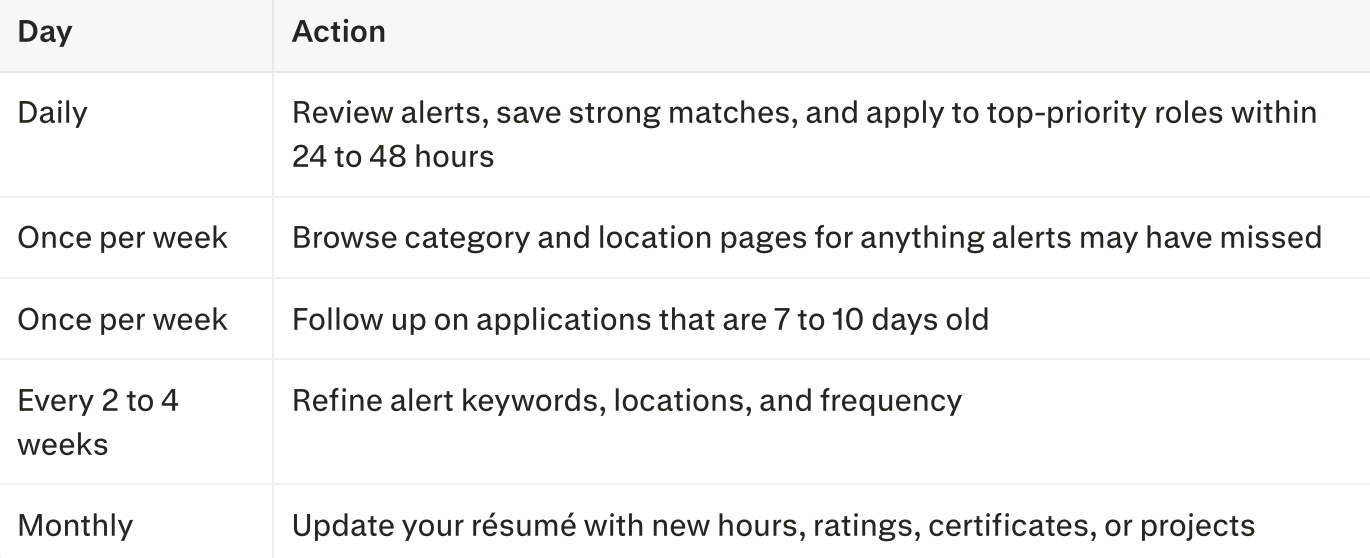
For Employers: Reaching Candidates Who Use Alerts
Job alerts also affect how employers should post openings. Clear, specific job titles, accurate locations, and required certificates listed in the posting help your role reach candidates whose alerts match it.
Employers can post a job on AllAviationJob.com or review posting options and pricing.
For hard-to-fill roles, such as experienced A&P technicians, Directors of Maintenance, or type-rated captains, OSI Recruit's employer services provide recruiter-led support.
OSI Recruit also explains its approach in Recruiting A&P Mechanics in a Shortage: Proven Strategies That Work.
Conclusion
Aviation offers strong long-term demand for pilots, technicians, cabin crew, and support professionals, but the best individual openings still move quickly. Job alerts give you an early view of new opportunities, help you avoid missing roles, and give you time to submit a well-prepared application while employers are still actively reviewing candidates.
The strategy is straightforward: define your target roles precisely, build several focused alerts, choose the right frequency, keep your application toolkit ready, and refine your approach as your career grows. Candidates who combine speed with preparation give themselves a real advantage.
Start Receiving Better Aviation Opportunities Today
Stop checking dozens of websites and hoping you catch the right posting in time. AllAviationJob.com brings pilot, maintenance, avionics, flight department, FBO, dispatch, and aerospace jobs together on one aviation-focused platform.
Create your free AllAviationJob.com account to save your preferences and build your candidate profile, then browse the latest aviation jobs and be among the first to apply when the right opportunity lands.
Your next cockpit, hangar, or flight department role may already be posted. Make sure you see it first with AllAviationJob.com.
Sources
- Boeing. "Boeing Forecasts 20-Year Global Demand for Nearly 2.4 Million New Commercial Pilots, Technicians, Cabin Crew." July 22, 2025. https://investors.boeing.com/investors/news/press-release-details/2025/Boeing-Forecasts-20-Year-Global-Demand-for-Nearly-2-4-Million-New-Commercial-Pilots-Technicians-Cabin-Crew/default.aspx
- Boeing. "Pilot and Technician Outlook 2025–2044." https://www.boeing.com/content/dam/boeing/v2/products/pilot-technician-outlook/pdf/2025-pto-download.pdf
- U.S. Bureau of Labor Statistics. "Airline and Commercial Pilots." Occupational Outlook Handbook. https://www.bls.gov/ooh/transportation-and-material-moving/airline-and-commercial-pilots.htm
- U.S. Bureau of Labor Statistics. "Aircraft and Avionics Equipment Mechanics and Technicians." Occupational Outlook Handbook. https://www.bls.gov/ooh/installation-maintenance-and-repair/aircraft-and-avionics-equipment-mechanics-and-technicians.htm
- Federal Reserve Bank of St. Louis. "How Quickly Do People Apply for Jobs?" November 13, 2017. https://www.stlouisfed.org/on-the-economy/2017/november/how-quickly-people-apply-jobs
- Davis, Steven J., and Brenda Samaniego de la Parra. "Application Flows." National Bureau of Economic Research Working Paper 32320. https://www.nber.org/system/files/working_papers/w32320/revisions/w32320.rev0.pdf
- Federal Aviation Administration. "Guide for Aviation Medical Examiners: Classes of Medical Certificates." https://www.faa.gov/ame_guide/app_process/general/classes
- Federal Aviation Administration. "Air Traffic Controller Hiring." https://www.faa.gov/atc-hiring
- USAJOBS Help Center. "How Do I Set Up Notifications for Future Job Announcements?" https://help.usajobs.gov/faq/search/job-not-posted
- Federal Trade Commission. "How to Spot the Latest Job Scams." December 2023. https://consumer.ftc.gov/consumer-alerts/2023/12/how-spot-latest-job-scams
- Federal Trade Commission. "Job Scams." https://consumer.ftc.gov/articles/job-scams