Few nursing roles combine clinical skill, independence, and aviation the way flight nursing does. A flight nurse is a registered nurse (RN) who cares for critically ill or injured patients aboard helicopters and fixed-wing aircraft, often with limited space, limited resources, and no physician on board. The work may involve a rotor-wing response to a highway trauma scene, a fixed-wing interfacility transfer across several states, or a military aeromedical evacuation mission at altitude.
Because the job demands such a high level of independent judgment, flight nursing is not an entry-level position. Most nurses spend six or more years moving from nursing school to their first flight job. This guide explains each step: education, licensure, clinical experience, certifications, transport-specific training, compensation, and the career options available once you are in the air.
What Does a Flight Nurse Do?
Flight nurses are part of an air medical crew, which typically includes a pilot and one or two clinicians, such as a second nurse, a flight paramedic, or a physician. Crew configurations vary by program; some operate with a nurse and a paramedic, while others operate with two nurses.
Typical responsibilities include:
- Scene response: Assessing, triaging, and stabilizing patients at accident sites, rural emergencies, and disaster scenes.
- Interfacility transport: Moving critically ill patients from community hospitals to trauma centers, burn units, cardiac centers, or neonatal intensive care units.
- Advanced interventions: Managing airways and ventilators, titrating vasoactive medications, administering blood products, and performing other advanced procedures within the program's protocols.
- Flight physiology management: Anticipating how altitude, cabin pressure, vibration, noise, and temperature affect patients and medical equipment.
- Safety and communication: Participating in crew resource management, coordinating with pilots and dispatch, and following strict aviation safety procedures.
In the U.S. Air Force, flight nurses serve as senior members of aeromedical evacuation teams. Their responsibilities include patient assessment, triage, stabilization, critical care interventions, and intensive care monitoring for patients ranging from newborns to older adults, sometimes at altitudes up to 30,000 feet.
Flight Nurse Requirements at a Glance
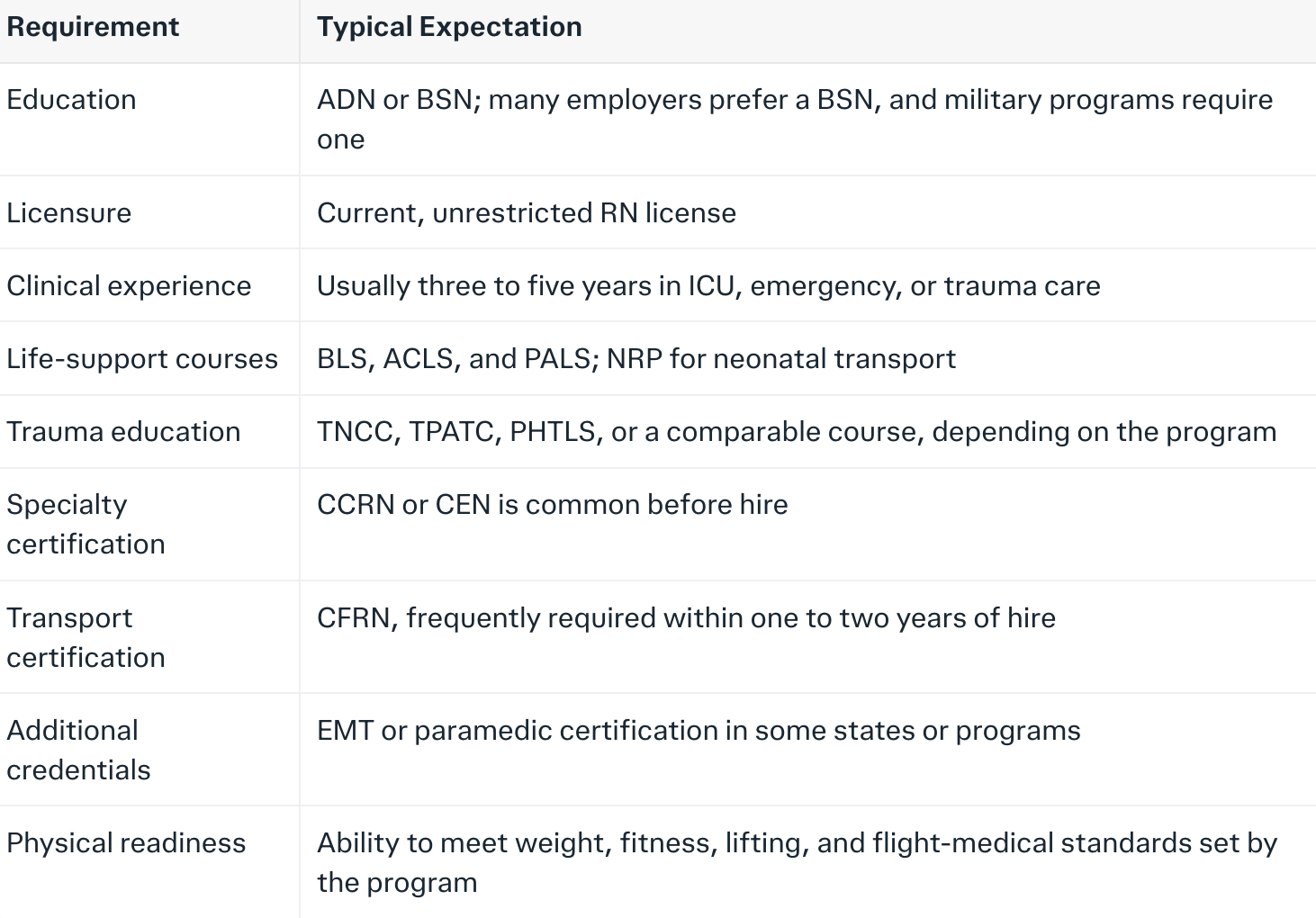
Requirements differ by employer, state, and program type, so always verify the specific job posting before investing in additional credentials.
Step 1: Earn a Nursing Degree
Every flight nurse begins as a registered nurse. According to the U.S. Bureau of Labor Statistics, aspiring RNs usually pursue one of three education paths: a Bachelor of Science in Nursing (BSN), an Associate Degree in Nursing (ADN) or Associate of Science in Nursing (ASN), or a diploma from an approved nursing program. All approved programs include supervised clinical experience, along with coursework in anatomy, physiology, microbiology, and the behavioral sciences.
An ADN can qualify you for RN licensure, but the BSN is the stronger long-term choice for flight nursing. Many hospital-based and large air medical programs prefer or require a bachelor's degree, and military flight nursing requires it. Air Force, Air Force Reserve, and Air National Guard Nurse Corps entry requires a BSN from a nationally accredited program; ADN graduates without a BSN are not eligible unless they hold an accredited graduate nursing degree.
If you already hold an ADN, an RN-to-BSN program can be completed while you gain bedside experience.
Step 2: Pass the NCLEX-RN and Obtain Your License
After graduation, you must pass the National Council Licensure Examination for Registered Nurses (NCLEX-RN) and apply for licensure through your state board of nursing. State requirements vary and may include background checks, fingerprinting, and transcripts.
Your license must remain active and unencumbered throughout your career. This matters for certification as well: the Board of Certification for Emergency Nursing (BCEN) states that any active restriction, suspension, probation, or order from a nursing license authority disqualifies a candidate from sitting for or renewing a BCEN credential.
Because air medical crews frequently cross state lines, many programs also value nurses who hold multistate licensure or licenses in multiple states.
Step 3: Build Critical Care or Emergency Experience
Clinical experience is the most important gate in the hiring process. Most programs screen first for recent, high-acuity bedside experience rather than for certificates.
BCEN notes that nurses are typically required to have at least three to five years of bedside critical care or emergency experience before being hired as flight nurses. Professional associations offer similar guidance: the Air and Surface Transport Nurses Association (ASTNA) recommends at least two to three years of acute care, emergency, or ICU experience, while the Association of Air Medical Services (AAMS) recommends at least three years of ICU or emergency department experience.
The most valuable clinical settings include:
- Adult ICU: Experience with ventilators, vasoactive drips, invasive lines, and hemodynamic monitoring.
- Emergency department: Rapid assessment of undifferentiated patients, trauma care, and procedural skills.
- Level I or Level II trauma center: Exposure to severe multisystem injuries.
- PICU or NICU: Essential for programs that specialize in pediatric or neonatal transport.
- Ground critical care transport: A common stepping stone into flight programs.
- Rapid response or critical care float roles: Experience making independent decisions across units.
Nurses who combine both ICU and emergency experience are especially competitive, because flight work requires the speed of the ED and the sustained critical care management of the ICU.
Step 4: Complete Required Life-Support and Trauma Courses
Most flight programs expect candidates to hold current resuscitation and trauma credentials before or shortly after hire. Common requirements include:
- BLS: Basic Life Support.
- ACLS: Advanced Cardiovascular Life Support.
- PALS: Pediatric Advanced Life Support.
- NRP: Neonatal Resuscitation Program, particularly for neonatal or mixed-age transport.
- TNCC: Trauma Nursing Core Course.
- TPATC: Transport Professional Advanced Trauma Course.
- PHTLS: Prehospital Trauma Life Support.
Keep every card current. Each credential has its own renewal cycle, and a lapsed certification can delay a job offer or remove you from the schedule.
Step 5: Earn Specialty Nursing Certifications
Before applying to flight programs, many nurses earn a specialty certification that validates their bedside expertise. The two most common are:
- CCRN (Critical Care Registered Nurse): Offered by the AACN Certification Corporation for critical care nurses.
- CEN (Certified Emergency Nurse): Offered by BCEN for emergency nurses.
These certifications are not always mandatory before hire, but they demonstrate clinical depth and help your application stand out in a competitive field.
Step 6: Understand the CFRN Certification
The Certified Flight Registered Nurse (CFRN) credential, offered by BCEN, is the primary specialty certification for flight nurses. It was introduced in 1993 and meets the certification requirements of the Commission on Accreditation of Medical Transport Systems (CAMTS).
CFRN eligibility
To sit for the exam, you must hold a current, unencumbered RN license in the United States, a U.S. territory, Canada, or Australia, or a verified foreign equivalent. BCEN recommends at least two years of experience in the specialty area before testing, but this experience is not required.
CFRN exam content
The CFRN content outline includes General Principles of Flight Transport Nursing Practice, which covers transport physiology, scene operations management, communications, safety and survival, disaster management, and professional issues. Additional domains include resuscitation principles, trauma, medical emergencies, and special populations.
The exam is delivered by computer at PSI testing centers or through Live Remote Proctoring. It contains 150 scored questions and has a three-hour time limit. BCEN has also announced an updated passing score of 102 out of 150 questions, effective August 31, 2026.
CFRN cost
BCEN lists the initial CFRN exam fee at $380, or $285 for ASTNA members. Active-duty service members, reservists, and veterans qualify for a reduced fee of $195. Retests submitted within one year of the initial exam cost $200, and an optional BCEN Test Assurance package allows a second attempt.
Why timing matters
CAMTS-accredited programs require nurses to hold a transport-specific board certification within two years of hire, with the CFRN preferred for flight nurses who treat patients of all ages. Some employers set a shorter timeline; for example, some programs expect new hires to earn the CFRN within 12 months.
The certification is valid for four years and can be renewed through continuing education or by retaking the exam.
Step 7: Consider EMT or Paramedic Credentials
Some states and programs require flight nurses to also hold EMT or paramedic certification, particularly when the nurse provides prehospital scene care. This requirement is not universal. Before enrolling in an EMT or paramedic course, confirm the requirements of the programs and states where you intend to work.
Step 8: Prepare for the Physical and Operational Demands
Flight nursing is physically demanding. Crews lift and move patients in confined spaces, work long shifts, wear flight suits and helmets, and must remain alert in noisy, vibrating, and sometimes turbulent environments. Many programs set weight limits because aircraft performance depends on total payload, and many require candidates to pass physical agility assessments.
Military programs add formal flight medical standards. For example, a New York Air National Guard flight nurse vacancy lists requirements that include a Class 3 flight physical, Air Force fitness standards, height limits, correctable vision, and a background investigation.
Once hired, new flight nurses complete an orientation that typically includes:
- Aircraft familiarization and safety procedures.
- Flight physiology and altitude effects.
- Hot and cold loading of patients.
- Radio communication and crew resource management.
- Emergency egress and survival training.
- Program-specific clinical protocols and supervised precepted flights.
Civilian and Military Flight Nursing Paths
Civilian programs
Civilian flight nurses work for hospital-based air medical programs, independent air ambulance companies, public safety agencies, and fixed-wing medical transport providers. Rotor-wing programs often focus on scene calls and regional transfers, while fixed-wing programs handle long-distance and international patient transport.
If you are curious about how rotor-wing and fixed-wing operations differ from an aviation perspective, read our guide on how to choose between a fixed-wing and rotor-wing pilot career.
Military programs
The U.S. Air Force, Air Force Reserve, and Air National Guard train flight nurses for aeromedical evacuation missions. Air Force nurse candidates must be U.S. citizens between the ages of 18 and 47, hold a BSN or MSN from an accredited school, maintain an active RN license, and complete Officer Training School. The Air Force Flight Nurse course covers altitude physiology, stresses of flight, in-flight nursing care, patient safety, medical equipment, aircraft configurations, and crew resource management.
Veterans transitioning out of military aviation or medical roles can use our military-to-civilian aviation career transition guide to plan their next move.
How Much Do Flight Nurses Earn?
The Bureau of Labor Statistics does not publish separate wage data for flight nurses, so the registered nurse category is the most reliable official benchmark. The median annual wage for registered nurses was $97,550 in May 2025, or $46.90 per hour. The lowest 10 percent earned less than $68,940, and the highest 10 percent earned more than $137,470.
Flight nurse pay can be higher than general RN pay because of specialty differentials, shift structures, overtime, and the advanced credentials the role demands. However, actual compensation varies widely by region, employer type, experience, and schedule. Third-party salary estimates differ significantly, so treat them as general indicators rather than guarantees.
For broader aviation compensation trends, explore the AllAviationJob.com Salary Report.
Job Outlook
Demand for registered nurses remains strong. The Bureau of Labor Statistics projects RN employment to grow 6 percent from 2025 to 2035, faster than the average for all occupations, with about 180,800 openings each year on average. Many of those openings will result from nurses retiring or changing occupations.
Flight nursing remains a smaller and more competitive specialty, so openings at individual programs can be limited. Nurses who have strong critical care experience, current certifications, and flexibility on location typically have the best chance of being hired.
Long-Term Flight Nurse Career Path
Flight nursing can lead to a variety of advanced roles:
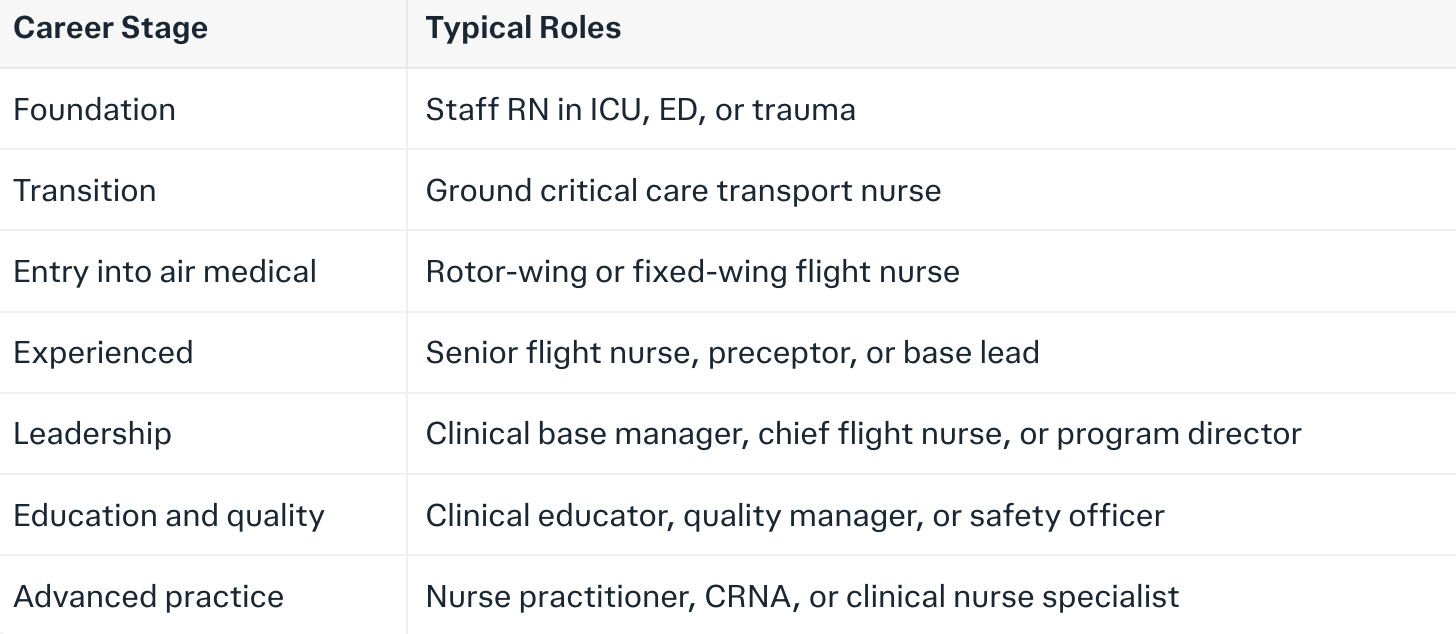
Many flight nurses also pursue a Master of Science in Nursing (MSN) to move into leadership, education, or advanced practice.
How Long Does It Take to Become a Flight Nurse?
A realistic timeline looks like this:
- Nursing school: Two to four years, depending on whether you pursue an ADN or BSN.
- Licensure: Several weeks to a few months to pass the NCLEX-RN and receive your license.
- Critical care experience: Three to five years for most programs.
- Certifications: Ongoing during your bedside career, with the CFRN often earned within one to two years of hire.
In total, most nurses should expect a journey of six years or more from the first day of nursing school to a competitive flight nursing application.
Tips for Standing Out as a Flight Nurse Candidate
- Choose high-acuity units early. The type of experience matters as much as the number of years.
- Gain both ICU and ED exposure. Cross-training or float roles can strengthen your profile.
- Earn the CCRN or CEN before applying. It signals clinical depth to hiring managers.
- Study for the CFRN early. Even if it is not required before hire, preparation builds knowledge you will use in interviews.
- Shadow or ride along with a transport team. Many programs value candidates who understand the realities of the job.
- Keep your resume focused. Highlight high-acuity patient populations, procedures, and certifications. Use the free AllAviationJob.com resume templates or the OSI Recruit free resume samples to get started.
- Prepare for scenario-based interviews. Air medical interviews often include clinical scenarios, skills testing, and safety questions. Review the OSI Recruit interview prep tips before your interview.
Work With a Specialized Recruiter
Flight nursing sits at the intersection of healthcare and aviation, and few recruiters understand both. OSI Recruit's medical recruitment services help connect qualified healthcare professionals with employers, while its aviation recruitment team supports operators across the aviation industry. Job seekers can learn more on the OSI Recruit job seekers page.
Air medical operators and hospital transport programs that need help hiring clinical or aviation staff can contact OSI Recruit to discuss their staffing needs.
Ready to Take Your Career to New Heights?
You have the clinical skills. Now, put them where they matter most: in the air. AllAviationJob.com connects nurses, pilots, mechanics, and aviation professionals with employers who are actively hiring.
- Create your free job seeker profile so employers can find you.
- Browse current aviation jobs and set your sights on your next opportunity.
- Explore hiring companies to research operators, programs, and employers.
- Read more career guides on the AllAviationJob.com blog to keep building your aviation career knowledge.
Do not wait for the right opportunity to find you. Register on AllAviationJob.com today and take the first step toward your future as a flight nurse.
Employers looking to reach qualified aviation and air medical candidates can also post a job on AllAviationJob.com.
Frequently Asked Questions
Do I need a BSN to become a flight nurse?
Not always. Many civilian programs accept an ADN with strong experience, although a BSN is often preferred. Military flight nursing requires a BSN.
Can I become a flight nurse as a new graduate?
Generally, no. Most programs require three to five years of critical care or emergency experience.
Is the CFRN required before I apply?
Usually not. Many programs hire experienced ICU or ED nurses and require the CFRN within one to two years of hire.
Do flight nurses need to be paramedics?
Only in some states and programs. Confirm requirements with the specific employer before pursuing paramedic training.
How often must the CFRN be renewed?
The CFRN is valid for four years and can be renewed through continuing education or by retaking the exam.
Sources
- Board of Certification for Emergency Nursing (BCEN). "CFRN Certification." https://bcen.org/cfrn/
- BCEN. "Certified Flight Registered Nurse Program Overview." https://bcen.org/cfrn/program-overview/
- BCEN. "CFRN Eligibility." https://bcen.org/cfrn/eligibility/
- BCEN. "The CFRN Certification Process." https://bcen.org/cfrn/the-certification-process/
- BCEN. "About the CFRN Exam." https://bcen.org/cfrn/about-the-exam/
- BCEN. "The Cost of a CFRN Certification." https://bcen.org/cfrn/cost/
- BCEN. "Evolving Excellence: Updating the CFRN Exam." https://bcen.org/blog/evolving-excellence-updating-the-cfrn-exam/
- BCEN. "Role Study Highlights Aspects of Two Emergency Nursing Specialties." https://bcen.org/news-releases/cfrn-and-ctrn-content-outlines-separats/
- BCEN. "Excellence in the Air: The Certified Flight Registered Nurse (CFRN)." https://bcen.org/wp-content/uploads/2026/02/CFRN-Commitment-to-Excellence.pdf
- U.S. Bureau of Labor Statistics. "Registered Nurses: Occupational Outlook Handbook." https://www.bls.gov/ooh/healthcare/registered-nurses.htm
- Commission on Accreditation of Medical Transport Systems (CAMTS). "Standards." https://www.camts.org/standards
- Air Force Reserve Command. "Flight Nurses: Saving Lives at 30,000 Feet." https://www.afrc.af.mil/News/Features/Display/Article/3764194/flight-nurses-saving-lives-at-30000-feet/
- U.S. Air Force Accessions Center. "Nurse Specialties." https://www.afaccessionscenter.af.mil/Portals/78/HP%2023-029%20Nurse%20Brochure%20Digital.pdf
- Air Force Research Laboratory. "USAFSAM – Aeromedical Evacuation." https://www.afrl.af.mil/About-Us/Fact-Sheets/Fact-Sheet-Display/Article/2354520/usafsam-aeromedical-evacuation/
- New York Division of Military and Naval Affairs. "Traditional Guard Officer Vacancy Announcement: Flight Nurse." https://dmna.ny.gov/jobs/traditional/1785247064-nyang-A2406__Flight_Nurse_AES.pdf
- Nursing CE Central. "All About Flight Nursing." https://nursingcecentral.com/lessons/all-about-flight-nursing/
- NursingSchools.com. "Flight Nurse Career Guide: Education, Duties & Salary." https://www.nursingschools.com/careers/flight-nurse
- NursingFloor. "How to Become a Flight Nurse: Requirements and Salary." https://nursingfloor.com/career-paths/flight-nurse
- RenewRN. "How to Become a Flight Nurse." https://www.renewrn.net/careers/flight-nurse
- American College of Education. "Flight Nurse Career Guide." https://ace.edu/student-success/career-guides/flight-nurse/