Every aspiring professional pilot eventually faces a defining question: airplanes or helicopters? Both paths lead to rewarding, well-paid careers, but they differ in almost every practical way: how much the training costs, how many hours you need before employers will hire you, what your first job looks like, how you spend your workday, and where your career can take you after ten or twenty years.
This guide breaks down the fixed-wing (airplane) and rotor-wing (helicopter) career paths side by side, using FAA regulations, federal labor data and current industry information. Whether you are a student pilot, a career changer or a military aviator planning your next step, the goal is to help you make an informed decision rather than an emotional one.
If you already know which direction you are leaning, you can browse current pilot jobs on AllAviationJob.com to see what employers in each sector are asking for right now.
Understanding the Two Career Paths
Fixed-wing pilots fly airplanes: anything from single-engine piston trainers to regional jets, widebody airliners, cargo freighters and business jets. The fixed-wing world is dominated by scheduled airline flying (Part 121), along with charter (Part 135), corporate flight departments (Part 91), cargo, flight instruction, aerial survey and government work.
Rotor-wing pilots fly helicopters, which can take off and land vertically, hover and operate from rooftops, ships, offshore platforms, remote clearings and accident scenes. Helicopter careers are built around missions: air medical transport, offshore energy support, law enforcement, firefighting, utility and power-line work, tours, electronic news gathering and VIP transport.
The U.S. Bureau of Labor Statistics groups both under airline and commercial pilots and notes that helicopter pilots in rescue operations may fly at low levels in bad weather or at night, and land in areas surrounded by power lines, highways and other obstacles. That single description captures a key difference: helicopter flying is often less about getting from point A to point B and more about completing a demanding task once you arrive.
Training Requirements: What the FAA Requires
Both paths start with the same certificate sequence: student pilot, private pilot, instrument rating and commercial pilot certificate. The commercial certificate is the minimum credential to be paid to fly, but the hour requirements differ.
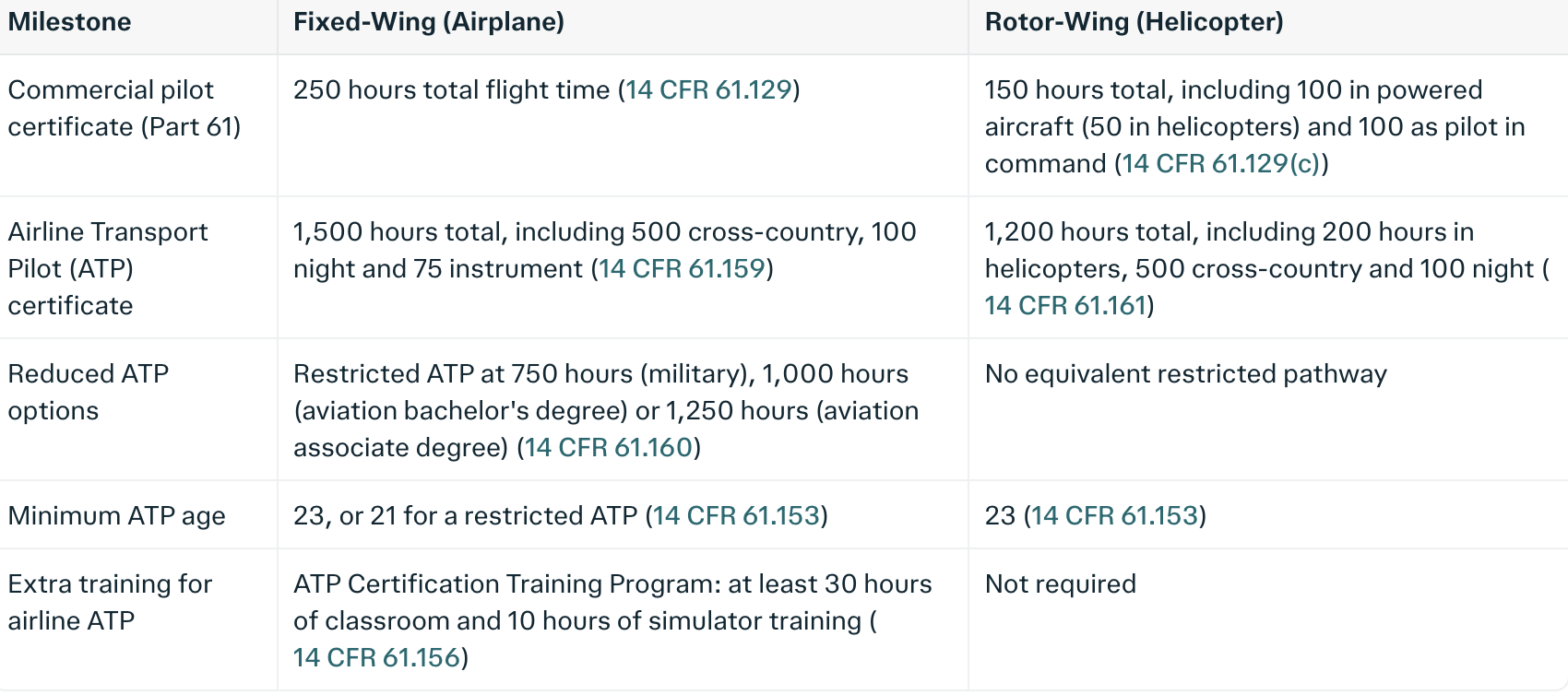
A practical point many students overlook: the hours you log in one category can partly count toward the other. For a commercial helicopter certificate, the 100 hours of powered-aircraft time can include airplane time, although at least 50 hours must still be in helicopters, as Superprof's 2026 cost analysis explains. That makes a later "add-on" rating more realistic than many people assume.
Medical Certification
Both paths require a medical certificate. Commercial pilot privileges require at least a second-class medical, while serving as pilot in command under Part 121 airline operations requires a first-class medical, according to 14 CFR 61.23. Before investing tens of thousands of dollars in training, get a first-class medical exam. For more detail, read our guide to aviation medical certificates and what pilots need to know when job hunting.
Cost of Training: Helicopters Cost More per Hour
Helicopter training is generally more expensive per flight hour because rotorcraft cost more to operate, maintain and insure. Pilot Institute puts a typical airplane training hour at $150 to $200, compared with $350 to $450 for a Robinson R22, and estimates $70,000 to $95,000 to go from zero experience to a helicopter flight instructor certificate.
A useful comparison comes from a single school that trains in both categories. Using Hillsboro Aero Academy's published prices, Superprof reported:
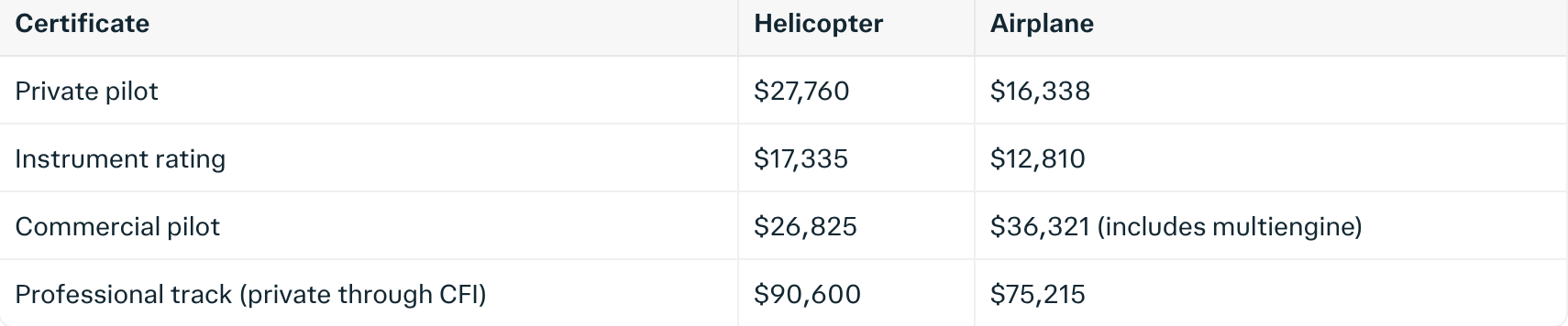
The private certificate shows the largest gap. Because the commercial helicopter certificate requires fewer total hours, the full professional track is about 20 percent more expensive for helicopters rather than double, as Superprof noted.
What this means for you: Do not compare only the cost of the certificates. Compare the total cost of getting to your first job that pays a living wage. Fixed-wing pilots usually need roughly 1,500 hours for an airline job, while many helicopter pilots reach well-paying turbine jobs at 1,000 to 2,000 hours, though helicopter time-building flights cost more if you pay for them yourself.
Before enrolling, compare programs in the AllAviationJob.com flight school directory and the aviation school directory.
Building Hours: The First Jobs After Training
Earning a commercial certificate does not make you immediately competitive for top jobs. Both paths have an "hours gap" that must be closed, and how you close it shapes your early career.
Fixed-Wing Time-Building
Most new airplane pilots become Certified Flight Instructors (CFIs) and teach until they reach airline minimums. Other common time-building jobs include banner towing, pipeline patrol, skydiving operations, aerial survey and Part 135 freight. We cover these options in the best ways to build flight time after earning your commercial certificate and from flight school to first job: a roadmap for new commercial pilots. If aerial work interests you, see our guide to aerial survey pilot jobs.
Rotor-Wing Time-Building
Helicopter pilots also usually begin as flight instructors, but with an important regulatory wrinkle. Under SFAR 73, anyone who instructs in a Robinson R22 or R44 must have at least 200 hours of helicopter flight time and at least 50 hours in the specific Robinson model, as Pilot Institute explains. Because most training helicopters are Robinsons, many students plan their training to graduate at or near 200 hours.
After instructing, tour flying is a common next step. Tour pilots often log 300 to 600 or more hours per year, which can shorten the path to EMS or offshore minimums, according to Pilot Institute's helicopter salary guide. From there, pilots move into utility, law enforcement, offshore and air medical roles. For a detailed breakdown, read helicopter pilot careers: jobs, qualifications and hiring paths and how many flight hours you need for different pilot jobs.
Commercial Operations Minimums
For both categories, Part 135 on-demand and commuter operations set clear pilot-in-command thresholds. Under 14 CFR 135.243, a VFR pilot in command needs at least 500 hours, including 100 hours of cross-country time (25 at night), and an IFR pilot in command needs at least 1,200 hours, including 500 cross-country, 100 night and 75 instrument hours. Helicopter air ambulance pilots in command must meet those 135.243 requirements and hold a helicopter instrument rating or an ATP certificate not limited to VFR, according to 14 CFR 135.603. Learn more in Part 91 vs. Part 135 pilot jobs: key career differences and what is a PIC job.
Career Destinations and Pay
Fixed-Wing Destinations
- Regional airlines: The traditional entry point into airline flying. See regional airline pilot jobs: what to expect before you apply.
- Major and cargo airlines: The highest-paid positions in civil aviation, with seniority-driven pay, schedules and aircraft choice.
- Corporate and private aviation: Flight departments and charter operators flying business jets. Read corporate pilot vs. airline pilot and how to get a job in private aviation and corporate flight departments.
- Other paths: Instruction, test flying, government and special-mission work. See the best aviation career paths beyond airline pilot jobs.
Rotor-Wing Destinations
- Helicopter emergency medical services (HEMS): One of the most in-demand helicopter sectors. Typical minimums are about 2,000 total hours and 1,500 helicopter hours, with IFR currency often required, according to 3G Helicopter Prep.
- Offshore oil and gas: Requires turbine and multi-engine experience and strong IFR skills, often on a rotational 14-days-on, 14-days-off schedule, as described by 3G Helicopter Prep.
- Tours, utility, law enforcement, firefighting and news gathering: Mission-driven work that rewards precision, local knowledge and low-level flying skill.
- Corporate and VIP transport: Twin-engine helicopters serving executives and high-net-worth clients, frequently in major metropolitan areas.
What the Pay Data Shows
According to the Bureau of Labor Statistics, the May 2025 median annual wage was $232,140 for airline pilots, copilots and flight engineers, and $123,220 for commercial pilots. Commercial pilots include most helicopter pilots, as well as charter, corporate and other non-airline airplane pilots.
The key insight is that the highest pay ceiling in civil aviation is found at major airlines, which fly fixed-wing aircraft. Helicopter pay is solid and grows with experience; Pilot Institute estimates that entry-level CFIs and tour pilots earn about $25,000 to $65,000 per year, with higher pay in EMS, offshore and other senior roles. If maximizing lifetime earnings is your primary goal, the fixed-wing airline path generally offers the greater upside. For current market data, view the AllAviationJob.com salary report.
Job Market and Long-Term Demand
The BLS projects employment of airline and commercial pilots to grow 7 percent from 2025 to 2035, with about 16,400 openings per year on average, many of them created by retirements (BLS). Within that, airline pilot jobs are projected to grow 8 percent and commercial pilot jobs 5 percent over the same decade.
On the fixed-wing side, Boeing's 2026 Pilot and Technician Outlook projects a need for 674,000 new commercial airline pilots worldwide through 2045. North America alone accounts for 122,000 of them, according to AVweb, which also notes that the forecast excludes business aviation and civil helicopters.
The helicopter market is much smaller in raw numbers, but demand is concentrated in specialized, experience-heavy sectors. HeliOps Magazine cites a Vertical Aviation International (VAI) estimate that a wave of retirements could contribute to a global shortage of nearly 61,000 helicopter pilots by 2038, with air medical and offshore energy among the main drivers. Industry observers also stress that the shortage is mainly for experienced pilots with roughly 1,500 to 2,000 hours, not for newly certificated graduates (Dubois Aviation).
Bottom line: Fixed-wing offers far more total openings and a well-defined airline pipeline. Rotor-wing offers fewer but highly specialized openings, with strong demand once you have the experience employers require.
Lifestyle and Day-to-Day Work
Pay and demand matter, but daily life is what determines whether you will enjoy the career for decades.
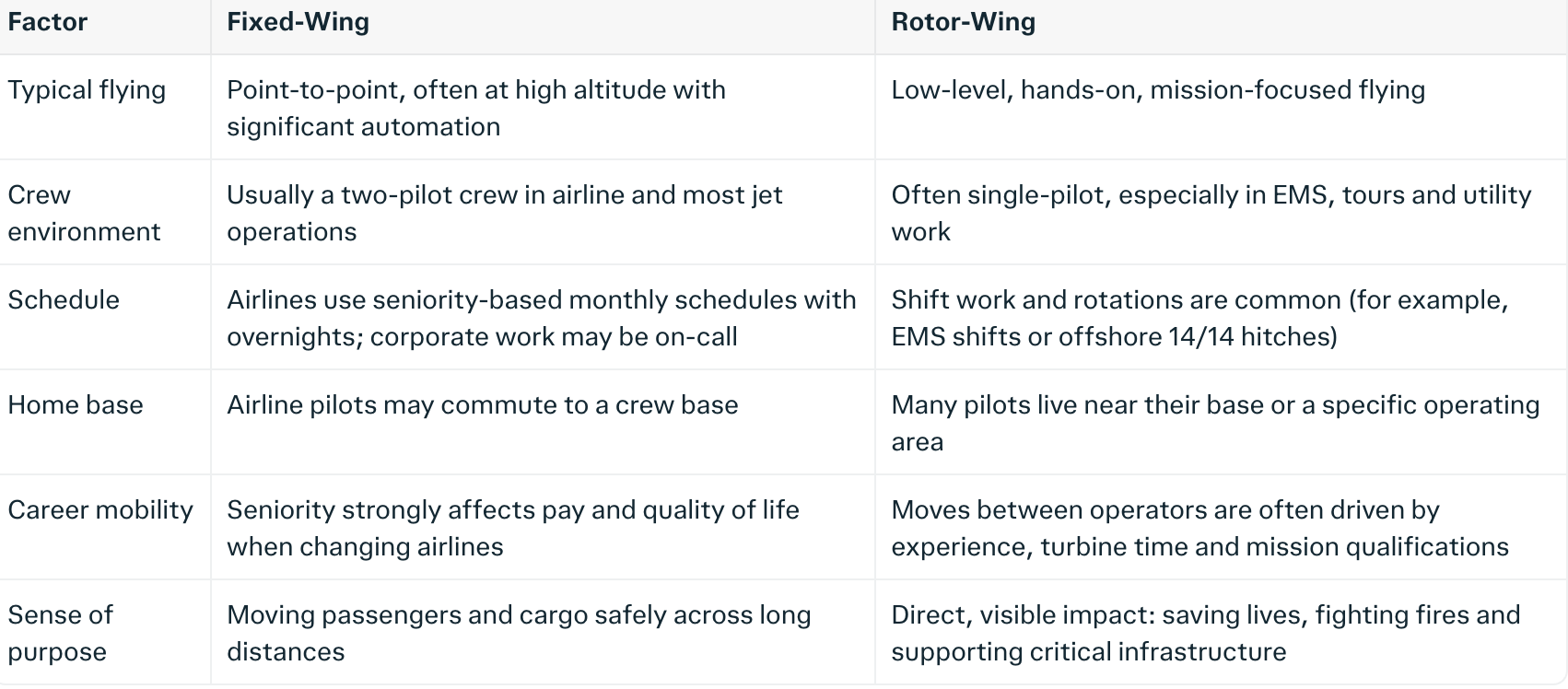
Neither column is better. A pilot who enjoys systems management, long flights and the structure of an airline will thrive in a fixed-wing career. A pilot who wants variety, precision flying and a direct connection to the mission may find rotor-wing work more fulfilling.
A Note for Military Aviators
Military pilots have unique advantages. Fixed-wing military pilots can qualify for a restricted ATP certificate with as few as 750 hours under 14 CFR 61.160. Military helicopter pilots often enter civilian roles with turbine, night-vision and instrument experience that EMS, law enforcement and offshore operators value highly. Our guide to how military veterans can launch civilian aviation careers covers this transition step by step.
Seven Questions to Help You Decide
Ask yourself these questions honestly before committing your money and time:
- What kind of flying excites you? Long-distance travel and complex jets, or hovering, precision landings and mission work?
- What is your realistic training budget? Helicopter training generally costs more per hour. Can you finance the full path to your first paying job, not just the certificates?
- How important is maximum earning potential? Major airlines offer the highest pay ceiling in civil aviation.
- Do you prefer working in a crew or alone? Airline flying is crew-based; much helicopter work is single-pilot.
- Where do you want to live? Helicopter jobs are often tied to specific regions, such as offshore hubs, tour destinations and hospital bases. Airline pilots may commute.
- What schedule fits your life? Seniority-based airline lines, on-call corporate work, or shift and rotational helicopter schedules.
- Have you flown both? Take a discovery flight in an airplane and a helicopter before deciding. The difference in how each one feels is often the deciding factor.
Can You Switch Later?
Yes, and many pilots do. Helicopter pilots sometimes add fixed-wing ratings to pursue airline careers, and airplane pilots add helicopter ratings to move into EMS or utility flying. Because some flight time can transfer toward certain requirements, an add-on rating costs less than starting over. However, employers hire for experience in the specific category and mission, so switching later in a career usually means rebuilding category-specific time. If you think you may eventually want both, plan your training path deliberately.
How to Position Yourself With Employers
Whichever path you choose, employers look for the same core qualities: a clean safety record, well-documented logbooks, current certificates and medicals, professionalism and strong decision-making. To stand out:
- Build a targeted resume with tips from how to build an aviation resume with limited flight experience and the free resume samples from OSI Recruit.
- Prepare for technical questions and simulator evaluations with pilot interview questions and how to answer them, how to prepare for a pilot simulator interview and OSI Recruit's interview prep tips.
- Plan your turbine transition with how to land your first turbine pilot job.
- Match openings to your exact qualifications using how to find aviation jobs that match your license, ratings and experience.
- Network consistently; read why pilot networking still matters.
Experienced pilots seeking guidance on placement can also connect with the aviation recruiters at OSI Recruit for job seekers. Operators looking to hire fixed-wing or rotor-wing pilots can learn about OSI Recruit's aviation recruitment services.
Final Thoughts
There is no universally "better" choice between fixed-wing and rotor-wing flying. The fixed-wing path offers more job openings, a clear airline pipeline and the highest pay ceiling in civil aviation. The rotor-wing path offers mission-driven, hands-on flying, a lower commercial-certificate hour requirement and strong demand for experienced pilots in specialized sectors. The right choice depends on your budget, goals, lifestyle preferences and the kind of flying that keeps you motivated year after year.
Make the decision with clear information, fly both aircraft types if you can, and build a plan that reaches all the way to your first career job, not just your next checkride.
Start Your Pilot Career With AllAviationJob.com
Airplane or helicopter, your next pilot job starts here. AllAviationJob.com connects pilots with airlines, charter operators, corporate flight departments, air medical providers and helicopter operators across the aviation industry, with hundreds of active pilot listings at any given time.
- Browse current pilot jobs for fixed-wing and rotor-wing openings, from first officer and CFI roles to captain and IFR helicopter positions.
- Create your free job seeker profile so employers can find you based on your certificates, ratings and flight hours.
- Explore flight department jobs and research hiring companies to target the operators that fit your goals.
Do not wait until you reach your hour minimums to get noticed. Register on AllAviationJob.com today, set up your profile and put your pilot career on the right flight path.
Sources
- U.S. Bureau of Labor Statistics, "Airline and Commercial Pilots," Occupational Outlook Handbook: https://www.bls.gov/ooh/transportation-and-material-moving/airline-and-commercial-pilots.htm
- Electronic Code of Federal Regulations, 14 CFR 61.129, "Aeronautical Experience" (Commercial Pilots): https://www.ecfr.gov/current/title-14/chapter-I/subchapter-D/part-61/subpart-F/section-61.129
- Electronic Code of Federal Regulations, 14 CFR Part 61 Subpart G, "Airline Transport Pilots" (61.153, 61.156, 61.159, 61.160, 61.161): https://www.ecfr.gov/current/title-14/chapter-I/subchapter-D/part-61/subpart-G
- Electronic Code of Federal Regulations, 14 CFR 61.23, "Medical Certificates: Requirement and Duration": https://www.ecfr.gov/current/title-14/chapter-I/subchapter-D/part-61/subpart-A/section-61.23
- Cornell Law School Legal Information Institute, 14 CFR 135.243, "Pilot in Command Qualifications": https://www.law.cornell.edu/cfr/text/14/135.243
- Electronic Code of Federal Regulations, 14 CFR 135.603, "Pilot-in-Command Instrument Qualifications": https://www.ecfr.gov/current/title-14/chapter-I/subchapter-G/part-135/subpart-L/section-135.603
- Boeing, "Pilot and Technician Outlook 2026–2045": https://www.boeing.com/commercial/market/pilot-technician-outlook
- AVweb, "Boeing Forecasts Need for 674,000 New Pilots": https://avweb.com/air-shows-events/airventure/boeing-2026-pilot-technician-outlook/
- Pilot Institute, "How Much Does It Cost to Become a Helicopter Pilot?": https://pilotinstitute.com/helicopter-pilot-costs/
- Pilot Institute, "Helicopter Pilot Salary Guide": https://pilotinstitute.com/helicopter-pilot-salary/
- Superprof, "How Much Does It Cost to Get a Helicopter License?": https://www.superprof.com/blog/helicopter-pilot-training-cost/
- 3G Helicopter Prep, "Is There a Helicopter Pilot Shortage in 2026?": https://3gheliprep.com/blog/b/helicopter-pilot-shortage-2026
- HeliOps Magazine, "The Helicopter Pilot Shortage: Understanding the Causes and Crafting Solutions": https://www.heliopsmag.com/heliops/articles/the-helicopter-pilot-shortage-understanding-the-causes-and-crafting-solutions/
- Dubois Aviation, "Is Becoming a Helicopter Pilot Worth It in 2026?": https://duboisaviation.com/is-becoming-a-helicopter-pilot-worth-it/