Every airline pilot, from a new-hire first officer to a 30-year captain, goes back to training on a regular schedule. Behind every initial type rating, upgrade course, recurrent check and simulator session stands an instructor pilot. These professionals turn regulations, procedures and aircraft systems into safe, repeatable crew performance.
For many experienced pilots, becoming an airline instructor pilot is a natural next step. It rewards technical depth, communication skill and a strong safety mindset. It can also offer a different schedule from line flying, a way to influence an airline's safety culture, and, for some pilots, a long second career in the simulator.
This guide explains what airline instructor pilots do, which FAA regulations apply, what employers ask for, and the practical steps that move a pilot from the line to the training center.
What Is an Airline Instructor Pilot?
"Airline instructor pilot" is a broad term. In practice, it covers several related roles, and the requirements differ for each one.
Flight Instructor (Airplane)
Under the FAA's airline training rules, a flight instructor (airplane) is "a person who is qualified to instruct in an airplane for a particular type airplane" (14 CFR § 121.412). These instructors are typically line-qualified pilots who can train crews in the actual aircraft and in simulators.
Flight Instructor (FSTD), or Simulator Instructor
A flight instructor (FSTD) is qualified to instruct only in a flight simulation training device for a particular airplane type (14 CFR § 121.412). "FSTD" covers full flight simulators and flight training devices. Most modern airline training, including type ratings, upgrades and recurrent events, takes place in these devices.
Check Pilot (Check Airman)
Check pilots go a step further: they conduct the flight checks that qualify other pilots. The FAA defines a check pilot (airplane) as a person who may conduct flight checks or instruction in an airplane for a particular type, and a check pilot (FSTD) as a person who does so only in an FSTD (14 CFR § 121.411). Unlike instructors, check pilots must also be approved by the FAA for the checking duties involved (14 CFR § 121.411). Many pilots move into checking after a period of instructing.
Ground and Systems Instructor
Some airline training roles focus on classroom and systems training rather than simulator flying. For example, a United Airlines Fleet Technical Instructor posting described instructing pilots on aircraft systems through classroom teaching and fixed-base flight simulation training devices, along with courseware development.
Part 142 Training Center Instructor
Not every airline instructor works for an airline. FAA-certificated Part 142 training centers, such as CAE and FlightSafety International, train airline, corporate and military crews on contract. A CAE Boeing 737 simulator and ground school instructor listing covered initial, transition, upgrade and recurrent flight training delivered under the company's Part 142 Training Center Manual.
The Regulatory Framework at a Glance
Airline instructor qualifications are set by federal regulation, then supplemented by each employer's own standards. The table below summarizes the core rules.
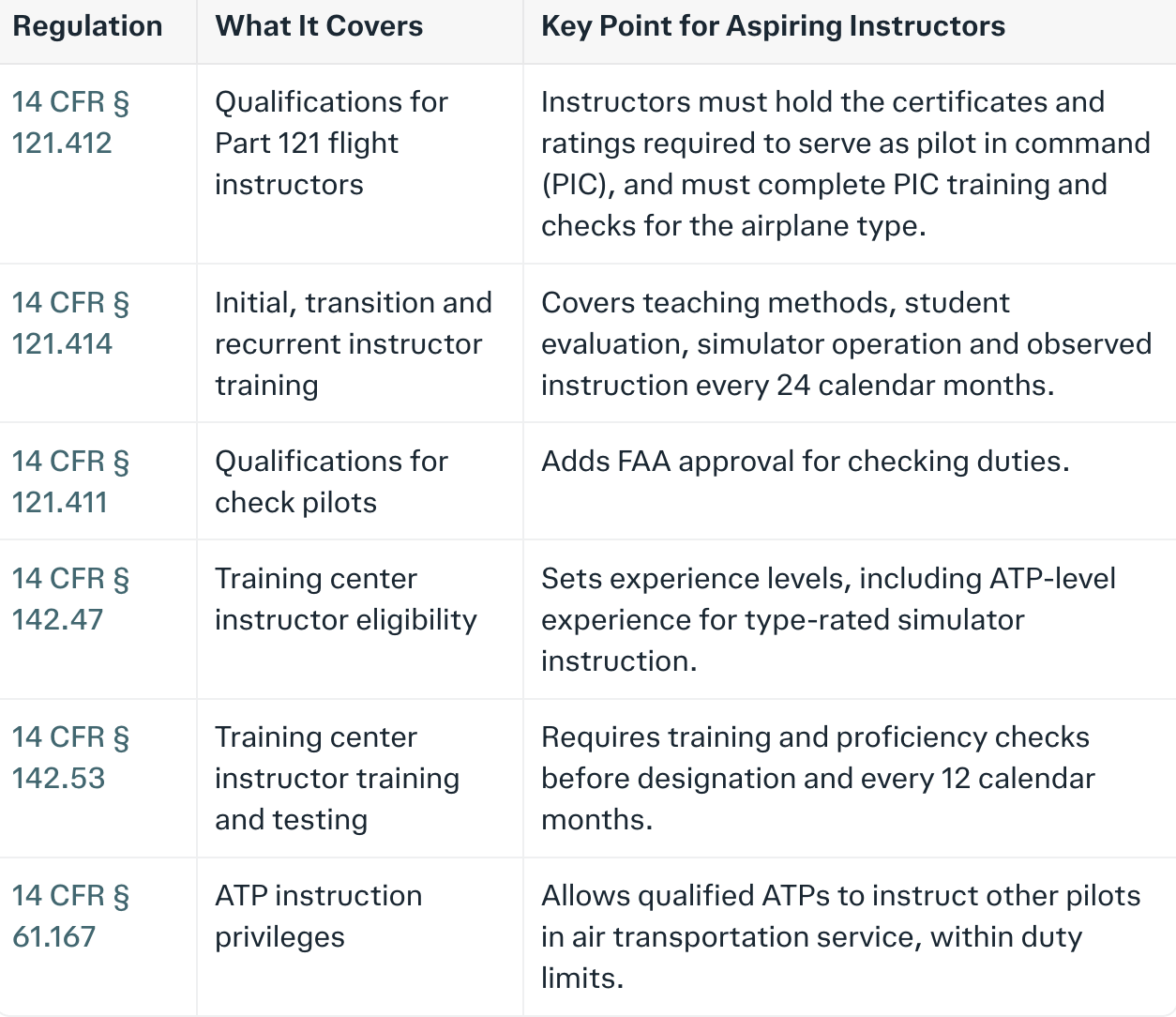
Many major airlines also train under the FAA's Advanced Qualification Program (AQP), a voluntary alternative to traditional Part 121 and Part 135 training and checking requirements. According to the FAA's AQP overview, nearly all major U.S. airlines participate, and each carrier develops its own proficiency objectives through a structured instructional systems development process. In practice, an instructor at an AQP carrier teaches and evaluates against that airline's approved curriculum.
Step 1: Build a Strong Pilot Foundation
Every path to an airline instructor role begins with a solid set of pilot certificates: private, instrument, commercial and multiengine. Most airline pilots also build hours as a certificated flight instructor (CFI) early in their careers.
To earn a CFI certificate, an applicant must be at least 18, hold a commercial or airline transport pilot certificate with the appropriate category, class and instrument privileges, pass knowledge tests on the fundamentals of instructing and the relevant aeronautical subjects, and pass a practical test (14 CFR § 61.183).
A CFI certificate is not always mandatory for Part 121 airline instruction, but it is valuable. The FAA's required initial ground training for airline flight instructors includes the teaching-learning process, teaching methods and the instructor-student relationship, except for people who already hold a flight instructor certificate (14 CFR § 121.414). In other words, the CFI background you build early in your career is recognized later.
The FAA's Aviation Instructor's Handbook is a useful study resource at any stage. Its chapters cover human behavior, the learning process, effective communication, assessment and techniques of flight instruction, all of which apply directly in an airline simulator.
If you are still building the credentials that lead to airline work, see the AllAviationJob.com guide to five certifications that can help advance your aviation career.
Step 2: Earn Your Airline Transport Pilot (ATP) Certificate
The ATP certificate is the baseline credential for almost every airline instructor role. An unrestricted ATP with an airplane category rating requires at least 1,500 hours of total time as a pilot, including 500 hours of cross-country time, 100 hours of night time, 75 hours of instrument time and 250 hours as pilot in command or qualifying second in command (14 CFR § 61.159).
Some pilots qualify earlier for a restricted-privileges ATP. Eligible military pilots may apply with as few as 750 hours, and graduates of qualifying bachelor's degree aviation programs may apply with as few as 1,000 hours (14 CFR Part 61, Subpart G). The FAA explains that a restricted ATP allows a pilot to serve as a co-pilot until reaching 1,500 hours (FAA).
For instructor roles, however, the unrestricted ATP matters. Part 142 rules require instructors teaching in simulators that represent type-rated airplanes, or in ATP curricula, to meet full ATP aeronautical experience or hold an unrestricted ATP with the appropriate ratings (14 CFR § 142.47).
For a detailed breakdown of hour requirements by job type, read How Many Flight Hours Do You Need for Different Pilot Jobs? on AllAviationJob.com.
Step 3: Gain Airline Experience and Type Ratings
Airlines want instructors who know the aircraft and the operation from the flight deck. The regulations reflect this. A Part 121 flight instructor must hold the certificates and ratings required to serve as pilot in command and must have completed the training and proficiency checks required to serve as PIC on that airplane type (14 CFR § 121.412).
Training-center employers set similar expectations in their hiring requirements:
- A FlightSafety International flight instructor listing required an unrestricted ATP (or an ICAO member-state ATPL), at least one unrestricted PIC type rating, and participation in DOT drug and alcohol testing. It listed Part 135, Part 121 or military training experience and 2,500 total hours as preferred.
- A CAE Boeing 737 instructor listing required an unrestricted FAA ATP, at least one unrestricted PIC type rating with no supervised operating experience limitations, and at least two years of Part 121 experience.
- A Southwest Airlines flight crew training instructor listing required an ATP, the ability to obtain a Boeing 737 type rating, and the ability to take part in the FAA-required line observation program. It listed experience in the 737 or other aircraft above 12,500 pounds, and prior work as a simulator instructor, flight instructor, check airman or evaluator, as preferred.
The pattern is consistent. Employers want ATP-level pilots with type-rated, multi-crew experience. Prior teaching experience helps you stand out.
Step 4: Build an Instructional Track Record
Flying skill alone does not make a strong instructor. Airlines and training centers look for pilots who can explain complex systems clearly, assess performance fairly and correct mistakes without damaging a trainee's confidence.
You can build this track record before you apply:
- Keep teaching. Continue part-time CFI or ground instruction, or volunteer for company training projects, so your instructional skills stay sharp.
- Volunteer for standards work. Take part in procedure reviews, safety committees, new-hire mentoring or courseware feedback.
- Know the regulations. Instructors must teach the applicable federal regulations along with the operator's policies and procedures (14 CFR § 121.414).
- Practice clear briefing. The United Fleet Technical Instructor posting listed public speaking and the ability to explain complex technical ideas as minimum qualifications (Indeed).
- Develop a reputation for professionalism. Instructor selection often weighs line reputation, training records and peer feedback as heavily as logbook totals.
Step 5: Apply and Complete Instructor Training
At many airlines, line-pilot instructor and check pilot roles are filled internally and may be governed by the pilot contract. Training centers and some airline training departments also hire instructors directly. Watch internal postings, training-center career pages and aviation job boards, and keep your résumé ready.
Once selected, you will complete a formal instructor qualification course. Under 14 CFR § 121.414, initial instructor ground training includes:
- Instructor duties, functions and responsibilities.
- Applicable federal regulations and company policies.
- Methods, procedures and techniques for conducting flight instruction.
- Proper evaluation of student performance, including detecting improper or insufficient training.
- Corrective action for unsatisfactory training progress.
- For simulator instructors, operation of the device's controls, environmental and fault panels, simulation limitations and minimum equipment requirements.
Flight training for airplane instructors includes practice conducting instruction from both the left and right seats, along with safety measures for emergencies likely to develop during instruction (14 CFR § 121.414).
At a Part 142 training center, new instructors must complete at least eight hours of ground training before designation. Topics include instruction methods, the learning process, simulator operation, crew resource management, and a written test of difficulty equivalent to the FAA flight instructor knowledge tests (14 CFR § 142.47). The training center must also designate each instructor in writing for each approved course (14 CFR § 142.47).
Step 6: Maintain Your Instructor Qualification
Instructor qualification is not a one-time event. Requirements continue throughout your career:
- Observed instruction. Part 121 flight instructors must, within the preceding 24 calendar months, conduct instruction while observed by an FAA inspector, an operator check pilot or another authorized evaluator (14 CFR § 121.414).
- Recurrent simulator ground training. Instructors who train in an FSTD must complete recurrent instructor ground training every 12 calendar months (14 CFR § 121.414).
- Line currency for simulator instructors. A flight instructor (FSTD) must either fly at least two flight segments as a required crewmember on the airplane type within the previous 12 months or complete an approved line-observation program (14 CFR § 121.412).
- Annual Part 142 checks. Training-center instructors must complete instructional demonstrations, training and testing before designation and every 12 calendar months, including written tests and proficiency checks in the training equipment (14 CFR § 142.53).
- Duty limits. An ATP instructing other pilots in air transportation service may not instruct for more than 8 hours in any 24 consecutive hours or 36 hours in any 7 consecutive days, excluding briefings and debriefings (14 CFR § 61.167).
Simulator Instruction as a Second Career
Airline instruction can extend a pilot's career beyond the line. Federal rules bar Part 121 carriers from using any person as a pilot on an airplane in Part 121 operations once that person reaches age 65 (14 CFR § 121.383). That limit applies to flying the airplane in Part 121 operations.
Simulator-only instructor roles have a different currency pathway. Instead of flying two segments on the type, a flight instructor (FSTD) can meet the requirement by completing an approved line-observation program (14 CFR § 121.412). Part 142 training centers likewise allow simulator instructors to meet their in-aircraft experience requirement through approved line-observation or in-flight observation programs (14 CFR § 142.53). For experienced captains, this structure can make simulator instruction a practical way to stay connected to airline flying and pass on decades of knowledge.
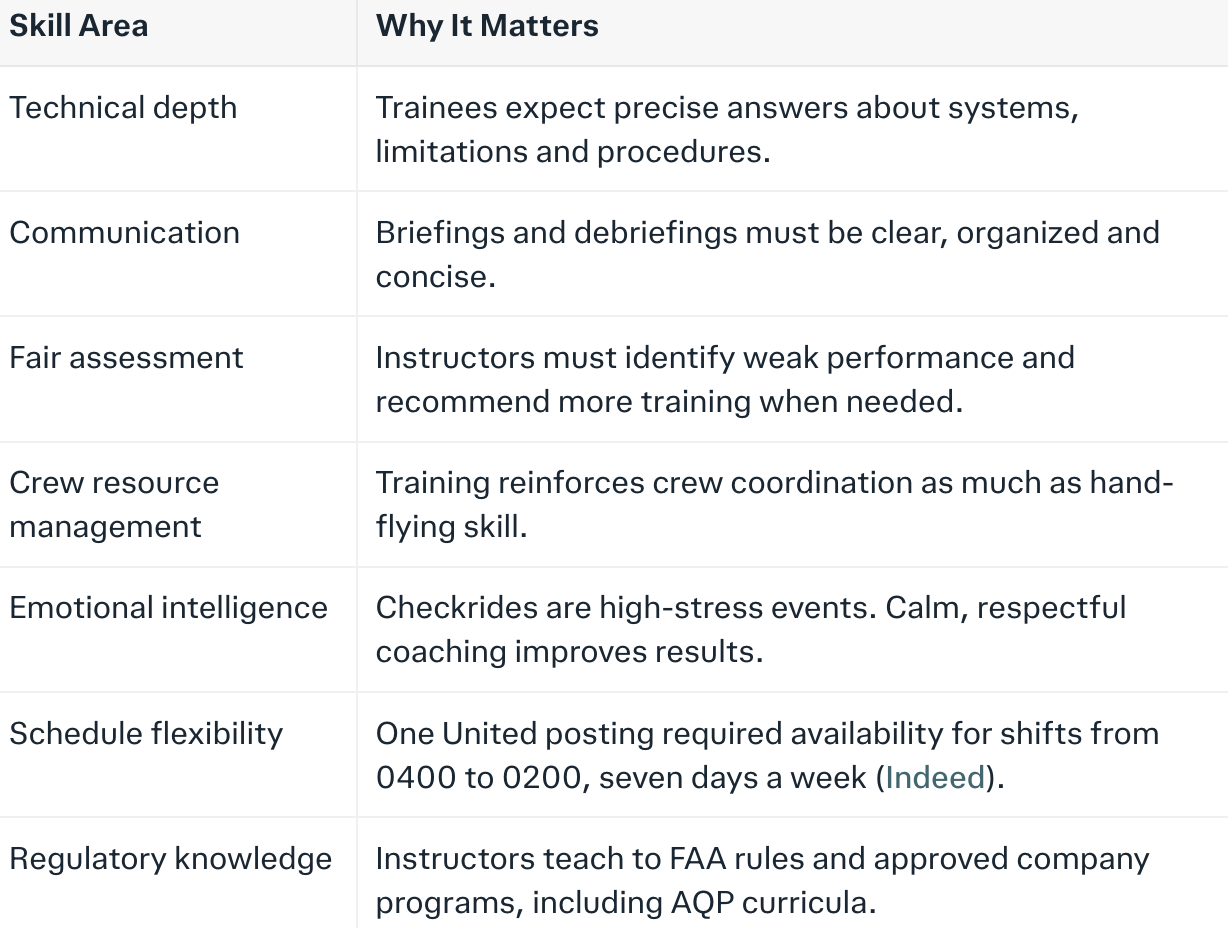
Skills That Set Top Instructor Candidates Apart
Pay and Career Outlook
Instructor pay varies widely by employer, role, aircraft type and labor agreement. Line pilots who instruct part-time often keep their line pay structure with instructor premiums or credit set by contract. Full-time simulator and ground instructors are paid salary or hourly rates set by the training department or training center.
For context, the U.S. Bureau of Labor Statistics reports a May 2025 median annual wage of $232,140 for airline pilots, copilots and flight engineers, and $123,220 for commercial pilots (BLS). BLS projects 8% employment growth for airline pilots from 2025 to 2035 and about 16,400 openings per year for airline and commercial pilots combined (BLS). Every new pilot hired needs training, and every working pilot needs recurrent training, so instruction stays central to the industry.
At the technical-instructor level, one United Airlines Fleet Technical Instructor posting listed monthly pay of $6,248.02, with benefits including a 401(k), a pension and flight privileges subject to the collective bargaining agreement (Indeed). For broader compensation benchmarks, review the AllAviationJob.com Salary Report.
Pros and Cons of Becoming an Airline Instructor Pilot
Advantages
- Direct influence on airline safety and crew standards.
- Deeper mastery of aircraft systems and procedures.
- Possible schedule variety, with more time at a training base and less overnight travel.
- Clear progression toward check pilot, standards captain or training management roles.
- A potential second career in simulator instruction.
Challenges
- Early-morning and late-night simulator periods, often on weekends.
- Ongoing recurrent training, observations and proficiency checks.
- Pay that may differ from senior line flying, depending on contract and role.
- The responsibility of recommending whether a pilot passes or needs more training.
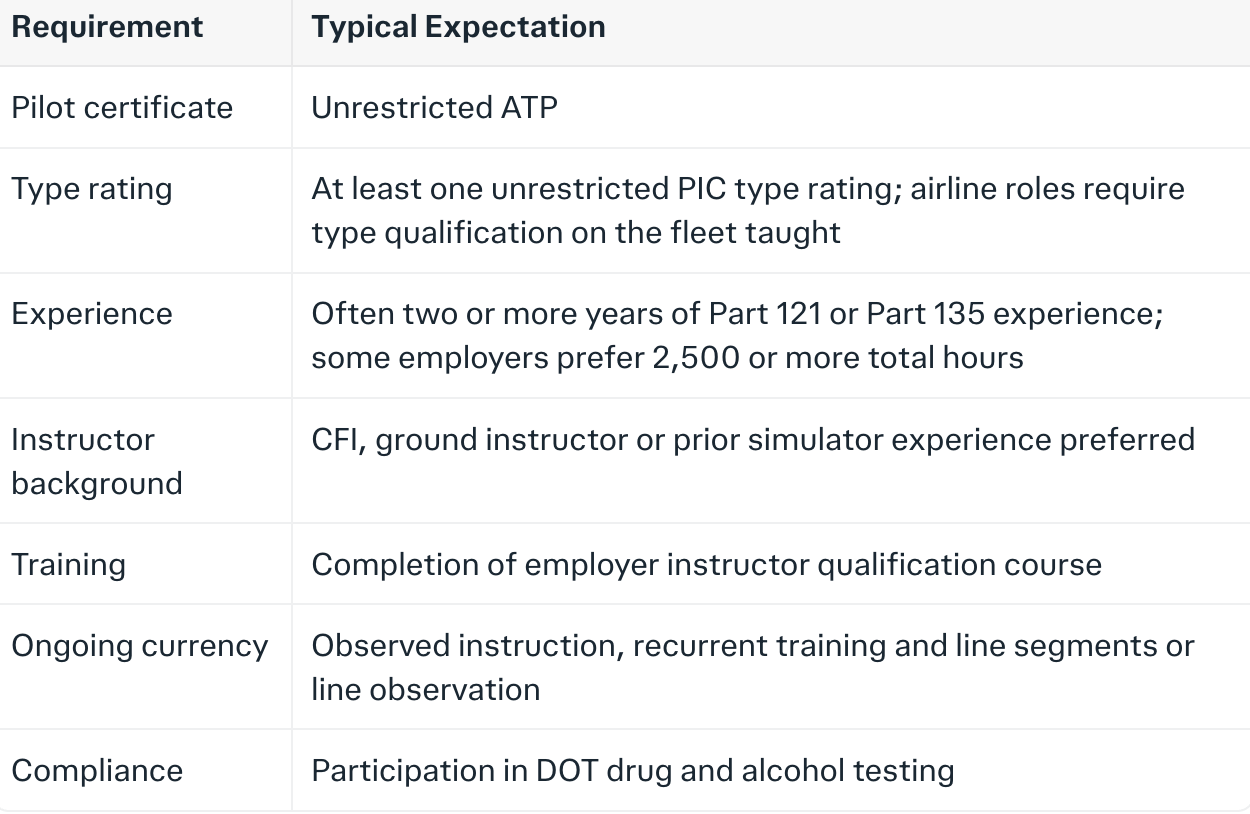
Quick Checklist: Airline Instructor Pilot Readiness
Frequently Asked Questions
Do I need a CFI certificate to become an airline instructor pilot?
Not always. Part 121 rules focus on PIC-level qualification for the airplane type plus completion of the airline's instructor training (14 CFR § 121.412). A CFI certificate is still a strong asset, and holders are exempt from certain teaching-fundamentals subjects in initial instructor ground training (14 CFR § 121.414).
How many hours do I need?
Most roles require an unrestricted ATP, which normally means at least 1,500 hours (14 CFR § 61.159). Some training centers list 2,500 total hours as preferred (FlightSafety International).
What is the difference between an instructor and a check pilot?
Instructors train. Check pilots conduct the flight checks that qualify pilots, and they must be approved by the FAA for those duties (14 CFR § 121.411).
Can I work as a simulator instructor without flying the line?
Yes, in many cases. A flight instructor (FSTD) can meet currency through an approved line-observation program instead of flying segments (14 CFR § 121.412). Part 142 training centers employ dedicated simulator instructors under their own approved programs (14 CFR § 142.47).
Where can I find airline instructor pilot jobs?
Check airline training department postings, Part 142 training center career pages and aviation job boards. Start with pilot jobs on AllAviationJob.com, or search all aviation jobs by keyword, such as "simulator instructor" or "check airman."
Prepare Your Application
Instructor hiring panels expect a polished résumé and a confident interview that shows both flying expertise and teaching ability.
- Use the AllAviationJob.com résumé templates or the free résumé samples from OSI Recruit to present your type ratings, Part 121 or Part 135 experience and instructional history clearly.
- Review the interview preparation tips from OSI Recruit before panel interviews and technical evaluations.
- Explore OSI Recruit's job-seeker resources for additional career support.
- If you are transitioning from military aviation, read How Military Veterans Can Launch Civilian Aviation Careers.
For airlines, training centers and flight departments: If you need qualified instructor pilots, check airmen or type-rated crew, OSI Recruit's aviation recruitment services help employers find and screen aviation talent. Contact OSI Recruit to discuss your hiring needs.
Take the Next Step in Your Aviation Career with AllAviationJob.com
Becoming an airline instructor pilot takes years of flying, a commitment to standards and a desire to help other pilots succeed. Once you are ready for your next role, you need to be visible to the employers hiring instructors.
AllAviationJob.com connects pilots with airlines, training centers, charter operators and corporate flight departments that are actively hiring.
- Create your free job-seeker profile so aviation employers can find you.
- Browse current pilot jobs, including instructor, training and type-rated roles.
- Explore aviation employers and learn who is hiring.
- Check the latest Salary Report to benchmark your next offer.
Your experience is valuable, and the next generation of airline pilots needs instructors like you. Register on AllAviationJob.com today and take the next step toward the training center.
Sources
- 14 CFR § 121.411, Qualifications: Check pilots and check flight engineers. Legal Information Institute, Cornell Law School. https://www.law.cornell.edu/cfr/text/14/121.411
- 14 CFR § 121.412, Qualifications: Flight instructors. Legal Information Institute, Cornell Law School. https://www.law.cornell.edu/cfr/text/14/121.412
- 14 CFR § 121.414, Initial, transition and recurrent training and checking requirements for flight instructors. Legal Information Institute, Cornell Law School. https://www.law.cornell.edu/cfr/text/14/121.414
- 14 CFR § 121.383, Airman: Limitations on use of services. Legal Information Institute, Cornell Law School. https://www.law.cornell.edu/cfr/text/14/121.383
- 14 CFR § 142.47, Training center instructor eligibility requirements. Legal Information Institute, Cornell Law School. https://www.law.cornell.edu/cfr/text/14/142.47
- 14 CFR § 142.53, Training center instructor training and testing requirements. Electronic Code of Federal Regulations. https://www.ecfr.gov/current/title-14/chapter-I/subchapter-H/part-142/subpart-C/section-142.53
- 14 CFR § 61.159, Aeronautical experience: Airplane category rating. Legal Information Institute, Cornell Law School. https://www.law.cornell.edu/cfr/text/14/61.159
- 14 CFR Part 61, Subpart G, Airline Transport Pilots. Electronic Code of Federal Regulations. https://www.ecfr.gov/current/title-14/chapter-I/subchapter-D/part-61/subpart-G
- 14 CFR § 61.167, Airline transport pilot privileges and limitations. Legal Information Institute, Cornell Law School. https://www.law.cornell.edu/cfr/text/14/61.167
- 14 CFR § 61.183, Flight instructor eligibility requirements. Legal Information Institute, Cornell Law School. https://www.law.cornell.edu/cfr/text/14/61.183
- Federal Aviation Administration, Pilot Training: Restricted Privileges ATP. https://www.faa.gov/pilots/training/atp
- Federal Aviation Administration, Aviation Instructor's Handbook. https://www.faa.gov/regulations_policies/handbooks_manuals/aviation/aviation_instructors_handbook
- Federal Aviation Administration, Overview of the Advanced Qualification Program. https://www.faa.gov/sites/faa.gov/files/training_testing/training/aqp/library/AQP_Overview.pdf
- U.S. Bureau of Labor Statistics, Occupational Outlook Handbook: Airline and Commercial Pilots. https://www.bls.gov/ooh/transportation-and-material-moving/airline-and-commercial-pilots.htm
- FlightSafety International, Flight Instructor job listing. https://careers.flightsafety.com/job/Flight-Instructor/1287855900/
- CAE, B737 Ground/Simulator Instructor job listing (via ZipRecruiter). https://www.ziprecruiter.com/c/Caeus/Job/B737-Ground-Simulator-Instructor-Full-Time/-in-Phoenix,AZ?jid=7ee142b1f19bd779
- Southwest Airlines, Flight Crew Training Instructor job listing (via LinkedIn). https://www.linkedin.com/jobs/view/152685515
- United Airlines, Fleet Technical Instructor job listing (via Indeed). https://www.indeed.com/viewjob?jk=81889aa486971ca3
Disclaimer: This article is for educational purposes only. Regulations, employer requirements and compensation change over time. Always confirm current requirements with the FAA, your employer and the applicable collective bargaining agreement.