Few words carry more weight in a pilot's career than "Captain." In regulatory language, that role is called the pilot in command, or PIC. When an airline, charter company, or corporate flight department posts a "PIC job," it is looking for a pilot who can legally and professionally accept final responsibility for an aircraft, its crew, its passengers, and every decision made from engine start to shutdown.
Yet "PIC" means different things depending on the context. It is a legal role defined by the Federal Aviation Administration (FAA), a category of flight time recorded in a logbook, and a job title with qualifications that vary sharply between a Part 91 corporate flight department, a Part 135 charter operator, and a Part 121 airline. This guide explains each of those meanings, outlines the federal requirements that apply, and shows how pilots can position themselves for PIC positions.
If you are already qualified and ready to apply, you can browse current pilot jobs on AllAviationJob.com.
What "Pilot in Command" Means Under FAA Rules
The FAA defines the pilot in command in 14 CFR § 1.1 as the person who:
- Has final authority and responsibility for the operation and safety of the flight;
- Has been designated as pilot in command before or during the flight; and
- Holds the appropriate category, class, and type rating, if appropriate, for the conduct of the flight.
By contrast, a second in command (SIC) is simply "a pilot who is designated to be second in command of an aircraft during flight time." In airline and business aviation terms, the SIC is the First Officer, while the PIC is the Captain.
The Authority That Comes With the Seat
The core of the PIC role is found in 14 CFR § 91.3, which states that the pilot in command "is directly responsible for, and is the final authority as to, the operation of that aircraft." The same regulation allows the PIC, during an in-flight emergency requiring immediate action, to deviate from any rule of Part 91 to the extent required to meet that emergency. A PIC who makes such a deviation must, upon the FAA's request, send a written report explaining it.
That combination of authority and accountability is what separates a PIC job from other cockpit positions. The Captain does not simply fly the aircraft; the Captain owns the outcome of the flight.
What Is a PIC Job?
A PIC job is any flying position in which the employer designates you as the pilot in command of its aircraft. Common examples include:
- Airline Captain at a regional, major, or cargo carrier operating under Part 121.
- Charter Captain at an on-demand or commuter operator flying under Part 135.
- Corporate Captain or Chief Pilot in a business aviation flight department operating under Part 91.
- Fractional ownership Captain flying under Part 91, Subpart K.
- Single-pilot roles, such as air ambulance, aerial survey, cargo feeder, tour, or utility flying, where the pilot is the only crewmember and is therefore always the PIC.
Day-to-day duties in a PIC job typically include flight planning and risk assessment, reviewing weather and performance data, accepting or declining an aircraft based on its maintenance status, briefing the crew and passengers, managing the cockpit and cabin team, making go/no-go and diversion decisions, and completing required documentation after the flight. In a two-pilot aircraft, the Captain also mentors the First Officer and sets the tone for crew resource management.
For pilots exploring the differences between operating environments, our guide on how to move from charter flying to corporate aviation explains how Part 91 and Part 135 roles compare.
Acting as PIC vs. Logging PIC Time
One of the most misunderstood distinctions in aviation is the difference between acting as PIC and logging PIC time. They are related, but they are not the same thing.
Acting as PIC is the legal role described above: the person with final authority and responsibility for the flight.
Logging PIC time is governed by 14 CFR § 61.51(e). Under that rule, a sport, recreational, private, commercial, or airline transport pilot may log PIC flight time when the pilot:
- Is the sole manipulator of the controls of an aircraft for which the pilot is rated;
- Is the sole occupant of the aircraft;
- Acts as PIC of an aircraft that requires more than one pilot under its type certification or under the regulations governing the flight; or
- Performs PIC duties under the supervision of a qualified PIC while enrolled in an approved PIC training program, with specific certificate and logbook requirements for both pilots.
The regulation also allows an airline transport pilot to log all flight time while acting as PIC of an operation requiring an ATP certificate, and allows a certificated flight instructor to log PIC time while serving as the authorized instructor.
In practice, this means two pilots can sometimes log PIC time on the same flight, but only one can be the legal pilot in command. When employers list "PIC hours" as a hiring minimum, they usually want to see time logged in accordance with § 61.51(e), and many will look more closely at whether that time was spent as the designated Captain in a comparable aircraft.
Core FAA Requirements to Act as Pilot in Command
Regardless of the type of operation, every PIC must meet a baseline of certificate, rating, medical, and currency requirements.
Certificates and Ratings
The pilot certificate required depends on the operation. A private pilot may act as PIC for non-commercial flying, but PIC jobs that involve compensation or hire require at least a commercial pilot certificate, and many require an Airline Transport Pilot (ATP) certificate.
Under 14 CFR § 61.31(a), a pilot acting as PIC must hold a type rating for:
- Large aircraft (more than 12,500 pounds maximum certificated takeoff weight), except lighter-than-air aircraft;
- Turbojet-powered airplanes;
- Powered-lift aircraft; and
- Other aircraft specified by the FAA through type certification procedures.
This is why most jet Captain positions list a specific type rating, such as a CE-525S, CE-680, G-V, or EMB-505, among the requirements.
Additional Training and Endorsements
Section 61.31 also requires one-time logbook endorsements, after training from an authorized instructor, before a pilot may act as PIC of certain aircraft:
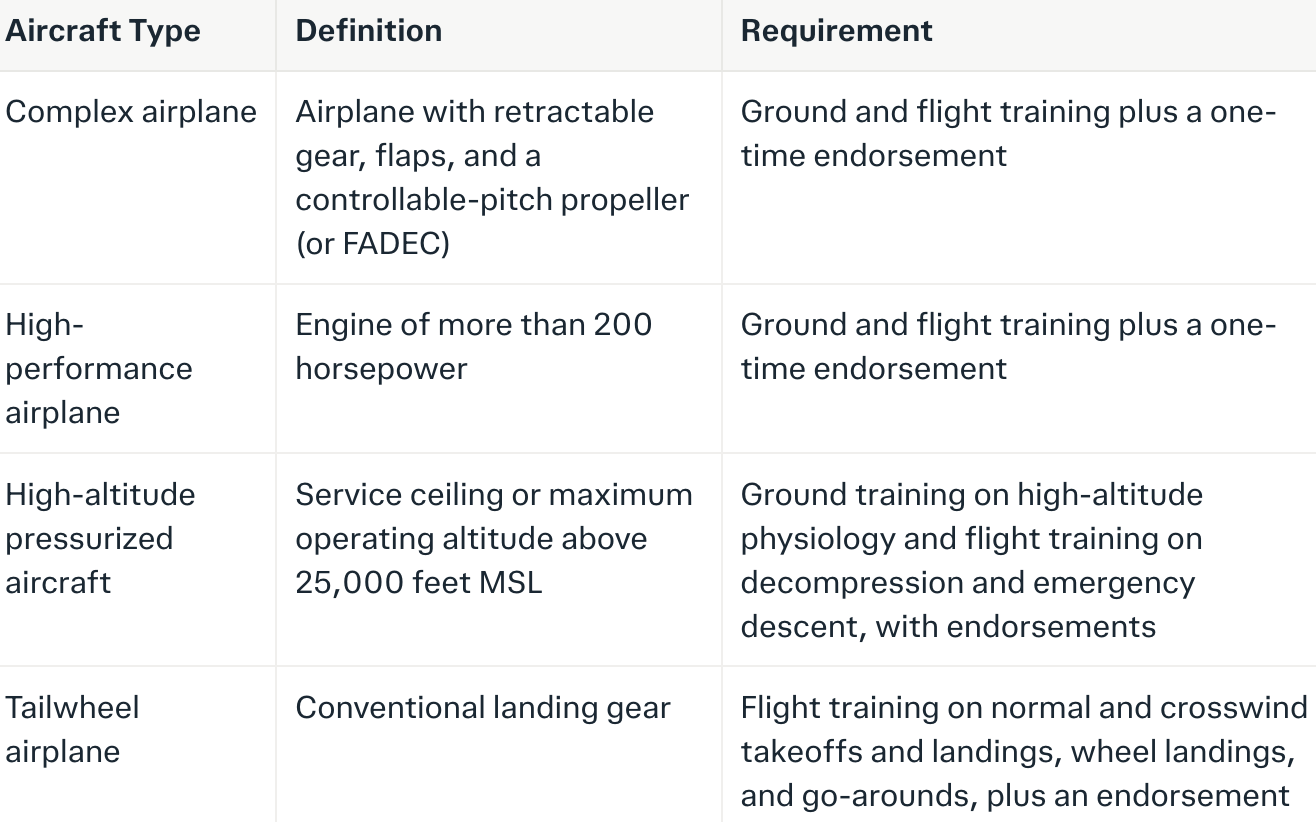
Certain exceptions apply, including credit for qualifying Part 135 competency checks and for experience logged before specific historical dates.
Medical Certification
Under 14 CFR § 61.23, the medical certificate a pilot needs depends on the privileges being exercised:
- First-class medical: Required when exercising the pilot-in-command privileges of an ATP certificate.
- Second-class medical: Required, at minimum, for commercial pilot privileges in aircraft other than balloons and gliders.
- Third-class medical: Required, at minimum, for private pilot privileges, unless the pilot operates under BasicMed provisions.
For ATP PIC operations, a first-class medical expires at the end of the 12th month after the examination for pilots under age 40, and at the end of the 6th month after the examination for pilots age 40 and older. Many Captains therefore visit their aviation medical examiner twice a year.
Recent Flight Experience (Currency)
Being qualified is not the same as being current. Under 14 CFR § 61.57, a pilot may not act as PIC of an aircraft carrying passengers unless, within the preceding 90 days, the pilot has made:
- Three takeoffs and three landings as sole manipulator of the controls, in an aircraft of the same category, class, and type (if a type rating is required), with full-stop landings in tailwheel airplanes; and
- For passenger flights between one hour after sunset and one hour before sunrise, three takeoffs and three landings to a full stop during that nighttime period.
To act as PIC under instrument flight rules (IFR), the pilot must have performed and logged, within the six calendar months preceding the month of the flight, at least six instrument approaches, holding procedures, and intercepting and tracking courses using navigation systems. A pilot who falls out of instrument currency must pass an instrument proficiency check before acting as PIC under IFR again.
PIC Proficiency Checks for Multi-Pilot and Jet Aircraft
Under 14 CFR § 61.58, a pilot who serves as PIC of an aircraft type certificated for more than one required pilot, or of any turbojet-powered aircraft, must complete:
- A PIC proficiency check within the preceding 12 calendar months in an aircraft that requires more than one pilot or is turbojet-powered; and
- A PIC proficiency check within the preceding 24 calendar months in the particular type the pilot will fly.
These § 61.58 checks apply most directly to Part 91 corporate and private operations. Pilots flying under Part 91 Subpart K, Part 121, Part 125, Part 133, Part 135, or Part 137 instead meet the testing requirements of those operating rules.
PIC Requirements by Type of Operation
The most significant differences between PIC jobs come from the operating rules under which the employer flies.
Part 91: Corporate and Private Flight Departments
Part 91 governs general aviation, including most corporate flight departments. The FAA's baseline PIC requirements for these operations are the certificate, type rating, endorsement, medical, currency, and § 61.58 proficiency requirements described above.
In practice, however, Part 91 Captain jobs are rarely filled at regulatory minimums. Aviation insurance underwriters, company operations manuals, and voluntary safety programs commonly set total time, PIC time, make-and-model experience, and recurrent training standards that are well above FAA minimums. That is why corporate job listings frequently specify total hours, turbine PIC hours, a type rating, and recent experience in a comparable aircraft. Pilots interested in this segment can review current openings in flight department jobs.
Part 135: Charter, On-Demand, and Commuter Operations
Part 135 sets specific experience minimums for PIC service under 14 CFR § 135.243:
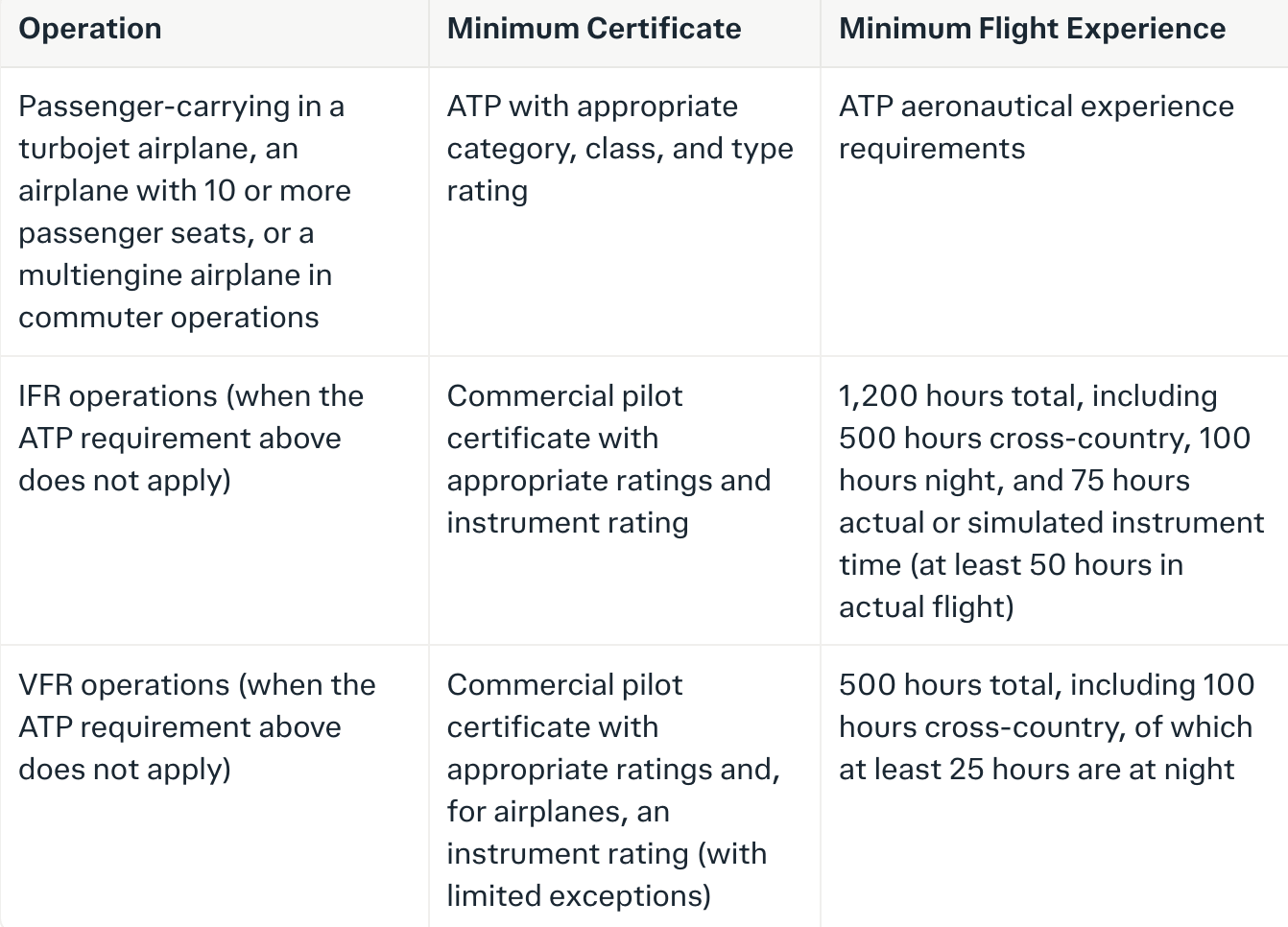
Part 135 Captains also face a structured system of recurring checks:
- Knowledge test (written or oral) since the beginning of the 12th calendar month before service, covering regulations, the operator's manual, aircraft systems, performance, weather, and navigation (§ 135.293(a)).
- Competency check since the beginning of the 12th calendar month before service (§ 135.293(b)).
- Instrument proficiency check since the beginning of the 6th calendar month before serving as PIC under IFR (§ 135.297).
- Line check since the beginning of the 12th calendar month before service, flown over at least one route segment with takeoffs and landings at representative airports (§ 135.299).
For commuter operations, a new PIC must also complete supervised operating experience under § 135.244 before designation, ranging from 10 hours in single-engine aircraft to 25 hours in turbojet-powered airplanes.
Part 121: Airline Captains
Part 121 carries the highest PIC standards in U.S. civil aviation. Under 14 CFR § 121.436, a Part 121 Captain must:
- Hold an ATP certificate that is not subject to the restricted-privileges limitations of § 61.167;
- Hold an appropriate type rating for the aircraft being flown; and
- Have 1,000 hours as a Second in Command in Part 121 operations, as PIC in qualifying Part 91 Subpart K or Part 135 operations, as PIC in eligible on-demand operations, or in any combination of these.
Before flying the line independently, a newly upgraded airline Captain must complete supervised operating experience under § 121.434. That experience is flown under the supervision of a check pilot and, for initial or upgrade training, includes observation by an FAA inspector on at least one flight leg. Requirements range from 15 to 25 hours depending on the airplane group, with at least four operating cycles, and the new Captain must then accumulate at least 100 hours of line flying within 120 days to consolidate knowledge and skills.
Part 121 pilots are also subject to a mandatory retirement age. Under § 121.383, no pilot may serve in Part 121 operations after reaching his or her 65th birthday.
For a closer look at entry-level airline flying, read Regional Airline Pilot Jobs: What to Expect Before You Apply.
The ATP Certificate: The Gateway to Most PIC Jobs
Because so many PIC positions require an ATP certificate, understanding its requirements is essential.
Under 14 CFR § 61.159, an applicant for an ATP certificate with an airplane category rating must generally have at least 1,500 hours of total time as a pilot, including:
- 500 hours of cross-country flight time;
- 100 hours of night flight time;
- 50 hours in the class of airplane for the rating sought;
- 75 hours of actual or simulated instrument time; and
- 250 hours as PIC, or as SIC performing PIC duties under supervision, including at least 100 hours of cross-country and 25 hours of night flight time.
Applicants must be at least 23 years old for an unrestricted ATP under 14 CFR § 61.153, and those seeking a multiengine ATP must complete the ATP Certification Training Program (ATP CTP) before taking the knowledge test.
The Restricted ATP (R-ATP)
Section 61.160 allows certain applicants to earn an ATP with restricted privileges at age 21 and with reduced total time:
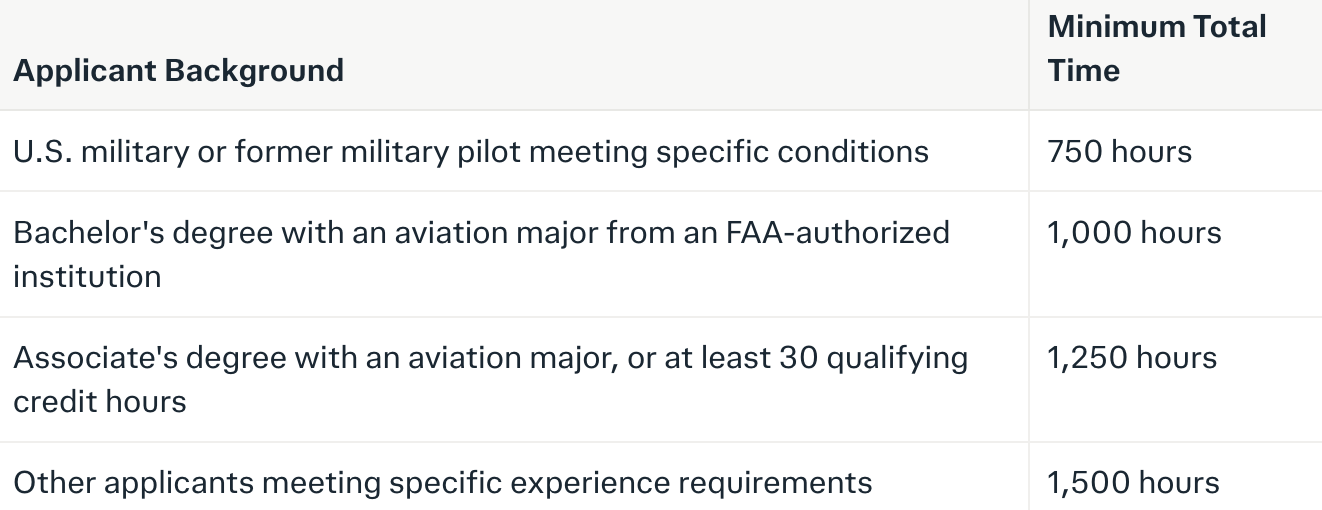
An R-ATP is an important stepping stone into airline First Officer roles, but it does not satisfy the Part 121 Captain requirement, which calls for an ATP not subject to the § 61.167 limitations. Military aviators exploring this path will find additional guidance in our civilian aviation career transition guide for veterans.
What Employers Look for Beyond the Regulations
Meeting FAA minimums makes a pilot eligible for a PIC job, but it does not guarantee an offer. Hiring managers and chief pilots typically evaluate several additional factors:
- Quality of PIC experience. Turbine PIC time, multi-crew experience, and time in a comparable aircraft often matter more than total hours alone.
- Safety and training history. Checkride results, incidents, and training records are reviewed carefully. The FAA's Pilot Records Database (PRD) allows pilots to view their records and share them with prospective employers, and employers operating under Parts 121, 135, 91, 91K, and 125 use the PRD's Employer Portal.
- Judgment and leadership. Captains manage crews, passengers, schedules, and risk. Interviews frequently include scenario-based questions designed to test decision-making under pressure.
- Customer service. In corporate and charter aviation, the Captain often serves as the face of the operation to owners and passengers.
- Professional presentation. A clean, well-organized logbook and an aviation-specific resume make a strong first impression.
To prepare, consider reviewing the AllAviationJob.com resume templates and the interview preparation tips from OSI Recruit. Pilots can also explore OSI Recruit's job seeker resources and Pilot Career Insights articles for further guidance.
How to Prepare for Your First PIC Job
Most professional pilots follow a progression that builds both flight time and command experience. A typical path includes:
- Earn your foundational certificates. Private, instrument, commercial, and multiengine ratings form the base. Our flight school directory can help you compare training options.
- Build quality time. Flight instruction, banner towing, aerial survey, skydiving operations, and cargo feeder flying are common ways to accumulate hours and PIC experience.
- Gain multi-crew experience. Serving as SIC in a turboprop or jet develops crew coordination skills and exposes you to Captain-level decision-making.
- Pursue an ATP and type ratings. These credentials open access to the broadest range of PIC jobs.
- Seek upgrade opportunities. Many Captains earn the left seat by upgrading within their current employer, while others move to a new operator to command a different aircraft.
- Stay current and documented. Keep your medical, currency, recurrent training, and logbook in order so you can respond quickly when the right opportunity appears.
Career Outlook and Compensation
PIC experience is one of the most valuable credentials a pilot can hold. According to the U.S. Bureau of Labor Statistics, airline pilots, copilots, and flight engineers earned a median annual wage of $232,140 in May 2025, while commercial pilots earned a median of $123,220. The BLS projects employment of airline pilots, copilots, and flight engineers to grow 8 percent from 2025 to 2035, with about 16,400 openings for airline and commercial pilots projected each year, on average, over the decade.
Pay for individual PIC jobs varies widely by aircraft, operator, region, seniority, and schedule. For more detailed compensation data, visit the AllAviationJob.com Salary Report.
For Employers: Hiring Qualified Captains
Finding a Captain who meets regulatory, insurance, and cultural requirements can be one of the most demanding searches an operator undertakes.
Aviation employers seeking experienced PIC candidates can partner with OSI Recruit's aviation recruitment team, learn more on the OSI Recruit employers page, or contact OSI Recruit to discuss pilot staffing needs.
Employers may also post a job on AllAviationJob.com to reach a dedicated aviation audience.
Key Takeaways
- A PIC job is any position in which you are designated as the pilot with final authority and responsibility for the flight.
- Acting as PIC and logging PIC time are different concepts governed by different regulations.
- Every PIC must hold the proper certificate, ratings, endorsements, and medical, and must remain current under § 61.57.
- Part 135 and Part 121 add specific experience minimums, recurring checks, and supervised operating experience.
- Most airline and jet PIC jobs require an ATP certificate, and Part 121 Captains need an unrestricted ATP plus 1,000 hours of qualifying experience.
- Employers look beyond minimums to the quality of your experience, your safety record, and your leadership.
Ready to Take Command of Your Career?
Whether you are building toward your first Captain upgrade or searching for your next left-seat opportunity, AllAviationJob.com connects you with employers who are hiring now. Explore hundreds of pilot jobs from airlines, charter operators, and corporate flight departments, and research hiring organizations through our company directory.
Create your free job seeker profile on AllAviationJob.com today so that aviation employers can find you, and be among the first to see the PIC opportunities that match your qualifications. Your next command starts here.
Sources
- Federal Aviation Administration, 14 CFR § 1.1, General Definitions. Legal Information Institute, Cornell Law School. https://www.law.cornell.edu/cfr/text/14/1.1
- Federal Aviation Administration, 14 CFR § 91.3, Responsibility and Authority of the Pilot in Command. https://www.law.cornell.edu/cfr/text/14/91.3
- Federal Aviation Administration, 14 CFR § 61.51, Pilot Logbooks. Electronic Code of Federal Regulations. https://www.ecfr.gov/current/title-14/chapter-I/subchapter-D/part-61/subpart-A/section-61.51
- Federal Aviation Administration, 14 CFR § 61.23, Medical Certificates: Requirement and Duration. https://www.law.cornell.edu/cfr/text/14/61.23
- Federal Aviation Administration, 14 CFR § 61.31, Type Rating Requirements, Additional Training, and Authorization Requirements. https://www.law.cornell.edu/cfr/text/14/61.31
- Federal Aviation Administration, 14 CFR § 61.57, Recent Flight Experience: Pilot in Command. https://www.ecfr.gov/current/title-14/chapter-I/subchapter-D/part-61/subpart-A/section-61.57
- Federal Aviation Administration, 14 CFR § 61.58, Pilot-in-Command Proficiency Check. https://www.law.cornell.edu/cfr/text/14/61.58
- Federal Aviation Administration, 14 CFR § 61.153, Airline Transport Pilot Eligibility Requirements. https://www.law.cornell.edu/cfr/text/14/61.153
- Federal Aviation Administration, 14 CFR § 61.159, Aeronautical Experience: Airplane Category Rating. https://www.law.cornell.edu/cfr/text/14/61.159
- Federal Aviation Administration, 14 CFR § 61.160, Aeronautical Experience: Airplane Category Restricted Privileges. https://www.law.cornell.edu/cfr/text/14/61.160
- Federal Aviation Administration, 14 CFR § 121.383, Airman: Limitations on Use of Services. https://www.law.cornell.edu/cfr/text/14/121.383
- Federal Aviation Administration, 14 CFR § 121.434, Operating Experience, Operating Cycles, and Consolidation of Knowledge and Skills. https://www.law.cornell.edu/cfr/text/14/121.434
- Federal Aviation Administration, 14 CFR § 121.436, Pilot Qualification: Certificates and Experience Requirements. https://www.ecfr.gov/current/title-14/chapter-I/subchapter-G/part-121/subpart-M/section-121.436
- Federal Aviation Administration, 14 CFR § 135.243, Pilot in Command Qualifications. https://www.law.cornell.edu/cfr/text/14/135.243
- Federal Aviation Administration, 14 CFR § 135.244, Operating Experience. https://www.law.cornell.edu/cfr/text/14/135.244
- Federal Aviation Administration, 14 CFR § 135.293, Initial and Recurrent Pilot Testing Requirements. https://www.law.cornell.edu/cfr/text/14/135.293
- Federal Aviation Administration, 14 CFR § 135.297, Pilot in Command: Instrument Proficiency Check Requirements. https://www.law.cornell.edu/cfr/text/14/135.297
- Federal Aviation Administration, 14 CFR § 135.299, Pilot in Command: Line Checks: Routes and Airports. https://www.law.cornell.edu/cfr/text/14/135.299
- Federal Aviation Administration, Pilot Records Database (PRD). https://www.faa.gov/regulations_policies/pilot_records_database
- U.S. Bureau of Labor Statistics, Occupational Outlook Handbook: Airline and Commercial Pilots. https://www.bls.gov/ooh/transportation-and-material-moving/airline-and-commercial-pilots.htm