For thousands of pilots, a regional airline is where the airline career actually begins. It is where you earn your first airline seat, your first type rating, and your first taste of Part 121 operations. It is also where the realities of reserve schedules, commuting, seniority, and structured training pipelines hit for the first time — and pilots who understand those realities before they apply consistently make better decisions than pilots who discover them after the job offer.
This guide walks through what regional airline pilot jobs genuinely involve in 2026: the FAA certification floor you must clear before anyone will interview you, what hiring teams evaluate beyond flight time, what training and initial operating experience look like, what you can realistically expect to earn, and how regional flying fits into a longer airline career. The goal is simple — to make sure you apply with your eyes open.
If you are weighing this path, start by browsing current openings on the AllAviationJob.com pilot jobs board so you can see what carriers are actually hiring for right now.
What Regional Airline Pilots Actually Do
Regional airlines operate shorter-haul routes, frequently under capacity purchase agreements, in which a major airline brand (American, Delta, or United, for example) buys the flying and the regional carrier operates it. That is why you can board a flight labeled "American Eagle," "Delta Connection," or "United Express" and find yourself on an Embraer 175 or Bombardier CRJ550 flown by a regional crew. For a deeper comparison of the two career tracks, see Regional vs. Major Airlines: Which Pilot Career Track Pays Off.
As a regional first officer, your core responsibilities include:
- Flying as second-in-command on scheduled Part 121 passenger operations, typically in the 50–76 seat regional jet range.
- Sharing decision-making with the captain across weather, fuel, de-icing, and abnormal procedures — regional flying often means more legs per day, more weather exposure, and more airport variety than long-haul flying.
- Operating in a two-crew, SOP-driven environment where standardization is the product. Airlines do not want creative pilots; they want disciplined, predictable ones.
- Managing the schedule realities of short-haul flying, including quick turns, high-frequency duty days, and the occasional reassignment when operations disrupt.
It is demanding, structured work, and it builds flight experience in jet aircraft faster than almost any other path in civilian aviation.
The Qualification Floor: What You Must Have Before You Apply
Regional airlines cannot legally hire you below the FAA's first officer qualification standards, so it is worth knowing exactly where that floor sits. Under the regulations that followed the Colgan Air 3407 accident, first officers at U.S. Part 121 airlines must hold an Airline Transport Pilot certificate — the full 1,500-hour ATP, or a restricted-privileges ATP (R-ATP) at reduced hours — along with an aircraft type rating (FAA).
An unrestricted ATP generally requires the applicant to be at least 23 years old and to meet the aeronautical experience requirements of 14 CFR 61.159, including at least 1,500 hours of total pilot time, 500 hours of cross-country flight, 100 hours of night flight, and 75 hours of instrument flight time (eCFR, 14 CFR Part 61, Subpart G).
The restricted-privileges ATP is what makes airline hiring accessible to lower-time pilots. Under 14 CFR 61.160, the FAA allows reduced total-time minimums for pilots age 21 and older with specific training backgrounds (eCFR, 14 CFR 61.160):
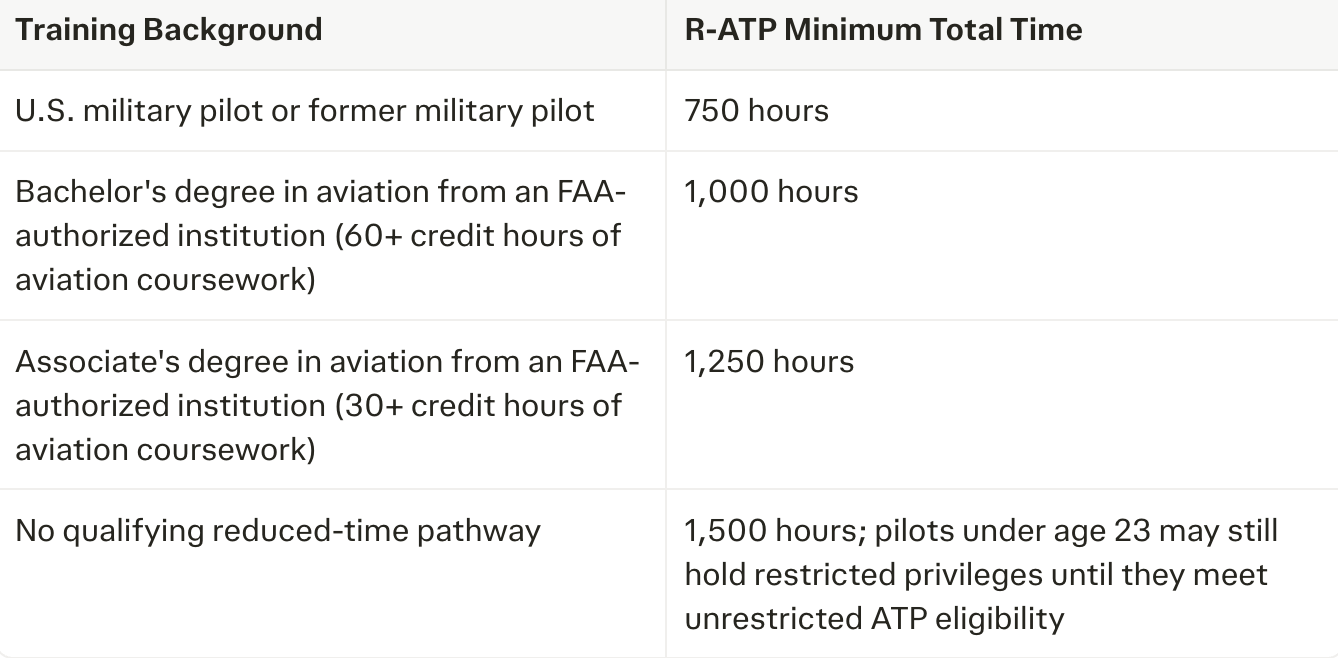
Two important details: the R-ATP is genuinely "restricted" — it allows you to serve as second-in-command in Part 121 operations, but the restriction is not simply removed once you reach 1,500 hours; you must meet the unrestricted ATP requirements and have the certificate limitation removed (FAA). And the university pathway only counts if the institution holds FAA authorization to certify R-ATP graduates, which the FAA publishes in an official list (FAA Advisory Circular 61-139).
Beyond certificate minimums, most regional applications will also involve:
- A first-class FAA medical certificate. Regional airlines generally require it at hire.
- ATP Certification Training Program (ATP CTP) completion before taking the ATP knowledge test, unless you have already completed equivalent training (FAA).
- A clean legal and driving record. Airlines run comprehensive background checks, Pilot Records Database (PRD) reviews, and examine FAA certificate actions going back years. For a candid look at how record and medical issues affect aviation careers, see the impact of a DUI, arrest record, or medical issues on an aviation career.
- The legal right to work in the United States and the ability to obtain a valid passport, since regional networks routinely cross borders.
Not sure how your current hours stack up against the various pilot career paths? Our guide on how many flight hours you need for different pilot jobs breaks it down role by role.
What Hiring Teams Evaluate Beyond Flight Time
Meeting the FAA minimums gets your application read. It does not get you hired. Regional recruiting teams — which process thousands of applications in a hiring cycle — are evaluating several things the regulations do not require:
Logbook integrity. Recruiters and interviewers will compare your logbook, IACRA records, and electronic records for consistency. Discrepancies, even innocent ones, are one of the fastest ways to lose an offer. If your total time comes from varied sources, get it reconciled before you apply.
Training performance indicators. Checkride pass rates, repeated stage-check failures, and the pace of your ratings all get attention. Airlines are hiring trainability. A pilot who struggled through primary training raises a flag about how they will handle a compressed airline initial course.
Professional history. Employment gaps, terminations, and reference feedback matter. So does how you talk about them. A candid, accountable answer beats a defensive one every time.
Interview presence. Regional interviews blend HR and technical content, and some include a simulator or cognitive evaluation. You will be asked about weather decision-making, regulations, aerodynamics, and how you handle conflict in a two-pilot cockpit. Preparation matters — see our pilot interview prep guide for the questions you are most likely to face.
On the employer side of the table, regional and private operators are screening just as deliberately — reviewing the Pilot Records Database, verifying credentials, and assessing judgment before an offer goes out. OSI Recruit's breakdown of the five-step screening process aviation employers should demand is useful reading if you want to understand exactly what hiring teams are checking about you.
Pay: What Regional First Officers and Captains Actually Earn
Regional pilot pay has transformed over the past several years. First-year pay that once sat near $30,000 has climbed sharply as carriers competed for a limited pilot supply, and 2026 figures reflect that shift.
Current reporting places first-year regional first officer hourly rates between roughly $50 and over $100 per flight hour depending on the carrier and contract, with 2026 listings including SkyWest at $92.73 per flight hour and Endeavor Air at $105.08 (Simple Flying). With signing and retention bonuses factored in, first-year regional first officers can expect total compensation in the range of $90,000 to $100,000, though figures vary by carrier, hours flown, and bonus terms (Simple Flying).
Captain pay scales climb higher. Regional captain rates generally run $100 to $150 per flight hour, with typical regional captain salaries estimated at $140,000 to $150,000, and experienced captains earning well beyond that — a 12-year Endeavor Air captain can exceed $200,000, and a 12-year SkyWest captain was reported at about $189,000 (Simple Flying).
For broader context across all sectors of the industry, the Bureau of Labor Statistics reports a median annual wage of $232,140 for airline pilots, copilots, and flight engineers as of May 2025 — a figure that includes major airline pilots and skews well above regional first-year earnings (Bureau of Labor Statistics). Employers and candidates tracking current compensation benchmarks across the industry may also find OSI Recruit's aviation salary benchmarks for 2026 useful.
Three practical notes about reading regional pay:
- Hourly rates are paid per flight hour, not per duty hour. A month with 85 credited hours of pay might include far more time away from base. Guaranteed monthly minimums (often 70–75 hours) matter as much as the headline rate.
- Bonuses are not salary. Signing and retention bonuses are typically paid on schedules tied to tenure, training completion, or employment status, and they can disappear when contracts change.
- Per diem, hotel provisions, and commuting benefits vary and materially affect your real quality of life. Read the full compensation package, not the first row of the pay scale.
Schedules, Reserve, Bases, and Commuting
This is the section that surprises the most new hires, so read it carefully.
Reserve is where new first officers start. Almost every regional pilot begins on reserve, which means being available on short notice to cover trips assigned the day before — or the hour before. Reserve predictability varies widely between carriers; some use a degree of long-call and short-call structuring, while others keep reserves on constant standby. Industry reporting is blunt about this stage: reserve schedules at regionals can be unpredictable, and quality of life has not always kept pace with the pay improvements of recent years (GlobalAir.com). Pilots who live within a short drive of their base consistently describe reserve as more tolerable than those who commute to it.
Your base is assigned by the company, not chosen by you. New hires get whatever base needs pilots, which may be on the other side of the country from where you live. You can bid to transfer as seniority allows, but there are no guarantees on timing.
Commuting is common and costly. Many regional pilots commute to base, flying standby on their own or other carriers' flights, often the day before a report. Commuting eats into days off, adds stress to reserve status, and can turn a 12-day work month into a 15-day one. Before accepting a job, understand the commuter policy, how many flights connect your home to your base, and how full those flights run.
Days off are seniority-based. Junior pilots take the trips and days off nobody senior wanted. That improves with time — but the pace depends on carrier growth and attrition, neither of which is guaranteed.
For a fuller picture of what the flying life actually looks like day to day, see what the life of a commercial pilot looks like: schedules, duties, and career paths.
Training: What Happens After You Accept the Offer
Signing the offer is the beginning of the hardest professional challenge most new airline pilots have faced to that point.
Regional initial training typically runs in phases: aircraft systems ground school, procedures training in full-motion simulators, maneuvers validation, and line-oriented training — all leading to a type rating checkride — followed by initial operating experience (IOE) on the line with a check airman before you are released to fly scheduled trips. Most new hires complete the sequence in several weeks to a few months, though timelines vary by carrier and aircraft.
What that means for you:
- It is fast and dense. Regional training programs compress an enormous amount of aircraft knowledge into a short window. Pilots who arrive with strong instrument procedures, turbine systems fundamentals, and disciplined study habits perform best.
- Failure has consequences. Training events are evaluated, and washouts happen. Airlines hire for trainability for exactly this reason.
- You will be away from home. Training usually occurs at a dedicated facility, and the social and financial strain of that should be planned for.
The payoff is real: a type rating in a transport-category jet, 121 operating experience, and flight time that builds faster than most civilian pathways. Pilots moving toward this step from flight school may find our roadmap from flight school to first job a practical companion to this article.
Career Progression: Upgrades, Flow-Through, and the Path to the Majors
A regional airline job is both a complete career in its own right and the most common bridge to the major airlines. Understanding the progression mechanics — and their limits — is essential context before you apply.
Captain upgrade is seniority-based. When you upgrade depends on your seniority position, fleet needs, and attrition at your carrier. Upgrades can be fast during growth periods and slow during contractions, and nobody can promise you a timeline.
Flow-through and preferential hiring agreements connect regionals to majors. Several regional carriers hold agreements tied to major airline partners: Envoy Air, PSA Airlines, and Piedmont Airlines carry guaranteed flow agreements to American Airlines; Endeavor Air holds a guaranteed flow to Delta Air Lines; SkyWest operates under preferential hiring arrangements with United; and Republic Airways maintains preferential arrangements with American, Delta, and United (Simple Flying).
Read that list carefully, because the words matter:
- A guaranteed flow obligates the major airline to take a defined share of its hiring from the regional. It is a powerful pathway, but "guaranteed" refers to the pathway's existence — not to a date certain. Flow classes depend on major airline hiring needs, which fluctuate with the economy and fleet plans.
- Preferential hiring provides an advantage in the major's process — typically interview guarantees or reduced experience minimums — but it is a step short of a flow.
These agreements can be the single most valuable term in a regional career decision, but they are not a schedule. Majors continue to hire off the street in large numbers even while flows operate, so your own competitiveness — flight time, checkride record, education, and interview performance — remains the ultimate driver. For pilots comparing the long-horizon economics of each track, ATP vs. commercial pilot: which path fits your career goals covers the decision framework.
The demand backdrop is real. Airline pilot hiring regained momentum entering 2026 after a slower 2025, with American planning approximately 1,500 pilot hires in 2026, United near 2,500, and Delta around 600 in the first quarter alone (AOPA). Part 121 regulations require pilots to retire at age 65, and the National Air Carrier Association estimates more than 12,000 airline pilots will reach mandatory retirement over the next five years, driving a projected shortfall exceeding 28,000 pilots by 2030 (AOPA). The Bureau of Labor Statistics projects employment of airline and commercial pilots to grow 7 percent from 2025 to 2035 — faster than the average occupation — with about 16,400 openings per year on average over the decade (Bureau of Labor Statistics).
That backdrop is encouraging, but it is not a personal guarantee. Hiring is cyclical, and regional capacity decisions are made by major network partners, not by the regional itself. Apply because the career fits you — not because a headline says pilots are needed.
How to Prepare a Stronger Application
Before you submit anything, do the following:
- Audit your logbook now. Reconcile totals, get endorsements documented, and be able to explain every entry. If your experience is limited, read our guide on building an aviation resume with limited flight experience.
- Verify your records. Pull your own FAA airman records and address any discrepancies before an airline finds them.
- Choose your targets strategically. Compare bases, fleets, pay scales, commuter policies, upgrade history, and flow agreements across carriers — the airline you pick matters more than the aircraft you fly. Our 2026 pilot hiring outlook covers where the opportunities are concentrated.
- Prepare for the interview like it is a checkride. Review instrument procedures, Part 121 basics, your logbook cold, and standard HR questions. Practice out loud.
- Read every document before signing. Training agreements, repayment clauses, and bonus terms are enforceable. Understand what you are committing to.
- Set up job alerts. Regional hiring windows open and close quickly. Our guide to aviation job alerts explains how to catch postings the day they go live.
And one mistake worth naming: applying only to one carrier because of a sign-on bonus. Bonuses change; bases, contracts, and flow structures shape years of your life. Decide accordingly.
Frequently Asked Questions
How many flight hours do I need to apply to a regional airline?
Most regionals require eligibility for an ATP or R-ATP certificate: 750 hours for qualifying military pilots, 1,000 or 1,250 hours for graduates of FAA-authorized aviation degree programs, or 1,500 hours otherwise (eCFR, 14 CFR 61.160). Some carriers run cadet or pipeline programs that engage you earlier, so check individual postings.
Is regional airline flying still a good career move in 2026?
For most pilots seeking an airline career, yes — pay has improved substantially, the hiring outlook is positive (AOPA), and the experience is the standard bridge to major airline jobs. The honest caveat is quality of life: reserve unpredictability, commuting, and junior scheduling remain genuine challenges that you should plan around (GlobalAir.com).
Do I need a college degree to fly for a regional?
No. A degree is not required for most regional first officer positions, though aviation degrees from FAA-authorized institutions reduce the R-ATP flight-hour requirement, and degrees remain a competitive factor later at some major airlines.
How long does it take to upgrade to captain at a regional?
It depends entirely on seniority, attrition, and fleet needs at your carrier — anywhere from under two years in strong growth cycles to several years in slow ones. No airline can guarantee an upgrade timeline.
What is a flow-through agreement?
A contractual pathway obligating a major airline to hire a defined share of a regional's pilots — such as Envoy, PSA, and Piedmont to American, or Endeavor to Delta (Simple Flying). It secures the path, not the date.
Your Next Step: Find Regional Airline Pilot Jobs That Fit
You now know what regional carriers require, what they pay, what the schedule demands, and how the career ladder actually works. The pilots who succeed in this industry are rarely the ones with the perfect logbook — they are the ones who applied informed, prepared deliberately, and kept their applications current while the market moved.
Start your search today at AllAviationJob.com. Browse live pilot jobs from regional carriers, major airlines, charter operators, and flight departments — posted fresh, searchable by location and role, and free to apply. Create your candidate profile, set up alerts for the bases you want, and take the first real step toward the flight deck. Your airline career is not going to start itself. Search pilot jobs on AllAviationJob.com now.
Hiring pilots for a regional carrier, charter operator, or flight department? AllAviationJob.com's sister brand OSI Recruit partners with aviation employers on pilot and crew recruitment — learn more at osirecruit.com/employers.
Sources
- Federal Aviation Administration — Pilot Training: Airline Transport Pilot Certification
- Electronic Code of Federal Regulations — 14 CFR Part 61, Subpart G (Airline Transport Pilots, §§ 61.159–61.160)
- Federal Aviation Administration — Advisory Circular 61-139: Restricted-Privileges ATP Flight-Time Requirements
- U.S. Bureau of Labor Statistics — Occupational Outlook Handbook: Airline and Commercial Pilots
- AOPA — Airline Pilot Hiring Shows Renewed Momentum (January 28, 2026)
- Simple Flying — How Much Do Regional Airline Captains Make Compared to Major Airline Captains in 2026?
- Simple Flying — Regional to Widebody: How US Pilot Pay Climbs from $90 to $465 an Hour
- GlobalAir.com — Are Regional Airlines Still Worth It in 2026?