A corporate pilot resume has one job: to help a chief pilot or aviation manager decide, quickly and confidently, that you are worth a phone call. Flight departments are small, the aircraft are expensive, and the people in the back are often senior executives, owners, or their families. As a result, hiring managers read resumes for two things at once: verifiable qualifications and evidence that you will represent the company well.
This guide explains what flight departments look for, how to structure each section of a corporate pilot resume, and what strong examples look like at three career stages: an entry-level second in command (SIC), a mid-career captain, and a senior international captain. Each example is a fictional model that shows format and content choices, not a real person's record.
If you are actively searching, you can review current openings on the AllAviationJob.com pilot jobs page while you work through this guide.
Why Corporate Pilot Resumes Are Different
Airline hiring tends to follow standardized minimums, structured online applications, and seniority-based career paths. Corporate aviation works differently. Corporate flight departments typically operate under 14 CFR Part 91, where the FAA does not set a specific hour minimum beyond the certificates and type ratings required for the aircraft; one academic comparison of professional pilot jobs notes that the regulatory floor is a commercial pilot certificate with an instrument rating plus any applicable type rating (Western Michigan University ScholarWorks).
In practice, the real bar is set by insurance underwriters and the department's own standards. AllAviationJob.com's guide to how many flight hours you need for different pilot jobs explains that, although Part 91 departments are not bound by Part 135 or Part 121 hour minimums, insurance underwriters largely set the hiring bar.
Corporate departments also hire for fit. One recruiting firm that specializes in this market notes that flight departments are often 2 to 10 pilots and are hiring someone who will represent the company in front of executives, board members, and clients (TPN Talent). The same source points out that departments prefer pilots who are already typed in their aircraft or a similar platform, because it reduces training cost and risk, and that they value stability because they do not want to train someone who leaves for an airline after 18 months (TPN Talent).
Your resume must therefore do three things:
- Prove you meet the legal and insurance requirements for the seat.
- Show that your experience matches the department's aircraft and mission.
- Signal professionalism, discretion, and long-term commitment.
What Flight Departments Look For First
Certificates, Ratings, and Medical
Hiring managers want to see your certificate level and ratings immediately. For any role involving turbojet aircraft, the ATP certificate is a strong expectation. Under 14 CFR 61.159, an applicant for an ATP with an airplane category rating generally needs at least 1,500 hours of total time, including 500 hours of cross-country, 100 hours of night, and 75 hours of instrument time.
Many corporate pilots also fly charter, where the rules are more prescriptive. Under 14 CFR 135.243, a Part 135 pilot in command (PIC) flying under IFR in aircraft not covered by paragraph (a) needs at least 1,200 hours, including 500 hours of cross-country, 100 hours of night, and 75 hours of instrument time. The FAA has also clarified that paragraph (a) requires an ATP certificate for PICs in passenger-carrying operations in turbojet airplanes or airplanes with 10 or more passenger seats (FAA legal interpretation).
List every type rating, including any SIC-only limitations, plus your medical class. Hiring managers frequently scan for specific type designations, so write them as they appear on your certificate (for example, CE-525S, CE-560XL, EMB-505, CL-600, or G-VI).
Flight Time, Broken Down Clearly
Flight time is the most scrutinized section of any pilot resume. GlobalAir.com advises including total time, instrument, instructor, turbine, multi-engine, and PIC time, and placing the flight experience section toward the top of the resume (GlobalAir.com). Industry career guides also list time in type, recent experience, turbojet time, and international experience among the totals employers evaluate (Aviation Jobs Guide).
Recency matters too. A business aviation recruiter at API Aviation recommends putting your flight hours for the last 12 months and type ratings front and center, with dates and locations on everything, such as your most recent class dates.
Aircraft and Mission Match
Departments hire for their fleet and mission profile. Many published job postings make this explicit. For example, a Dow corporate pilot posting listed 2,500+ total hours, 1,000+ hours of multi-engine turbine or jet time, 500+ hours of PIC experience, and preferred previous G650 or Falcon 2000EASy experience along with Part 91 international experience. A Part 91 corporate pilot posting from Kalahari Resorts & Conventions, listed on AllAviationJob.com, required 3,000 hours total time, 1,500 hours PIC, and 500 hours of turbojet time (AllAviationJob.com).
When your resume uses the same terms as the posting (aircraft types, Part 91 versus Part 135, international operations, RVSM, oceanic), the reader can match you to the role in seconds.
Safety Record and Verifiability
Corporate departments, insurers, and charter operators all expect your record to be verifiable. Under 14 CFR Part 111, Part 119 certificate holders, fractional ownership programs, and certain air tour operators must access and evaluate a pilot candidate's records in the FAA's Pilot Records Database (PRD) before making a hiring decision (FAA AC 120-68J). The PRD final rule also requires pilots to enter five years of employment history when they consent to a records review (FAA PRD Final Rule).
Practical guidance for employers reinforces the same point: verify claimed flight experience through logbook reviews and cross-check it with previous employers or training providers (ZipRecruiter). Your resume, application, PRD employment history, and logbook should therefore agree exactly. 14 CFR 61.51 specifies what must be recorded for each flight logged, including date, total time, departure and arrival locations, aircraft type and identification, type of pilot experience (PIC, SIC, or training), and conditions of flight.
Professionalism, Service, and Discretion
Corporate pilots interact directly with principals and their guests. Career guides note that companies want pilots who represent the brand professionally, handle high-level passengers gracefully, show scheduling flexibility, and integrate well with small teams. Employers also describe additional responsibilities, such as budgeting for flight operations, selecting fuel and ground-service vendors, and protecting the confidentiality of executive travel plans (ZipRecruiter).
Strong resumes include concrete examples of these non-flying contributions without revealing confidential information about principals or employers.
How to Structure a Corporate Pilot Resume
Use a clean, one- to two-page format with consistent headings. A logical order looks like this:
- Header: Full name, city and state, phone, professional email, and an optional LinkedIn link. Note passport status if you are targeting international roles.
- Professional summary: Two to three sentences stating your certificate level, total time, turbine PIC, current type ratings, and the type of role you want.
- Certificates and ratings: Certificate level, type ratings, medical class, and other relevant credentials (CFI, CFII, MEI, dispatcher, A&P).
- Flight time: A short table or list of totals, including last-12-month time.
- Aviation experience: Reverse chronological employment with operator type (Part 91, 135, 91K, 121, or military), aircraft flown, base, and three to five accomplishment-focused bullet points.
- Training: Most recent initial or recurrent training at a Part 142 center, with month and year, plus international procedures, CRM, upset recovery, or safety management system (SMS) training.
- Education: Degree, school, and year, if applicable.
- Professional affiliations: NBAA, regional business aviation groups, or safety committees.
One resume template provider suggests the first line of your summary should name total time, PIC turbine time, and your current type rating (ResumeTemplates.com). That advice works especially well in corporate aviation, where the reader is often a working chief pilot reviewing applications between trips.
Corporate Pilot Resume Example 1: Entry-Level SIC
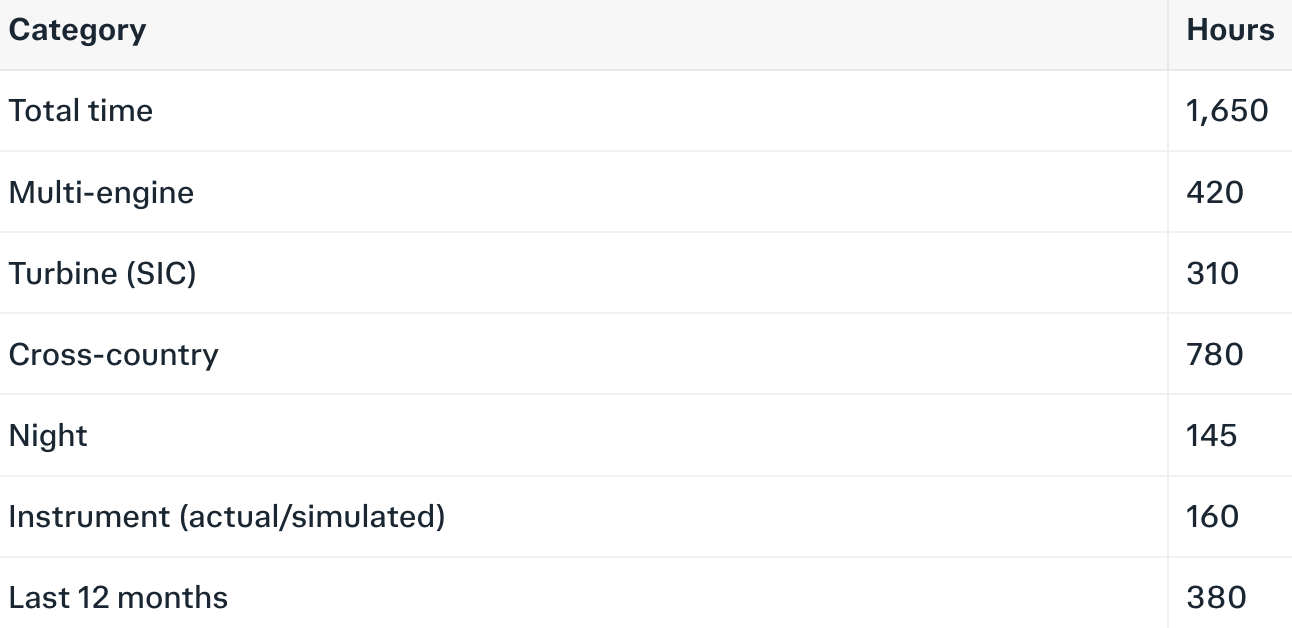
This example suits a pilot moving from instructing or charter flying into a first corporate right seat. Industry guidance commonly cites roughly 1,000 to 1,500 total hours for entry-level corporate SIC roles, with some multi-engine time, current IFR proficiency, and a clean FAA record (Flight Nerd Air Force).
JORDAN A. MILLER
Stuart, FL | (555) 555-0142 | jordan.miller@email.com | Valid U.S. Passport
Professional Summary
ATP-certificated pilot with 1,650 hours total time, 420 hours multi-engine, and 310 hours turbine SIC in the Citation CJ3. CE-525S SIC type rating. Seeking a Part 91 corporate first officer position with a stable flight department committed to safety and passenger service.
Certificates and Ratings
- FAA Airline Transport Pilot, Airplane Multi-Engine Land
- Type Rating: CE-525S (SIC privileges)
- Commercial privileges: Airplane Single-Engine Land
- CFI, CFII, MEI
- FAA First-Class Medical (current)
Flight Time
Aviation Experience
First Officer, Citation CJ3 | Coastal Charter Group, Part 135 | Fort Lauderdale, FL | 2025–Present
- Fly on-demand passenger trips throughout the Southeast, Northeast, and Bahamas.
- Complete trip planning, weight and balance, performance, and weather briefings for the PIC on each leg.
- Coordinate catering, ground transportation, and FBO services for passengers on short notice.
- Participate in the company's SMS hazard-reporting program and submitted two reports that led to revised ramp procedures.
Flight Instructor (CFI, CFII, MEI) | Treasure Coast Flight Academy, Part 141 | Stuart, FL | 2023–2025
- Provided 1,100 hours of dual instruction for private, instrument, commercial, and multi-engine students.
- Maintained a 90% first-time pass rate on FAA practical tests.
Training
- CE-525S Initial SIC Training, Part 142 training center, March 2025
- Recurrent Training, Part 142 training center, March 2026
- Upset Prevention and Recovery Training, 2025
Education
B.S., Aeronautical Science, 2023
Why this example works: The summary leads with the numbers that matter, the type rating is easy to spot, and recent turbine time is shown separately. The bullet points show service and safety habits, not just duties.
Corporate Pilot Resume Example 2: Mid-Career Captain
This example suits a pilot moving into or between captain seats in light or mid-size jets. TPN Talent's market summary lists typical PIC minimums of 1,500 to 2,500 hours for light jets and 2,500 to 4,000 hours for mid-size jets, with an ATP and a type rating (TPN Talent).
MARIA L. SANTOS
Palm Beach Gardens, FL | (555) 555-0188 | maria.santos@email.com | Valid U.S. Passport
Professional Summary
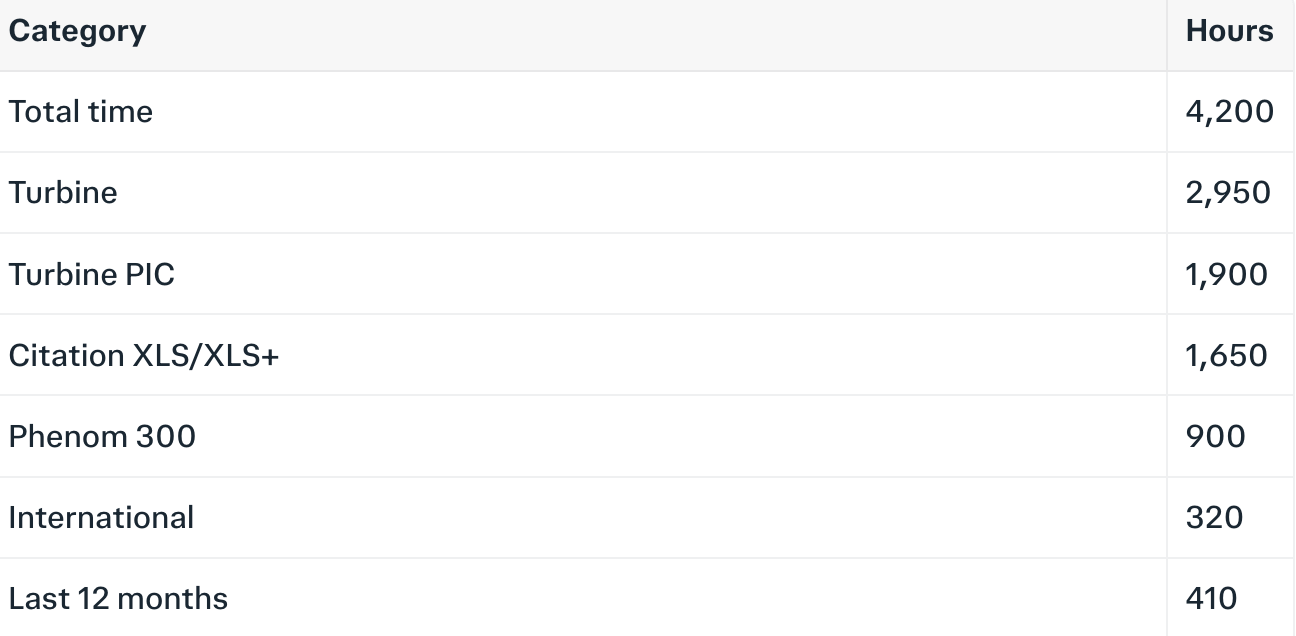
Corporate captain with 4,200 hours total time, 1,900 hours turbine PIC, and CE-560XL and EMB-505 type ratings. Seven years of Part 91 and Part 135 experience supporting executive and owner travel across North America and the Caribbean. Known for reliable dispatch performance, conservative decision-making, and discreet, service-focused passenger care.
Certificates and Ratings
- FAA Airline Transport Pilot, Airplane Multi-Engine Land
- Type Ratings: CE-560XL, EMB-505
- FAA First-Class Medical (current)
Flight Time
Aviation Experience
Captain, Citation XLS+ | Private Corporate Flight Department, Part 91 | West Palm Beach, FL | 2022–Present
- Serve as PIC for executive travel on a two-aircraft, four-pilot department supporting a privately held manufacturing company.
- Lead trip planning, international handling, and customs coordination for Caribbean, Mexico, and Canada operations.
- Serve as department safety officer; helped maintain the SMS manual and quarterly safety meetings.
- Work with the director of maintenance to schedule inspections around trip demand without lost trips.
Captain / First Officer, Phenom 300 | Regional Jet Charter, Part 135 | Orlando, FL | 2019–2022
- Upgraded from SIC to PIC within 18 months.
- Flew 900 hours in the Phenom 300, primarily single-day executive and medical-support trips.
- Served as company check airman candidate and mentored newly hired first officers.
Training
- CE-560XL Recurrent, Part 142 training center, January 2026
- International Procedures Course, 2024
- CRM and SMS Training, annually
Professional Affiliations
- National Business Aviation Association (NBAA)
Why this example works: It shows time in type, upgrade history, non-flying leadership duties, and a stable career path. Each bullet point connects to something a chief pilot cares about: safety culture, reliability, and teamwork.
Corporate Pilot Resume Example 3: Senior International Captain
This example suits a pilot targeting large-cabin or ultra-long-range aircraft. TPN Talent reports that PIC roles in ultra-long-range aircraft such as the G650 or Global 7500 typically call for 5,000+ hours, a type rating, an ATP, and international experience (TPN Talent). The same source notes that RVSM, MNPS, oceanic, and international procedures experience is valued and should be highlighted (TPN Talent).
DAVID R. CHEN
Teterboro, NJ area | (555) 555-0119 | david.chen@email.com | Valid U.S. Passport
Professional Summary
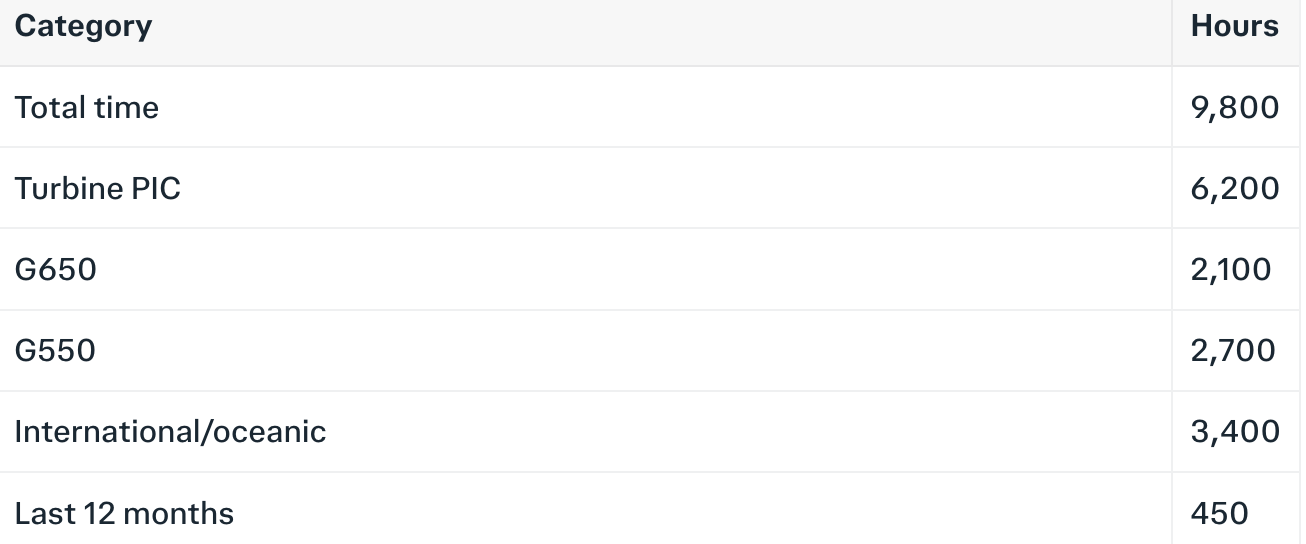
Senior international captain with 9,800 hours total time, 6,200 hours turbine PIC, and G-VI (G650) and GLF5 (G550) type ratings. Fourteen years in Fortune 500 Part 91 flight departments with extensive oceanic, polar, and long-range operations in Europe, Asia, the Middle East, and South America.
Certificates and Ratings
- FAA Airline Transport Pilot, Airplane Multi-Engine Land
- Type Ratings: G-VI, GLF5, CL-604
- FAA First-Class Medical (current)
Flight Time
Aviation Experience
Lead Captain, Gulfstream G650 | Fortune 500 Flight Department, Part 91 | Teterboro, NJ | 2019–Present
- Lead a team of six pilots on a two-aircraft long-range fleet.
- Plan and fly North Atlantic, Pacific, and polar routings, including permits, overflight clearances, and international trip support coordination.
- Helped the department achieve and maintain its third-party safety audit standard.
- Developed a fatigue-risk scheduling guideline adopted by the department.
Captain, Gulfstream G550 | Corporate Flight Department, Part 91 | White Plains, NY | 2012–2019
- Flew executive missions to more than 40 countries.
- Served as international procedures lead and trained new hires on oceanic operations.
Training
- G-VI Recurrent, Part 142 training center, April 2026
- International Procedures and Datalink Recurrent, 2025
- Leadership and Flight Department Management Course, 2024
Why this example works: At this level, numbers alone are expected. The resume differentiates itself through leadership, international planning depth, and safety program contributions.
Common Mistakes That Cost Interviews
- Inconsistent numbers. If totals on your resume, application, and logbook differ, a reviewer may question your attention to detail. Employers are advised to confirm that all claimed flight hours, type ratings, and certifications are accurate and current (ZipRecruiter).
- Burying the type rating. A chief pilot hiring for a Challenger should not have to search for your CL-600 rating.
- Duty lists instead of results. "Flew passengers" says little. "Planned and flew 140 executive legs with zero lost trips" says much more.
- Oversharing confidential details. Never name principals, passengers, or sensitive trip details. Discretion is part of the job, and your resume is the first test.
- Typos and formatting errors. GlobalAir.com notes that spelling and grammar mistakes are widespread in resumes and recommends double- or triple-checking your work and having a trusted friend review it (GlobalAir.com).
- Formatting habits from the past. Avjobs.com advises against putting the word "resume" on your resume and recommends keeping references on a separate sheet.
- One generic resume for every application. GlobalAir.com recommends reading the job description and tying your prior work to the specific characteristics it emphasizes (GlobalAir.com).
Tailoring Your Resume for Each Opening
Before applying, read the posting and note the aircraft, operating rules, base, travel expectations, and minimums. Then adjust your summary, flight time order, and top bullet points so the most relevant experience appears first.
For example, an Entergy posting for a pilot or co-pilot listed a bachelor's degree and years of Part 91, Part 135, or Part 121 passenger experience, along with a requirement to live within a one-hour commute of the base (AllAviationJob.com). A resume aimed at that role should show education, passenger-carrying experience by operating rule, and a location that matches the commute requirement.
If you are coming from Part 135 flying, AllAviationJob.com's guide on how to move from charter flying to corporate aviation explains how to build a clear experience inventory and separate total, PIC, SIC, multi-engine, turbine, jet, and type-specific time. For a broader view of the private sector, see how to get a job in private aviation and corporate flight departments.
After the Resume: Preparing for the Interview
A strong resume earns the interview; the interview earns the offer. One corporate aviation training overview reports that 65% of hiring decisions hinge on soft-skills interviews. Expect questions about technical knowledge, decision-making, CRM, passenger service, and why you want corporate flying rather than an airline career.
AllAviationJob.com's guide to pilot interview questions and how to answer them with confidence breaks interview questions into technical competence, safety and judgment, professionalism and teamwork, and career fit.
If you want personal help polishing your materials, OSI Recruit's job seeker services include resume building and interview preparation for aviation candidates.
The Career Outlook for Corporate Pilots
Demand for qualified pilots remains solid. The U.S. Bureau of Labor Statistics projects employment of airline and commercial pilots to grow 7% from 2025 to 2035, with about 16,400 openings per year on average (BLS). BLS reports a May 2025 median annual wage of $123,220 for commercial pilots, a category that includes many charter and non-airline roles (BLS). Individual corporate compensation varies widely by aircraft, seat, region, and employer.
Type-rated pilots in high-demand aircraft can have an advantage. OSI Recruit's analysis of type ratings and talent supply examines which aircraft are hardest for operators to staff.
For Flight Departments: Hiring the Right Pilot
If you are on the hiring side, a resume is only the beginning of a responsible screening process. Credential review, PRD checks where required, drug and alcohol record requests under 49 CFR 40.25 (FAA), reference calls, and technical and fit interviews all matter. OSI Recruit's aviation recruitment services support corporate flight departments, Part 91 operations, and Part 135 charter operators that need full-time or contract private jet pilots. To discuss an opening, contact OSI Recruit.
Find Your Next Corporate Pilot Job on AllAviationJob.com
Your resume is ready to work for you, so put it in front of the employers who are hiring now.
AllAviationJob.com brings corporate, charter, fractional, airline, helicopter, and specialty flying jobs together in one aviation-focused job board. Browse the latest pilot jobs, filter by the aircraft and location you want, and apply directly to corporate flight departments, from light-jet operators to Fortune 500 long-range fleets.
- Search current openings: Browse pilot jobs on AllAviationJob.com
- Explore every aviation category: View all aviation jobs
- Get discovered by employers: Create your free candidate profile on AllAviationJob.com and upload your updated resume.
Do not let a great resume sit in a folder. Visit AllAviationJob.com today, upload your resume, and take the next step toward the left seat of a corporate jet.
Sources
- AllAviationJob.com, "How Many Flight Hours Do You Need for Different Pilot Jobs?" https://www.allaviationjob.com/blog/how-many-flight-hours-do-you-need-for-different-pilot-jobs-
- AllAviationJob.com, "How to Move From Charter Flying to Corporate Aviation." https://www.allaviationjob.com/blog/how-to-move-from-charter-flying-to-corporate-aviation
- AllAviationJob.com, "How to Get a Job in Private Aviation and Corporate Flight Departments." https://www.allaviationjob.com/blog/how-to-get-a-job-in-private-aviation-and-corporate-flight-departments
- AllAviationJob.com, "Pilot Interview Questions: Answer With Confidence." https://www.allaviationjob.com/blog/pilot-interview-questions-and-how-to-answer-them-with-confidence
- AllAviationJob.com, "Part 91 Corporate Pilot at Kalahari Resorts & Conventions." https://www.allaviationjob.com/jobs/755202361-part-91-corporate-pilot
- AllAviationJob.com, "Pilot or Co-Pilot at Entergy." https://www.allaviationjob.com/jobs/702910756-pilot-or-co-pilot
- Electronic Code of Federal Regulations, 14 CFR 61.51, Pilot Logbooks. https://www.ecfr.gov/current/title-14/chapter-I/subchapter-D/part-61/subpart-A/section-61.51
- Cornell Law School LII, 14 CFR 61.159, Aeronautical Experience: Airplane Category Rating. https://www.law.cornell.edu/cfr/text/14/61.159
- Cornell Law School LII, 14 CFR 135.243, Pilot in Command Qualifications. https://www.law.cornell.edu/cfr/text/14/135.243
- FAA, Legal Interpretation on Pilot in Command Qualifications Under 14 CFR 135.243. https://www.faa.gov/media/11366
- FAA, Advisory Circular 120-68J, Pilot Records Database and Pilot Records Improvement Act. https://www.faa.gov/regulations_policies/advisory_circulars/index.cfm/go/document.information/documentID/1039941
- FAA, Pilot Records Database Final Rule. https://www.faa.gov/sites/faa.gov/files/2021-08/Pilot_Records_Database_Final_Rule.pdf
- FAA, "If I hire a pilot, am I required to query the Pilot Records Database and request drug and alcohol records?" https://www.faa.gov/faq/if-i-hire-pilot-am-i-required-query-pilot-records-database-and-request-drug-and-alcohol-records
- U.S. Bureau of Labor Statistics, Occupational Outlook Handbook: Airline and Commercial Pilots. https://www.bls.gov/ooh/Transportation-and-Material-Moving/Airline-and-commercial-pilots.htm
- TPN Talent, "Corporate and Part 91 Pilot Hiring." https://www.tpntalent.com/resources/corporate-pilot-hiring
- GlobalAir.com, "How to Clean Up Your Aviation Resume." https://www.globalair.com/articles/how-to-clean-up-your-aviation-resume/11179
- ResumeTemplates.com, "Pilot Resume Examples and Templates for 2026." https://www.resumetemplates.com/pilot-resume-examples/
- ZipRecruiter, "Corporate Pilot Hiring Guide for Businesses." https://www.ziprecruiter.com/hiring/how-to-hire/corporate-pilot
- Western Michigan University ScholarWorks, "A Comparative Analysis of Professional Pilot Jobs." https://scholarworks.wmich.edu/cgi/viewcontent.cgi?article=3928&context=honors_theses
- OSI Recruit, Aviation Recruitment. https://www.osirecruit.com/aviation-recruitment
- OSI Recruit, Job Seekers. https://www.osirecruit.com/job-seekers
- OSI Recruit, "Type Ratings and Talent Supply: Which Aircraft Are Hardest to Staff Right Now?" https://www.osirecruit.com/post/type-ratings-and-talent-supply-which-aircraft-are-hardest-to-staff-right-now
- OSI Recruit, Contact. https://www.osirecruit.com/contact-osi