For most professional pilots, the first turbine job is the biggest step in the career. It is the point where you stop renting time in piston trainers and start flying turboprops or jets with crews, dispatchers, and paying customers. Turbine time is also the experience that charter operators, corporate flight departments, and airlines look for when they decide who gets hired next.
That first job can feel hard to reach. Many postings ask for turbine experience, but you can only get turbine experience by getting hired. This guide explains how the path really works: the FAA rules that set the floor, the insurance minimums that often set the real bar, the entry-level roles that hire pilots without turbine time, and the practical steps that help your application stand out.
What Counts as a Turbine Pilot Job
A turbine aircraft is powered by a gas turbine engine. That includes turboprops, such as the Cessna 208 Caravan, Pilatus PC-12, and Beechcraft King Air, and turbojet or turbofan aircraft, such as the Citation, Phenom, Learjet, and airline regional jets.
First turbine jobs usually fall into a few groups:
- Single-pilot turboprop flying, often a Caravan or PC-12 in Part 135 cargo, charter, or commuter work.
- Second-in-command (SIC) roles on twin turboprops or light and midsize jets, usually in Part 135 charter or Part 91 corporate flying.
- Regional airline first officer jobs under Part 121, which need an ATP or a Restricted ATP and a type rating.
- Specialty work such as air ambulance, skydiving operations, survey flying, or government and contract flying.
Each group has different hour requirements, so the right first target depends on where your logbook is today.
Know the Regulatory Minimums
Federal Aviation Regulations set the legal minimums. Employers and insurers often require more, but you need to understand the floor before you can plan your climb.
Part 135 Pilot in Command
Under 14 CFR 135.243, a pilot in command (PIC) of a Part 135 flight under IFR must hold at least a commercial pilot certificate and an instrument rating. The pilot must also have at least 1,200 hours of flight time, including 500 hours of cross-country time, 100 hours of night time, and 75 hours of actual or simulated instrument time, with at least 50 of those instrument hours in actual flight. VFR-only PIC work under the same section has lower minimums, but most turbine flying is done under IFR.
The same rule requires an Airline Transport Pilot (ATP) certificate to act as PIC in passenger-carrying operations in a turbojet, in an airplane with 10 or more passenger seats, or in a multiengine airplane in commuter operations. The FAA has clarified in a legal interpretation that this ATP requirement covers passenger-carrying flights, so all-cargo PIC jobs fall under the 1,200-hour IFR standard instead. This is one reason turboprop cargo flying is a popular first turbine job.
Second-in-Command Qualifications
Under 14 CFR 61.55, an SIC on an aircraft that needs two pilots must hold at least a private pilot certificate with the right category and class rating, an instrument rating for IFR flights, and SIC familiarization training in that aircraft type within the previous 12 calendar months. That training includes three takeoffs and three landings to a full stop, engine-out procedures, and crew resource management training.
For domestic flying within U.S. airspace, an SIC type rating is not required. For international flying, the SIC must hold at least an "SIC Privileges Only" pilot type rating, which can be issued without a practical test once the training is done. The National Business Aviation Association explains this process in detail. In practice, Part 135 operators also require their SICs to hold a commercial certificate with an instrument rating, as stated in 14 CFR 135.245.
Type Ratings
Under 14 CFR 61.31, a pilot acting as PIC of a turbojet-powered airplane or a large aircraft (more than 12,500 pounds maximum certificated takeoff weight) must hold a type rating for that aircraft. That is why a Citation needs a type rating while a Caravan or King Air 200 does not, even though both are turbine aircraft. AOPA notes that a heavier turboprop such as the King Air 350 also needs a type rating because of its weight.
Airline Transport Pilot Certificate
For Part 121 airline flying, both pilots need an ATP certificate and a type rating for the aircraft. Under 14 CFR 61.159, the standard ATP requires 1,500 hours of total time, including 500 hours of cross-country time, 100 hours of night time, 75 hours of instrument time, 250 hours as PIC, and 50 hours in the class of airplane. Applicants must be at least 23.
Under 14 CFR 61.160, a Restricted ATP (R-ATP) lets some pilots qualify sooner:
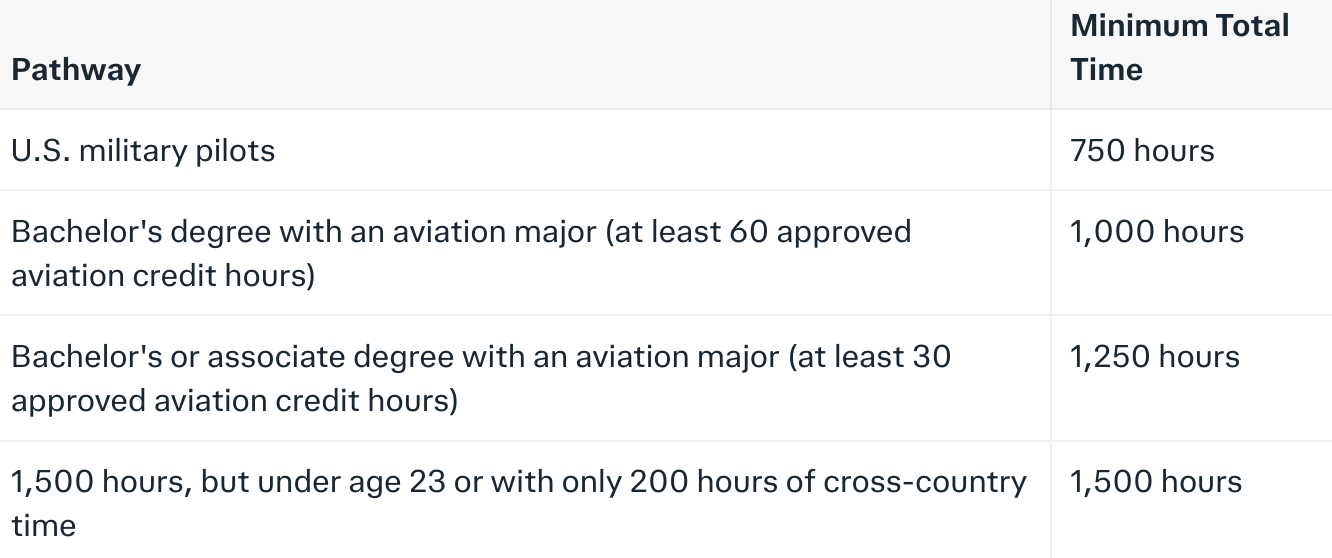
R-ATP applicants must be at least 21. FAA guidance confirms that an R-ATP allows a pilot to serve as SIC in Part 121 operations until reaching the full ATP standard. Every ATP applicant for a multiengine rating must also complete the ATP Certification Training Program (ATP CTP) before taking the knowledge test.
Understand the Insurance Factor
The FAA sets the legal floor, but an operator's insurance underwriter often sets the real hiring minimum. This is one of the most important facts for a pilot chasing a first turbine job.
Insurers look at total time, multiengine time, time in type, and the training you have completed. Underwriting standards vary widely by aircraft, operator, and mission. For example, an AOPA report on turbine insurance found that 1,000 total hours was a common target for first-time turbine pilots. The same report found that insurers often wanted 500 hours of multiengine time for a twin turboprop. Insurers also usually require approved initial training for the type, and often recurrent training each year.
For job seekers, this has three practical effects:
- A posting's "minimum" may be an insurance number, not a legal one. If you are close, apply anyway and say so clearly. Some operators can add a pilot to the policy with extra training or supervised time.
- Multiengine time matters. Many twin-turbine jobs depend on multiengine hours, so log them wherever you can.
- Time in type is valuable. Once you have some hours in a Caravan, King Air, or PC-12, the next job in that type gets easier to win.
Build the Right Kind of Flight Time
Total hours alone will not land a turbine job. Hiring managers look closely at what kind of time you have and how you earned it.
- Instrument experience. Part 135 IFR PIC work requires 75 hours of instrument time, with at least 50 in actual flight. Look for flying that puts you in real weather, such as instructing in instrument-heavy areas or flying cargo routes.
- Cross-country and night time. Both are required for Part 135 PIC and ATP minimums. Plan your hour-building to cover them rather than circling the local practice area.
- Multiengine time. Multiengine instructing, piston twin charter, and freight flying all help. Multiengine time also counts toward the ATP class requirement.
- PIC time. The ATP requires 250 hours as PIC, and insurers and employers look at PIC time when judging judgment and decision-making.
- Professional flying. Flight instructing remains the most common path from 250 hours to turbine minimums. Banner towing, aerial survey, pipeline patrol, skydive flying, and piston cargo work also build useful time. Flying for an operator that also runs turbine aircraft is a smart move, because internal upgrades are common.
If you are still choosing a training path, a structured Part 141 program tied to an R-ATP-eligible degree can reduce the hours you need for an airline job. You can compare options in the AllAviationJob.com Flight Schools listings and the Aviation School Directory.
Target the Right Entry-Level Turbine Jobs
Match your applications to your current experience. Here is how the main entry points usually line up, though every operator sets its own standards.
Single-Engine Turboprop Cargo and Charter
Caravan and PC-12 operators often hire pilots near the 1,200-hour Part 135 IFR PIC minimum. All-cargo operations do not require an ATP for PIC, as noted above. These jobs build turbine PIC time quickly and teach you to handle weather, schedules, and single-pilot workload.
Second-in-Command on Twin Turboprops and Jets
SIC roles on King Airs, Citations, Phenoms, and similar aircraft can start below Part 135 PIC minimums, because the SIC rules are less demanding. These jobs teach crew coordination, standard operating procedures, and the customer service side of charter and corporate flying. They also position you for an upgrade once you meet PIC and insurance minimums.
Regional Airline First Officer
Regional airlines hire first officers who hold an ATP or R-ATP. Many offer structured training, a clear seniority system, and a path to captain. To learn more about this route, read Regional Airline Pilot Jobs: What to Expect Before You Apply.
Corporate Flight Departments
Part 91 corporate departments often hire SICs who already have some turbine time, but networking and a strong reference can open doors earlier. If you start in charter and later want corporate work, see How to Move from Charter Flying to Corporate Aviation. You can also browse Flight Department jobs on AllAviationJob.com.
Military Pilots
Military pilots often have turbine time already and can qualify for an R-ATP at 750 hours. The main task is translating military experience into civilian terms. See How Military Veterans Can Launch Civilian Aviation Careers.
Prepare Your Records and Background
Turbine employers check backgrounds carefully, so get your records in order before you apply.
The Pilot Records Database
Under 14 CFR Part 111, Part 119 certificate holders, fractional ownership programs, and certain air tour operators must review a pilot's records in the FAA Pilot Records Database (PRD) before letting that pilot begin service. The PRD holds FAA certificate data, accident and incident data, enforcement history, drug and alcohol testing records, training records from past employers, and the employment history the pilot provides. According to the FAA, pilots control who can see their PRD records, so you will need to grant consent to each employer that reviews them.
Before you apply, log in to the PRD, check that your employment history is complete and accurate, and fix any errors. A clean, complete record makes the process faster.
Logbooks and Documents
- Make sure your logbook totals are correct and that categories such as PIC, cross-country, night, instrument, and multiengine are clearly separated.
- Keep copies of your certificates, medical, passport, and training records.
- Know your numbers by heart. Interviewers often ask for totals in specific categories.
- Be ready to explain any checkride failure, accident, incident, or gap in employment honestly and briefly. Employers will see this information through the PRD and background checks, so honesty matters.
Build a Résumé That Gets Noticed
A pilot résumé should be clear, factual, and easy to scan. Recruiters and chief pilots often review many applications at once.
- Lead with your flight time summary. List total time, PIC, multiengine, turbine (if any), instrument (actual and simulated), night, and cross-country.
- List certificates and ratings clearly. Include your medical class and the date it was issued.
- Show relevant experience. For each flying job, list the aircraft, type of operation (Part 91, 135, 141), and your duties.
- Highlight safety and professionalism. Mention instructing achievements, standardization roles, or safety program work.
- Keep it to one page unless your experience truly needs more.
AllAviationJob.com offers free aviation resume templates built for pilots and other aviation professionals.
Prepare for the Interview
Turbine interviews usually combine a technical assessment, a personal interview, and sometimes a simulator evaluation.
Technical Preparation
- Review regulations that apply to the operation, especially Parts 91, 135, and 121 where relevant.
- Brush up on instrument procedures, approach charts, weather, and performance planning.
- Learn the basics of the aircraft you would fly, including turbine engine operation and systems.
- If a simulator check is part of the process, practice instrument flying and crew procedures beforehand.
Personal Interview
Expect behavioral questions such as "Tell me about a time you disagreed with a captain" or "Describe a time you made a mistake in the aircraft." Use clear, short stories that show good judgment, honesty, and teamwork. Learn about the company's fleet, routes, safety culture, and customers before the interview.
If you are aiming for a captain or PIC seat later, read What Is a PIC Job? Understanding Pilot-in-Command Requirements to understand what employers expect.
Use Your Network and a Recruiter
Many first turbine jobs are filled through referrals. Stay in touch with former students, instructors, and fellow pilots who have moved on to charter, corporate, or airline flying. Attend aviation events and job fairs, and keep track of upcoming opportunities through the AllAviationJob.com Aviation Events calendar.
An aviation recruiter can also help, especially for charter and corporate roles that are not widely advertised. OSI Recruit works with aviation employers to fill pilot, maintenance, and support roles. Pilots can learn how OSI Recruit supports candidates on the OSI Recruit Job Seekers page.
Understand Pay and Career Outlook
According to the U.S. Bureau of Labor Statistics (BLS), the median annual wage for airline pilots, copilots, and flight engineers was $232,140 in May 2025. The median for commercial pilots, a group that includes charter and many corporate pilots, was $123,220. The BLS projects that overall employment of airline and commercial pilots will grow 7 percent from 2025 to 2035, which it describes as much faster than the average for all occupations.
Long-term demand also looks strong. Boeing's 2025 Pilot and Technician Outlook projects that the commercial aviation industry will need 660,000 new pilots worldwide from 2025 to 2044. North America alone will need about 119,000 of them.
Starting pay in a first turbine job is often well below these medians. Wages rise quickly as you gain turbine time, upgrade to PIC, and move to larger aircraft. For current pay data across aviation roles, see the AllAviationJob.com Salary Report.
Review Training Agreements Carefully
Some operators pay for initial training and type ratings, which can be worth thousands of dollars. In return, they may ask you to sign a training agreement or repayment contract. Before you sign, make sure you understand:
- How long you must stay with the company.
- How much you would owe if you leave early, and whether the amount decreases over time.
- What happens if the company furloughs you or ends your employment.
A training agreement is not always a bad deal, but you should understand it fully before committing.
Your First Turbine Job Checklist
- Confirm which regulatory minimums apply to your target job: Part 135 PIC, SIC under 61.55, or ATP/R-ATP for Part 121.
- Build instrument, cross-country, night, multiengine, and PIC time on purpose.
- Research insurance-driven minimums for the aircraft you want to fly.
- Review your Pilot Records Database profile and fix any errors.
- Organize your logbooks and documents.
- Prepare a clean, one-page pilot résumé.
- Study for technical, behavioral, and simulator assessments.
- Network actively and consider working with an aviation recruiter.
- Read every training agreement before you sign.
Find Your First Turbine Pilot Job on AllAviationJob.com
Your first turbine job is waiting, and the right employer is already looking for pilots like you. AllAviationJob.com brings together pilot openings from charter operators, corporate flight departments, cargo carriers, air ambulance providers, and airlines, all in one place.
- Browse current pilot jobs and filter for turboprop, jet, SIC, and first officer roles.
- Create your free candidate profile so employers and recruiters can find you.
- Explore aviation companies to research operators before you apply.
- Download free resume templates to put your best logbook forward.
Do not wait for the perfect posting. Register today at AllAviationJob.com, set up your profile, and start applying for the turbine jobs that will move your career forward.
Sources
- Electronic Code of Federal Regulations, 14 CFR Part 61 Subpart G, Airline Transport Pilots (§ 61.159 and § 61.160): https://www.ecfr.gov/current/title-14/chapter-I/subchapter-D/part-61/subpart-G
- Cornell Law School Legal Information Institute, 14 CFR § 135.243, Pilot in command qualifications: https://www.law.cornell.edu/cfr/text/14/135.243
- Federal Aviation Administration, Legal interpretation on pilot in command qualifications under 14 CFR § 135.243: https://www.faa.gov/media/11366
- Cornell Law School Legal Information Institute, 14 CFR § 61.55, Second-in-command qualifications: https://www.law.cornell.edu/cfr/text/14/61.55
- National Business Aviation Association, Second-In-Command Type Rating: https://nbaa.org/flight-department-administration/personnel/sic/
- Cornell Law School Legal Information Institute, 14 CFR § 61.31, Type rating requirements: https://www.law.cornell.edu/cfr/text/14/61.31
- AOPA, Mentor Matters: Type ratings 101: https://www.aopa.org/news-and-media/all-news/2017/march/pilot/turbine-type-ratings
- Federal Aviation Administration, Notice N 8900.225, Pilot Certification and Qualification Requirements: https://www.faa.gov/documentlibrary/media/notice/n_8900.225.pdf
- Federal Aviation Administration, Airline Transport Pilot Training and ATP CTP: https://www.faa.gov/pilots/training/atp
- AOPA, Turbine Pilot (insurance requirements for turbine aircraft): https://www.aopa.org/news-and-media/all-news/1994/october/01/turbine-pilot-(12)
- Cornell Law School Legal Information Institute, 14 CFR § 111.105, Evaluation of pilot records: https://www.law.cornell.edu/cfr/text/14/111.105
- Federal Aviation Administration, Advisory Circular 120-68J, Pilot Records Database and Pilot Records Improvement Act: https://www.faa.gov/documentLibrary/media/Advisory_Circular/AC_120-68J.pdf
- U.S. Bureau of Labor Statistics, Occupational Outlook Handbook, Airline and Commercial Pilots: https://www.bls.gov/ooh/transportation-and-material-moving/airline-and-commercial-pilots.htm
- Boeing, Pilot and Technician Outlook 2025–2044: https://www.boeing.com/content/dam/boeing/v2/products/pilot-technician-outlook/pdf/2025-pto-download.pdf
- Boeing Global Services, 435,000 New Aviation Jobs Coming to North America: https://services.boeing.com/news/north-america-435k-new-aviation-jobs