Earning your commercial pilot certificate is a major milestone. It is the first FAA certificate that allows you to be paid to fly. However, most new commercial pilots quickly discover an uncomfortable truth: the certificate opens the door, but flight time is what gets you through it.
Airlines, charter operators, and corporate flight departments hire on experience. For most pilots, that means building from roughly 250 hours to 1,500 hours or more. This is often called the "time-building" phase, and how you spend it shapes the quality of your logbook, your skills, and your future job options.
This guide explains the hour requirements that drive pilot hiring, the most practical ways to build flight time, how to log time correctly, and the legal pitfalls that can put your certificate at risk. If you are ready to start looking now, browse current pilot jobs on AllAviationJob.com.
Why Flight Time Matters So Much
Flight time is not just a number. Regulators and employers use it as a baseline measure of exposure, judgment, and experience. Several key thresholds define the professional pilot career path.
The ATP Certificate: 1,500 Hours (or Less With Restricted Privileges)
To serve as a first officer at a U.S. Part 121 airline, a pilot generally needs an Airline Transport Pilot (ATP) certificate. Under 14 CFR § 61.159, an applicant for an ATP with an airplane category rating needs at least 1,500 hours of total time as a pilot, including:
- 500 hours of cross-country time
- 100 hours of night flight time
- 50 hours in the class of airplane for the rating sought
- 75 hours of instrument time, in actual or simulated conditions
- 250 hours as pilot in command (or as second in command performing PIC duties under supervision), including 100 hours of cross-country and 25 hours of night time
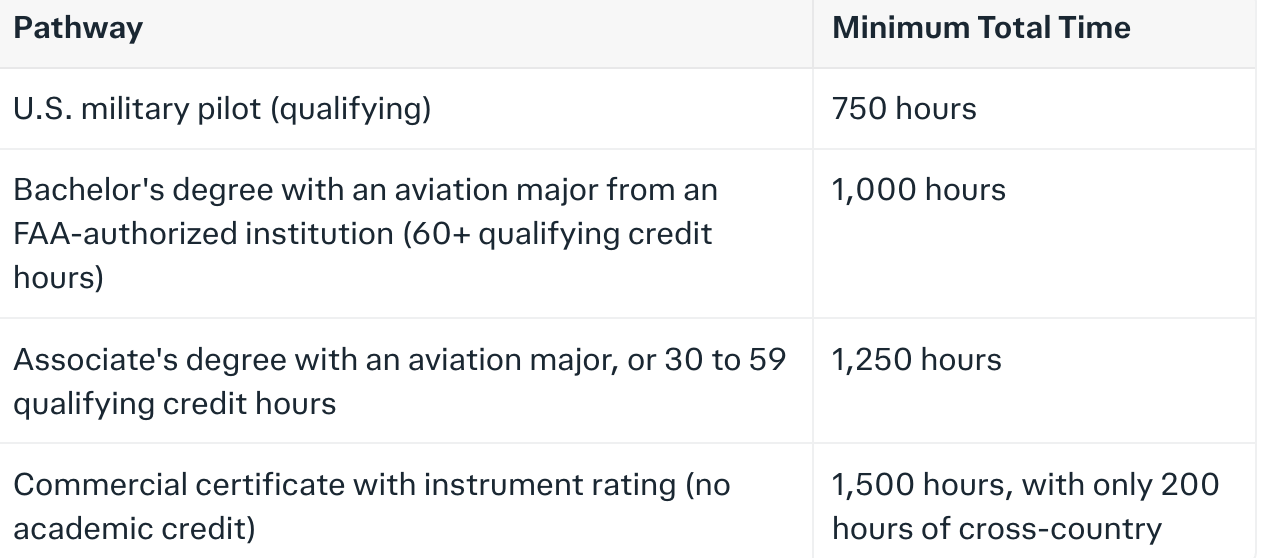
Some pilots qualify for a Restricted ATP (R-ATP) with fewer hours. Under 14 CFR § 61.160, the minimums are:
If you are a veteran, our military-to-civilian aviation transition guide explains how military experience can translate into civilian flying careers.
Part 135 Pilot-in-Command Minimums
Charter and on-demand flying also has experience thresholds. Under 14 CFR § 135.243, a Part 135 pilot in command generally needs:
- VFR operations: At least 500 hours as a pilot, including 100 hours of cross-country time, of which 25 hours must be at night.
- IFR operations: At least 1,200 hours as a pilot, including 500 hours of cross-country time, 100 hours of night time, and 75 hours of instrument time (at least 50 of which were in actual flight).
Certain Part 135 operations, such as PIC of turbojet airplanes or airplanes with 10 or more passenger seats, require an ATP certificate. These numbers matter because they create natural "steps" in your career: 500 hours, 1,200 hours, and 1,500 hours are common milestones that unlock new opportunities.
To understand how these two regulatory environments differ, read Part 91 vs. Part 135 Pilot Jobs: Key Career Differences.
The Best Ways to Build Flight Time
There is no single "best" option for every pilot. The right choice depends on your ratings, location, finances, and long-term goals. Below are the most common and reputable paths.
1. Become a Certified Flight Instructor (CFI)
Flight instructing remains the most common way for commercial pilots to build time, and for good reason. To be eligible for an airplane flight instructor certificate under 14 CFR § 61.183, you must hold a commercial or ATP certificate with the appropriate category and class rating, hold an instrument rating, pass the required knowledge and practical tests, and log at least 15 hours as PIC in the category and class for the rating sought.
Why it works:
- You are paid to fly. Instead of paying for every hour, you earn income while logging time.
- PIC time accrues quickly. Under 14 CFR § 61.51(e)(3), a certificated flight instructor may log PIC time for all flight time while serving as the authorized instructor, if rated to act as PIC of that aircraft.
- Skills improve dramatically. Teaching forces you to master procedures, regulations, and aircraft systems at a deeper level.
- Airlines value it. Many airlines and regional carriers recruit directly from flight school instructor pools.
Additional ratings to consider:
- CFII (instrument instructor): Lets you teach instrument students, which helps you log instrument-related experience and makes you more valuable to a flight school.
- MEI (multiengine instructor): Multi-engine time is scarce and valuable. Becoming an MEI is one of the most efficient ways to build it.
Things to watch: Hours can vary with weather, seasonality, and student volume. Instructing in a region with good year-round weather often builds time faster. When evaluating schools, ask how many active students each instructor has and how many hours instructors typically log per month.
To compare training providers, explore the AllAviationJob.com Flight Schools page and the Aviation School Directory. If you are interested in instructing at a higher level later in your career, see How to Become an Airline Instructor Pilot.
2. Aerial Work Operations
Federal rules carve out several commercial flying activities that do not require a Part 119 air carrier certificate. Under 14 CFR § 119.1(e), these include aerial work such as:
- Banner towing
- Aerial photography or survey
- Powerline or pipeline patrol
- Crop dusting, seeding, and spraying
- Firefighting
- Ferry and training flights
- Nonstop flights for parachute operations within 25 statute miles of the departure airport
A commercial pilot may legally be paid for these operations, provided the pilot and operation meet all applicable rules. Here is how the most common options compare.
Banner towing. Banner towing is a classic entry-level job, especially in coastal and seasonal markets. It builds stick-and-rudder skills and hours quickly, though much of the time is low-altitude, local, and daytime VFR. That means it may not add much cross-country, night, or instrument time.
Aerial survey and photography. Survey flying often involves long, precise flight lines at altitude, sometimes in twin-engine aircraft. It can build substantial cross-country time and develop disciplined, precise flying habits. Jobs may require travel for weeks at a time.
Pipeline and powerline patrol. Patrol flying involves visually inspecting infrastructure from low altitude. It typically offers steady, predictable hours and often counts as cross-country time when flights meet the regulatory definition used for the certificate or rating sought.
Skydiving operations. Flying jumpers is a short, repetitive mission with frequent takeoffs, climbs, and descents. It builds hours and engine-management skills, but individual flights are usually short and local.
Agricultural aviation. Ag flying is demanding, specialized, and often well paid for experienced pilots. Operators frequently require additional training and experience, and operations fall under Part 137. It is best suited to pilots who are interested in agriculture aviation as a long-term specialty, not just as a stepping stone.
3. Ferry and Aircraft Delivery Flights
Ferry flights, which involve repositioning aircraft for sales, maintenance, or delivery, are listed among the operations excluded from Part 119 in 14 CFR § 119.1(e)(3). They can provide valuable cross-country experience, exposure to different aircraft types, and real-world flight planning, weather, and navigation decisions.
Most ferry companies prefer pilots with more experience, so ferry work is usually a second-stage option once you have several hundred hours. Insurance requirements can also limit opportunities for very low-time pilots.
4. Part 135 Charter and Cargo Flying
Once you reach Part 135 minimums, on-demand charter or small cargo operators can be an excellent source of high-quality time. Freight flying in single-engine and light twin aircraft, for example, often involves night and instrument flying, which helps fill some of the most demanding ATP requirements.
Second-in-command professional development programs. 14 CFR § 61.159(c) allows a commercial pilot employed by a Part 135 operator to log SIC time toward the ATP in aircraft that do not normally require a second pilot, provided the time is earned in an FAA-approved SIC professional development program under § 135.99. This time cannot be logged as PIC and cannot be used toward the 250-hour PIC requirement, but it can help build total time and real-world operational experience.
The corporate and charter world offers strong long-term career paths. Browse Flight Department jobs or review operators on the AllAviationJob.com Companies page to see who is hiring.
5. Commercial Air Tours (Sightseeing)
Under 14 CFR § 119.1(e)(2), certain nonstop commercial air tours that begin and end at the same airport and stay within 25 statute miles may operate under a Letter of Authorization issued under § 91.147, rather than under a Part 135 certificate. Tour flying can provide paid flight time and excellent customer-service experience, but the flights are typically short and local.
6. Helicopter and Specialty Category Paths
If you fly rotorcraft, the time-building path is different but equally structured. Many helicopter pilots build time as flight instructors before moving into tour, utility, offshore, or emergency medical service flying. Learn more in Helicopter Pilot Careers: Jobs, Qualifications, and Hiring Paths.
7. Personal Flying and Strategic Rental
Some pilots choose to rent or buy time to accelerate specific requirements, such as night or cross-country time. This can be useful for filling targeted gaps, but it is the most expensive approach and does not produce income.
If you rent, plan with purpose:
- Fly long cross-country trips that also meet the cross-country definition required by the ATP rules.
- Schedule night flights strategically. Under 14 CFR § 61.159(b), after 20 night takeoffs and landings to a full stop, each additional night takeoff and landing to a full stop may substitute for one hour of night flight time, up to a maximum of 25 hours.
- Consider shared instrument practice with another qualified pilot acting as safety pilot, as permitted under 14 CFR § 91.109(c). Each pilot logs only the time they are legally entitled to log.
8. Simulator and Training Device Time
Simulator training improves proficiency, but it has strict limits for ATP credit. Under 14 CFR § 61.159(a)(6), no more than 100 hours of the total ATP experience requirement may come from a full flight simulator or flight training device, and only when completed in an approved training course under Part 121, 135, 141, or 142. Treat simulators as a skill-building tool rather than a primary method of building hours.
Understanding What You Can (and Cannot) Log
Accurate logbook records are essential. Employers, recruiters, and examiners will review your entries carefully. 14 CFR § 61.51 explains the key rules.
- Pilot-in-command time. A commercial pilot may log PIC time when they are the sole manipulator of the controls of an aircraft for which they are rated, when they are the sole occupant, or when acting as PIC of an aircraft that requires more than one pilot.
- Second-in-command time. SIC time may generally be logged only when more than one pilot is required by the aircraft's type certificate or by the regulations under which the flight is conducted, or under an approved Part 135 SIC professional development program.
- Instrument time. You may log instrument time only when operating the aircraft solely by reference to instruments in actual or simulated instrument conditions.
- Training time. Training received from an authorized instructor must be logged and endorsed by that instructor.
Logbook best practices:
- Keep a digital logbook backed up, along with your paper logbook.
- Track totals by category: total time, PIC, cross-country, night, instrument (actual and simulated), multi-engine, and turbine.
- Reconcile your totals regularly so they match exactly what you list on applications.
When you are ready to present that experience, use AllAviationJob.com Resume Templates to build a clean, professional pilot resume. OSI Recruit also offers free aviation resume samples.
Avoid the Biggest Time-Building Mistake: Illegal Charter
New commercial pilots are eager to fly, and that eagerness can lead to risky decisions. One of the most serious is accepting a flight that is actually an illegal charter.
Your commercial certificate allows you to be paid to fly, but the operation itself must also be legal. Under 14 CFR § 61.133, a commercial pilot may act as PIC for compensation or hire only when qualified under the applicable rules that apply to the operation. When an aircraft is offered for hire for air transportation, the operator generally needs a Part 135 or Part 121 certificate.
The FAA defines compensation broadly. According to the FAA's Safe Air Charter Team, compensation can include receiving anything of value, the promise of anything of value, or even the accrual of flight time. That means "free time" in someone else's airplane, flown in exchange for transporting passengers, can still create a serious legal problem.
Red flags to watch for:
- Someone offers you "free hours" to fly people or cargo in their aircraft.
- The arrangement relies on flight sharing, "time sharing," or a lease structure that seems designed to avoid certification.
- You are coached on what to say if an FAA inspector asks questions.
- The operator cannot show an Air Carrier or Operating Certificate.
The consequences can include civil penalties and possible certificate action. When in doubt, ask for the operator's certificate and operations specifications, and verify them before accepting the flight. The FAA's Safe Air Charter resources are a good starting point.
Building Quality Time, Not Just Quantity
Reaching 1,500 hours is important, but hiring managers look at more than total time. A well-rounded logbook tells a stronger story. Aim to balance:
- Cross-country experience, which demonstrates planning and navigation skills.
- Actual instrument time, which builds confidence in real weather.
- Night flying, which is required for multiple certificates and Part 135 PIC minimums.
- Multi-engine time, which is especially valued by airlines and charter operators.
- Turbine experience, which can make you more competitive for corporate, charter, and regional jobs.
Equally important is your safety record and professionalism. A clean record, strong references, and a reputation for sound judgment can matter as much as hours when a chief pilot or recruiter reviews your application.
A Sample Time-Building Roadmap
Every career is different, but the following progression is common for U.S. airplane pilots:
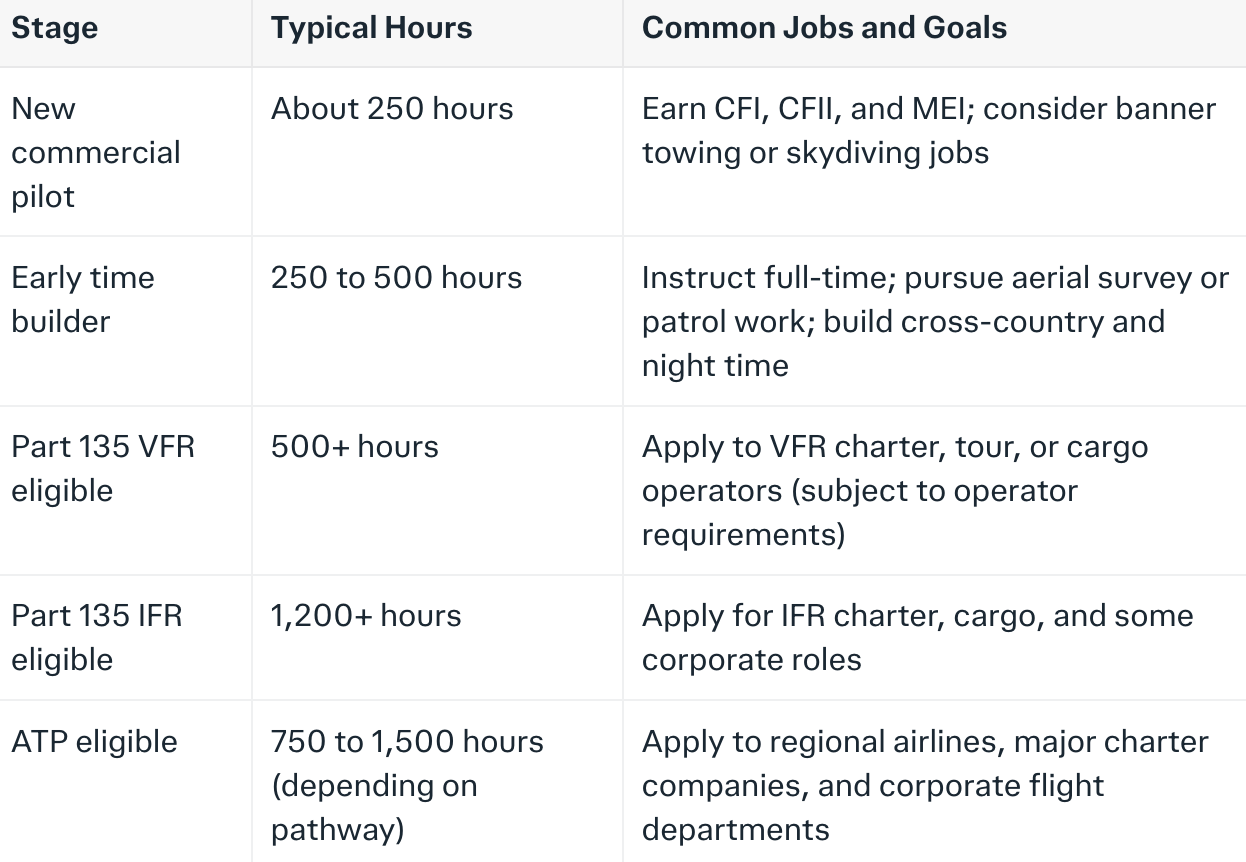
Use this roadmap as a planning tool, not a guarantee. Individual employers often set higher minimums than the FAA requires, and insurance requirements can also affect hiring.
Career Outlook for Commercial Pilots
The long-term outlook remains positive. According to the U.S. Bureau of Labor Statistics, employment of airline and commercial pilots is projected to grow 7 percent from 2025 to 2035, much faster than the average for all occupations, with about 16,400 openings projected each year. The BLS also reports that the median annual wage for commercial pilots was $123,220 in May 2025, while airline pilots, copilots, and flight engineers earned a median of $232,140.
For a closer look at compensation trends across aviation roles, review the AllAviationJob.com Salary Report.
How Recruiters Can Help You Move Forward
As you approach key hour milestones, working with an aviation recruiter can help you identify employers whose minimums match your logbook. OSI Recruit supports pilots and other aviation professionals through its Job Seekers resources and dedicated aviation recruitment services. Before your next interview, review OSI Recruit's Interview Prep Tips to prepare for technical, scenario-based, and behavioral questions.
Are you an operator or flight school looking for instructors, first officers, or captains? Visit the OSI Recruit Employers page to learn how a specialized aviation recruiter can help you find qualified pilots.
Final Thoughts
The years between your commercial certificate and your ATP are some of the most important in your flying career. They shape your skills, your judgment, and your professional reputation. The best approach is usually a combination of paid flying, targeted training, and careful record-keeping.
Start with legal, reputable opportunities. Build a balanced logbook. Protect your certificate. And keep your long-term goal in view, whether that is the airlines, corporate aviation, charter, or a specialized flying niche.
Ready to Turn Your Hours Into a Flying Career?
Your next flying job could be one click away. AllAviationJob.com connects pilots at every stage with employers who are hiring now, from flight schools and banner-tow operators to charter companies, corporate flight departments, and airlines.
- Browse Pilot Jobs to find flight instructor, time-building, charter, and corporate opportunities.
- Explore Minimal-Experience Jobs to find roles open to newer aviation professionals.
- Create Your Free Job Seeker Profile so employers can find you as your hours grow.
Do not wait until you hit 1,500 hours to start building your network. Join AllAviationJob.com today and take the next step toward the cockpit you are working for.
Sources
- Electronic Code of Federal Regulations, 14 CFR § 61.159, "Aeronautical experience: Airplane category rating." Cornell Law School Legal Information Institute. https://www.law.cornell.edu/cfr/text/14/61.159
- Electronic Code of Federal Regulations, 14 CFR § 61.160, "Aeronautical experience—airplane category restricted privileges." Cornell Law School Legal Information Institute. https://www.law.cornell.edu/cfr/text/14/61.160
- Electronic Code of Federal Regulations, 14 CFR § 135.243, "Pilot in command qualifications." Cornell Law School Legal Information Institute. https://www.law.cornell.edu/cfr/text/14/135.243
- Electronic Code of Federal Regulations, 14 CFR § 61.183, "Eligibility requirements" (flight instructor). Cornell Law School Legal Information Institute. https://www.law.cornell.edu/cfr/text/14/61.183
- Electronic Code of Federal Regulations, 14 CFR § 61.51, "Pilot logbooks." Cornell Law School Legal Information Institute. https://www.law.cornell.edu/cfr/text/14/61.51
- Electronic Code of Federal Regulations, 14 CFR § 119.1, "Applicability." Cornell Law School Legal Information Institute. https://www.law.cornell.edu/cfr/text/14/119.1
- Electronic Code of Federal Regulations, 14 CFR § 61.133, "Commercial pilot privileges and limitations." Cornell Law School Legal Information Institute. https://www.law.cornell.edu/cfr/text/14/61.133
- Electronic Code of Federal Regulations, 14 CFR § 91.109, "Flight instruction; Simulated instrument flight and certain flight tests." Cornell Law School Legal Information Institute. https://www.law.cornell.edu/cfr/text/14/91.109
- Federal Aviation Administration, AC 61-65K, "Certification: Pilots and Flight and Ground Instructors." https://www.faa.gov/documentLibrary/media/Advisory_Circular/AC_61-65K.pdf
- Federal Aviation Administration, "Safe Air Charter." https://www.faa.gov/charter
- Federal Aviation Administration, FAA Safety Briefing, September/October 2023, "How to Protect Your Certificate and Prevent an Illegal Air Charter." https://www.faa.gov/sites/faa.gov/files/SepOct2023.pdf
- Federal Aviation Administration, "Pilots, Owners, and Operators," Safe Charter Operations. https://www.faa.gov/about/initiatives/safecharteroperations/pilots-owners-and-operators
- U.S. Bureau of Labor Statistics, Occupational Outlook Handbook, "Airline and Commercial Pilots." https://www.bls.gov/ooh/transportation-and-material-moving/airline-and-commercial-pilots.htm