Helicopter pilots fly some of the most demanding and varied missions in aviation. On a given day, one rotorcraft pilot may carry a critical patient to a trauma center, another may shuttle crews to an offshore platform, and a third may hold a long line steady over a wildfire. Few flying careers offer this mix of mission variety, hands-on airmanship, and public service.
The path into this profession is also distinct. Helicopter careers have their own certificates, their own flight-hour bottlenecks, and their own hiring standards, many of which are set by insurers and contract customers rather than by the FAA alone. This guide explains the jobs available, the qualifications employers require, and the realistic hiring paths that take a pilot from first lesson to a professional cockpit.
If you are ready to start looking now, you can browse current pilot jobs on AllAviationJob.com while you read.
What Helicopter Pilots Do
The U.S. Bureau of Labor Statistics (BLS) groups helicopter pilots within the broader "commercial pilots" occupation, which covers unscheduled flying such as charter, aerial tours, aerial application, and similar work. The BLS notes that pilots who fly at low levels, such as helicopter pilots, must constantly watch for trees, bridges, power lines, transmission towers, and other obstacles. Pilots on rescue missions may fly low in bad weather or at night and land in areas surrounded by power lines and highways.
Beyond the flying itself, the job typically includes:
- Preflight planning, including weather, performance, weight-and-balance, and fuel calculations.
- Thorough preflight inspections and post-flight documentation.
- Risk assessment before accepting a mission, particularly in air medical and utility work.
- Coordination with dispatchers, medical crews, ground teams, passengers, or customers.
- Compliance with Federal Aviation Regulations, company operations manuals, and customer contract standards.
Because many helicopter operations are single-pilot, the pilot in command (PIC) carries a significant share of decision-making responsibility. That is one reason employers look so closely at experience, judgment, and safety record.
Helicopter Pilot Jobs by Sector
Helicopter employment is spread across several specialized sectors. Each has its own aircraft, schedules, and hiring standards.
Flight Instruction (CFI-H)
For most civilian pilots, the first paid job is as a Certified Flight Instructor – Helicopter (CFI-H). Instructing allows a new commercial pilot to log PIC time while being paid to teach. Many training fleets use Robinson R22 and R44 helicopters, which are subject to Special Federal Aviation Regulation (SFAR) No. 73. Under SFAR 73, an instructor must have logged at least 200 flight hours in helicopters, including at least 50 hours in the relevant Robinson model, and must receive a specific endorsement before providing instruction in those aircraft. This is an important planning detail: a newly certificated CFI-H may need to build hours before teaching in a Robinson-equipped school.
Tour and Sightseeing Operations
Tour flying is a common second job. Operators in destinations such as Hawaii, the Grand Canyon, Las Vegas, Alaska, and New York hire pilots who have built time as instructors. Industry reporting has noted that operators such as TEMSCO Helicopters have used 1,000 hours as a minimum for tour flying and 1,500 hours for utility work. Tour flying builds turbine time, passenger-handling skills, and experience in demanding terrain and weather.
Helicopter Air Ambulance (HAA / HEMS)
Air medical work is one of the most sought-after helicopter careers. It is also one of the most experience-intensive. Air Methods, one of the largest U.S. air medical operators, lists these minimums for its rotor-wing VFR program: 2,000 total flight hours (at least 1,500 in category), 1,000 hours PIC in category, 500 hours of rotor-wing turbine time, 200 hours of cross-country time (at least 50 at night), 100 hours of unaided night PIC time, and 50 hours of actual or hood instrument time. Its IFR program requires 2,500 total hours, along with additional cross-country and instrument experience. allaviationjob The company states that its pilots typically work a seven-on, seven-off rotation of 12-hour shifts and fly roughly 200 to 300 hours per year. allaviationjob
Federal rules add a further requirement. Under 14 CFR 135.603, a pilot in command of a helicopter air ambulance operation must hold a helicopter instrument rating, or an airline transport pilot (ATP) certificate with the appropriate category and class rating that is not limited to VFR. osirecruit
For deeper context on this sector, OSI Recruit has published an employer-focused guide on hiring air ambulance pilots and what employers should look for, which is also useful reading for candidates who want to understand how they will be evaluated.
Offshore Oil and Gas
Offshore operators transport personnel and cargo to platforms and vessels, often in medium and heavy twin-engine helicopters flown by two-pilot crews. Requirements are typically demanding. A recent Bristow Group posting for Gulf of America (Gulf of Mexico) work listed a first-class medical, an FAA commercial pilot certificate with a helicopter instrument rating, one year of offshore PIC experience, and at least 500 hours of multi-engine, multi-crew PIC time, with an ATP and 1,500 hours of helicopter PIC time preferred. pilotinstitute Another Bristow listing for New Iberia, Louisiana, required 1,500 hours of helicopter PIC time and 100 helicopter hours in the preceding 12 months. firsthr Offshore schedules often follow rotations such as 14 days on and 14 days off.
Utility, External Load, and Aerial Work
Utility pilots perform powerline construction and patrol, long-line and external-load operations, aerial survey, pipeline patrol, agricultural application, and construction lifts. These jobs reward precision flying and vertical-reference skill, and they often require 1,500 hours of PIC time or more. Pilots interested in survey work can learn more in AllAviationJob.com's guide to aerial survey pilot jobs, requirements, pay, and how to get hired.
Wildland Firefighting
Firefighting pilots fly water-bucket, crew-transport, and reconnaissance missions under federal and state contracts. The interagency fire helicopter standards used by the U.S. Forest Service and the Department of the Interior call for a commercial or ATP certificate with a helicopter rating, a first- or second-class medical, 1,500 hours of helicopter PIC time, 100 hours of helicopter time in the preceding 12 months, 100 hours of turbine helicopter operations, and additional make-and-model, mountain-flying, and long-line experience. pelicanflightschool The same standards limit pilots to a maximum 14-hour duty day and eight hours of flight in a duty day. pelicanflightschool
Law Enforcement, Public Safety, and Government
Police aviation units, sheriff's offices, fire departments, and state and federal agencies employ helicopter pilots for patrol, search and rescue, surveillance, and disaster response. Some agencies hire experienced civilian pilots; others train sworn officers to fly. Requirements vary widely by agency, but high-experience minimums are common. For example, the City of San Diego's Fire Helicopter Pilot classification calls for 4,000 hours of turbine helicopter time, including extensive mountainous-terrain PIC experience. jobs Candidates can watch for openings in AllAviationJob.com's government aviation jobs category.
Corporate, VIP, and Charter Flying
Corporate and charter helicopter operators transport executives and private clients in metropolitan markets and between airports, heliports, and private estates. These roles typically require polished customer service, twin-engine and IFR experience, and familiarity with either Part 91 or Part 135 operations. For a detailed comparison of these two operating environments, see Part 91 vs. Part 135 pilot jobs: key career differences.
Electronic News Gathering and Media
Television stations and media contractors in large markets employ helicopter pilots to support live coverage. These jobs are limited in number but valued for their regular schedules and urban flying.
Qualifications: FAA Certificates and Requirements
Every U.S. civilian helicopter career rests on a sequence of FAA certificates and ratings. The following summary reflects current 14 CFR Part 61 requirements.
Private Pilot Certificate – Helicopter
Under 14 CFR 61.109(c), an applicant for a private pilot certificate with a helicopter rating must log at least 40 hours of flight time, including at least 20 hours of flight training from an authorized instructor and 10 hours of solo flight, with specific cross-country, night, and checkride-preparation training. truflightacademy Most students need more than the minimum.
Commercial Pilot Certificate – Rotorcraft Helicopter
The commercial certificate is the legal foundation of a paid flying career. Under 14 CFR 61.123, applicants must be at least 18 years old, read, speak, write, and understand English, pass a knowledge test and a practical test, and hold at least a private pilot certificate. uswages Under 14 CFR 61.129(c), applicants must log at least 150 hours of flight time, including: bls
- 100 hours in powered aircraft, of which 50 hours must be in helicopters.
- 100 hours of pilot-in-command time, including 35 hours in helicopters and 10 hours of cross-country flight in helicopters.
- 20 hours of training, including 5 hours of instrument control training, a 2-hour day cross-country, a 2-hour night cross-country, and 3 hours of checkride preparation.
- 10 hours of solo or PIC-duty flight time in a helicopter, including a cross-country flight with landings at three points.
Instrument Rating – Helicopter
The instrument rating is not required to earn a commercial helicopter certificate, but it is increasingly required to get hired. Helicopter air ambulance PICs must hold one under 14 CFR 135.603, osirecruit and offshore operators commonly list it as a minimum qualification. pilotinstitute A helicopter instrument rating is also required under 14 CFR 135.243 for Part 135 IFR operations and for VFR over-the-top helicopter flights. salarybyoccupation
Flight Instructor Certificates (CFI-H and CFII-H)
The CFI-H certificate allows a commercial pilot to teach. Adding the instrument instructor rating (CFII-H) makes an instructor more valuable to flight schools because it allows them to train instrument students. Instructors must also comply with SFAR 73 if they teach in Robinson R22 or R44 helicopters.
Airline Transport Pilot Certificate – Helicopter
The ATP is the highest helicopter certificate. Under 14 CFR 61.161, applicants need at least 1,200 hours of total pilot time, including 200 hours of cross-country time, 75 hours of instrument time, 100 hours of night time, and 200 hours in helicopters, with at least 75 hours of helicopter PIC time. pilotinstitute Offshore and air medical employers frequently list the ATP as preferred, and it can substitute for the instrument rating under several Part 135 provisions. osirecruit+1
Medical Certification
Under 14 CFR 61.23, a pilot must hold at least a second-class medical certificate to exercise commercial pilot privileges. bls Many employers require more. Offshore operators often require a first-class medical, pilotinstitute and Air Methods notes that a first-class medical may be required for some customer contracts. allaviationjob Because a disqualifying medical condition can end a career before it begins, aspiring pilots should obtain a medical certificate before investing heavily in training. The FAA's Synopsis of Medical Standards outlines the conditions examiners review. ecfr
Part 135 Minimums for Commercial Operations
Many professional helicopter jobs are flown under Part 135, which sets its own experience floor. Under 14 CFR 135.243(b), a VFR pilot in command must hold at least a commercial certificate and have at least 500 hours as a pilot, including 100 hours of cross-country time, 25 of which were at night. Under 135.243(c), an IFR PIC needs at least 1,200 hours, including 500 hours of cross-country time, 100 hours of night time, and 75 hours of actual or simulated instrument time. salarybyoccupation
Qualification Summary Table
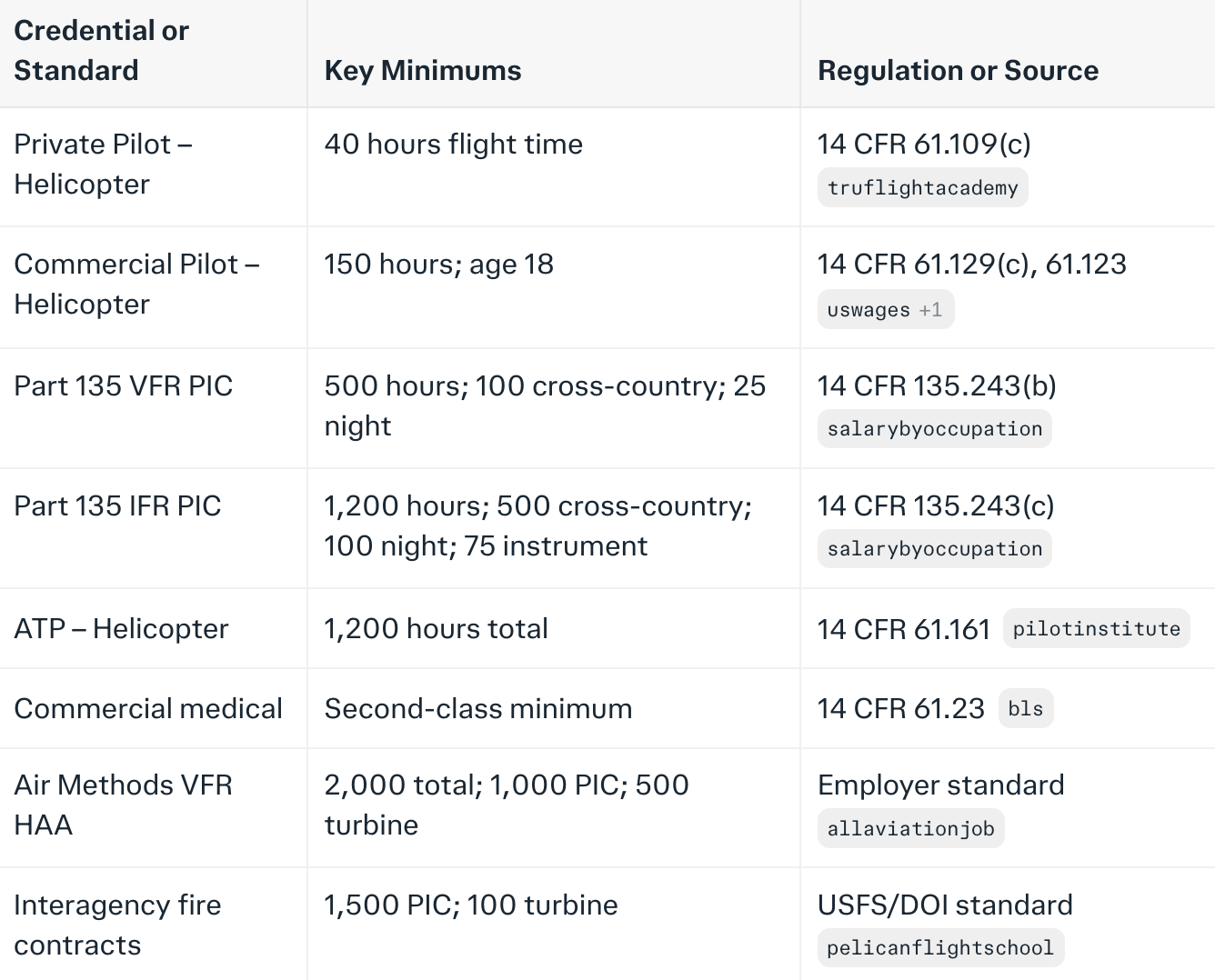
The Flight-Hour Gap: Why Experience Matters So Much
The most important fact for any aspiring helicopter pilot is the gap between legal minimums and hiring minimums. A new commercial pilot may hold a certificate with roughly 150 to 200 hours, yet most entry-level commercial jobs outside instruction require far more. Hillsboro Heli Academy notes that a pilot completing a professional program typically has somewhat over 200 hours, while entry-level commercial roles often require 1,000 to 1,500 hours, largely because of insurance requirements. govinfo
Industry leaders have described the challenge the same way. In reporting by Vertical magazine, representatives of the Helicopter Association of Canada and Helicopter Association International (HAI) emphasized that the core problem is a shortage of experienced pilots rather than of certificated pilots, with the 1,000-hour level and some turbine time serving as a key milestone that opens additional opportunities. govinfo For a broader look at how hour requirements differ across pilot jobs, see AllAviationJob.com's guide on how many flight hours you need for different pilot jobs.
Understanding this gap helps pilots plan realistically. The first 1,000 hours are typically the hardest to earn, and the choices made during that period, including where to instruct, which aircraft to fly, and how to log turbine and night time, strongly shape later opportunities.
Hiring Paths Into a Helicopter Career
There is no single route into the profession. Most pilots follow one of the paths below.
Path 1: Civilian Flight Training and Instruction
This is the most common civilian route:
- Obtain an FAA medical certificate to confirm eligibility.
- Earn the private pilot certificate – helicopter.
- Add the instrument rating – helicopter.
- Earn the commercial pilot certificate – helicopter.
- Earn the CFI-H, and ideally the CFII-H.
- Instruct to build hours, often to 1,000 hours or more.
- Move to a tour, utility, or entry-level commercial job to gain turbine time.
- Progress to air medical, offshore, firefighting, public safety, or corporate flying.
Training is a significant investment. Industry publications report that initial helicopter training can exceed $80,000 govinfo and, including additional hours, may exceed $100,000. govinfo Prospective students can compare training providers through AllAviationJob.com's flight schools listings and aviation school directory.
Path 2: Military Aviation
The U.S. Army remains one of the largest trainers of helicopter pilots. Through Warrant Officer Flight Training (MOS 153A, Rotary Wing Aviator), applicants must generally be between 18 and 32 years old at the time of board selection, score at least 40 on the Selection Instrument for Flight Training (SIFT), and pass a Class 1 flying-duty medical examination. Upon receiving aviator wings, Army aviators begin a 10-year active-duty service obligation. govinfo The Navy, Marine Corps, Air Force, and Coast Guard also train rotary-wing pilots through officer programs.
Military aviators often transition to civilian careers with substantial turbine, multi-engine, night-vision-goggle, and instrument experience. Veterans can find practical guidance in AllAviationJob.com's complete transition guide for military veterans launching civilian aviation careers.
Path 3: Fixed-Wing to Rotorcraft Transition
Pilots who already hold fixed-wing certificates can add a rotorcraft-helicopter rating. Some previous aeronautical experience may be creditable, but the FAA has made clear that applicants adding a commercial helicopter rating must still complete the required helicopter-specific training, including the 20 hours of training under 14 CFR 61.129(c)(3). faa This route can suit pilots who want to move into air medical or public-safety flying.
Path 4: Operator-Sponsored and Academy Pipelines
Some operators partner with flight schools or offer structured pipelines to address the shortage of experienced pilots. Industry reporting notes that some operators have increased pay, offered signing bonuses, and partnered with schools to create clearer career pathways with mentorship and accelerated training. govinfo These programs change frequently, so candidates should verify current terms directly with operators.
Pay and Job Outlook
According to the BLS, the median annual wage for commercial pilots was $123,220 in May 2025. This figure covers the full commercial pilot occupation, including fixed-wing charter, corporate, and aerial application pilots, so it should be treated as a broad benchmark rather than a precise helicopter wage. Helicopter pay varies considerably by sector and experience. Pilot Institute estimates that entry-level helicopter pilots, such as CFIs and tour pilots, typically earn $25,000 to $65,000 per year, while EMS, offshore, and utility pilots with more than 1,000 hours commonly earn $70,000 to $130,000 or more. faa Candidates can also review compensation data in AllAviationJob.com's aviation salary report.
The BLS reports that commercial pilots held about 50,400 jobs in 2025, with employment projected to grow 5 percent to about 53,000 by 2035. For airline and commercial pilots combined, the BLS projects about 16,400 openings per year on average from 2025 to 2035, many resulting from the need to replace workers who retire or leave the occupation. Notably, the BLS lists "other ambulatory healthcare services," the category that includes air ambulance providers, as one of the largest employers of commercial pilots, at 10 percent.
Workforce concerns specific to helicopters have been documented for years. A study by the University of North Dakota, conducted in collaboration with HAI, projected a shortfall of 7,649 U.S. helicopter pilots between 2018 and 2036. govinfo+1 More recent industry coverage indicates that operators continue to report difficulty finding qualified, experienced pilots. govinfo+1
How to Stand Out to Helicopter Employers
Meeting the minimums is only the starting point. Employers and recruiters also evaluate quality of experience, professionalism, and fit. The following practices help candidates stand out:
- Keep meticulous logbooks. Track PIC, turbine, night, NVG, instrument, cross-country, mountain, external-load, and make-and-model time separately. Employers will verify it.
- Prioritize turbine time. Turbine experience is a common gateway requirement for air medical, utility, and firefighting work. allaviationjob+1
- Earn the instrument rating early. It is required for HAA PIC roles and IFR operations, and it is often expected for offshore work. osirecruit+2
- Maintain recency. Many operators require recent flying; Air Methods, for example, expects pilots to have flown in category within the previous 24 months. allaviationjob
- Protect your safety record. A clean accident and violation history is critical in an industry driven by insurance and contract standards.
- Prepare a targeted résumé. Lead with total time, PIC time, turbine time, and aircraft types. AllAviationJob.com offers free aviation résumé templates, and OSI Recruit provides free résumé samples and interview preparation tips.
- Understand PIC requirements. Know exactly what qualifies as PIC time for each job you apply to. See What Is a PIC Job? Understanding Pilot-in-Command Requirements.
- Use job alerts. Helicopter openings can fill quickly, especially for seasonal tour and fire contracts. Learn how to set them up in The Complete Guide to Aviation Job Alerts.
- Keep your profile current. Recruiters search candidate profiles regularly. See how often you should update your aviation job profile.
Working With an Aviation Recruiter
For mid-career and high-time pilots, a specialized aviation recruiter can provide access to roles that are not widely advertised, including confidential searches, contract positions, and international opportunities. OSI Recruit is an aviation recruitment firm that supports pilots, maintenance professionals, and operational staff. Candidates can explore the OSI Recruit job seekers page, while helicopter operators, air medical programs, and flight departments looking to hire pilots can learn about OSI Recruit's employer services and placement options, or contact OSI Recruit directly.
Frequently Asked Questions
How many hours do I need to become a commercial helicopter pilot?
The FAA requires at least 150 hours of flight time for a commercial pilot certificate with a helicopter rating, with specific helicopter, PIC, cross-country, and training requirements. bls Most employers outside flight instruction require considerably more experience.
What is the most common first job for a helicopter pilot?
Flight instruction is the most common first job for civilian-trained pilots because it allows them to build PIC time while earning income. govinfo
Do helicopter pilots need an instrument rating?
It is not required for the commercial certificate itself, but it is required to serve as PIC in helicopter air ambulance operations and Part 135 IFR operations, and it is often required by offshore operators. osirecruit+2
What medical certificate does a helicopter pilot need?
At least a second-class medical is required to exercise commercial pilot privileges. bls Some employers, particularly offshore operators, require a first-class medical. pilotinstitute
Can I become a helicopter pilot through the military?
Yes. The U.S. Army's Warrant Officer Flight Training program accepts eligible applicants between 18 and 32 years old, subject to aptitude testing, medical standards, and a 10-year service obligation after flight school. govinfo
Find Your Next Helicopter Pilot Job on AllAviationJob.com
Whether you are a new CFI-H building your first 500 hours, a tour pilot ready for turbine work, or a 3,000-hour veteran pursuing air medical, offshore, or firefighting roles, the next step in your helicopter career starts with the right opportunity, and AllAviationJob.com is built to help you find it.
AllAviationJob.com connects pilots with employers across every sector of aviation. Browse hundreds of current pilot jobs, search the complete aviation job board, and research hiring companies in the employer directory.
Don't wait for the right job to find you. Create your free job seeker profile on AllAviationJob.com today, set up job alerts, upload your résumé, and put your flight experience in front of operators who are actively hiring helicopter pilots.
Register Now – It's Free | Search Pilot Jobs
Hiring helicopter pilots? Employers can post a job on AllAviationJob.com or partner with OSI Recruit for dedicated aviation recruitment support.
Sources
- U.S. Bureau of Labor Statistics, Occupational Outlook Handbook, "Airline and Commercial Pilots." https://www.bls.gov/ooh/Transportation-and-Material-Moving/Airline-and-commercial-pilots.htm
- 14 CFR Part 61, Special Federal Aviation Regulation No. 73, Robinson R-22/R-44 Special Training and Experience Requirements (Cornell Law School LII). https://www.law.cornell.edu/cfr/text/14/appendix-Special_Federal_Aviation_Regulation_No_73
- Vertical Magazine, "How Do I Get There From Here?" https://verticalmag.com/features/how-do-i-get-there-from-here-html/
- 14 CFR 135.603, Pilot-in-Command Instrument Qualifications (Cornell Law School LII). https://www.law.cornell.edu/cfr/text/14/135.603
- U.S. Department of the Interior and USDA Forest Service, Interagency Fire Helicopter Standards MOU. https://www.doi.gov/sites/default/files/documents/2025-04/doi-oas-usfs-interagency-fire-helicopter-standards-mou-exa-2030-04-07.pdf
- City of San Diego, Fire Helicopter Pilot Class Specification. https://www.sandiego.gov/sites/default/files/legacy/empopp/pdf/classspecs/Fire-Helicopter-Pilot.pdf
- 14 CFR 61.109, Aeronautical Experience (Private Pilot) (eCFR). https://www.ecfr.gov/current/title-14/chapter-I/subchapter-D/part-61/subpart-E/section-61.109
- 14 CFR Part 61, Subpart F, Commercial Pilots, including 61.123 (eCFR). https://www.ecfr.gov/current/title-14/chapter-I/subchapter-D/part-61/subpart-F
- 14 CFR 61.129, Aeronautical Experience (Commercial Pilot) (eCFR). https://www.ecfr.gov/current/title-14/chapter-I/subchapter-D/part-61/subpart-F/section-61.129
- 14 CFR 135.243, Pilot in Command Qualifications (Cornell Law School LII). https://www.law.cornell.edu/cfr/text/14/135.243
- 14 CFR 61.161, Aeronautical Experience: Rotorcraft Category and Helicopter Class Rating (ATP) (eCFR). https://www.ecfr.gov/current/title-14/chapter-I/subchapter-D/part-61/subpart-G/section-61.161
- 14 CFR 61.23, Medical Certificates: Requirement and Duration (eCFR). https://www.ecfr.gov/current/title-14/chapter-I/subchapter-D/part-61/subpart-A/section-61.23
- Federal Aviation Administration, "Synopsis of Medical Standards." https://www.faa.gov/ame_guide/standards
- Hillsboro Heli Academy, "Helicopter Pilot Careers." https://flyhaa.com/helicopter/career-path/
- Vertical Magazine, "Does the Helicopter Industry Have a People Problem?" https://verticalmag.com/features/does-the-helicopter-industry-have-a-people-problem/
- HeliOps Magazine, "The Helicopter Pilot Shortage: Understanding the Causes and Crafting Solutions." https://www.heliopsmag.com/heliops/articles/the-helicopter-pilot-shortage-understanding-the-causes-and-crafting-solutions/
- Just Helicopters, "Editor's Letter – Pilot Shortages Continue to Impact Industry." https://justhelicopters.com/Articles-and-News/Community-Articles/Article/181459/Editors-Letter-Pilot-Shortages-Continue-to-Impact-Industry
- U.S. Army Recruiting Command, "153A – Rotary Wing Aviator." https://recruiting.army.mil/ISO/AWOR/153A/
- Federal Aviation Administration, Legal Interpretation on Adding a Commercial Rotorcraft-Helicopter Rating. https://www.faa.gov/media/11891
- Pilot Institute, "Helicopter Pilot Salary Guide (EMS, Utility, Tours, Offshore)." https://pilotinstitute.com/helicopter-pilot-salary/
- U.S. House Committee on Small Business, "Troubled Skies: The Aviation Workforce Shortage's Impact" hearing memo. https://smallbusiness.house.gov/uploadedfiles/9-26-18_hearing_memo.pdf