Pilots exploring corporate and charter careers frequently encounter Part 91 and Part 135. Corporate flight departments, charter operators, fractional providers, and aircraft management companies all describe their flying in these terms, and the label affects far more than the paperwork. It shapes the experience you need to get hired, how often you are trained and checked, how your schedule is built, how much rest the regulations require, and even how a flight is planned on a stormy day.
Yet many pilots misunderstand what the terms actually mean. The most common myth is that "Part 91 pilots can't be paid." That is false. A pilot flying a company-owned aircraft under Part 91 can be a fully salaried employee; the regulations restrict who may charge for a flight, not whether a pilot earns a paycheck (NBAA). The real distinction is about the operation, not the aircraft or the pilot's job title.
This guide compares the two rule sets, explains how the resulting careers differ in practice, and helps you decide which environment fits your goals.
What Each Part Governs
Part 91 of Title 14 of the Code of Federal Regulations contains the general operating and flight rules that apply to all civil aircraft in the United States. In fact, Part 91 applies to every civil flight, including charter and airline flights; the commercial operating parts simply add requirements on top of it (NBAA). When people describe a job as "Part 91," they mean a non-commercial operation: a company flight department, a private owner, or a dry-lease arrangement in which the operator flies its own or leased aircraft without offering transportation to the public for compensation. Under Part 91, the baseline requirements are that the aircraft is airworthy and the pilot is properly certificated for it, with no additional operating certificate needed (NBAA).
Part 135 governs commuter and on-demand operations — air charter, air taxi, and many air ambulance and cargo operations. If an operator provides air transportation of persons or property for compensation or hire, the FAA generally requires a commercial operating certificate under Part 119, and the operator flies under Part 135 (NBAA). Earning that certificate is a serious undertaking. Among other requirements, an applicant must be a U.S. citizen-controlled company, maintain a principal base of operations, and have exclusive use of at least one aircraft; applicants for a "standard" certificate must also designate a Director of Operations, Chief Pilot, and Director of Maintenance (FAA).
Three nuances matter for your career planning:
- Fractional ownership programs occupy middle ground. Fractional flying is governed by Part 91 Subpart K, which prescribes additional rules for fractional owners and program managers, and some fractional providers also hold Part 135 certificates and operate certain or all flights under them (eCFR; NBAA). Because fractionals have their own rule set, this article compares conventional, non-fractional Part 91 operations with Part 135.
- The same employer can do both. Many aircraft management companies operate an owner's aircraft under Part 91 for the owner's private use and under Part 135 when that aircraft flies paying charter customers. A pilot at one company may therefore fly under both rule sets in the same month (NBAA).
- Compensation rules apply to the flight, not the pilot. A Part 91 operation generally cannot charge for flights, subject to narrow exceptions such as time-sharing and interchange agreements under § 91.501 (NBAA). The pilot flying that aircraft can absolutely be a paid employee.
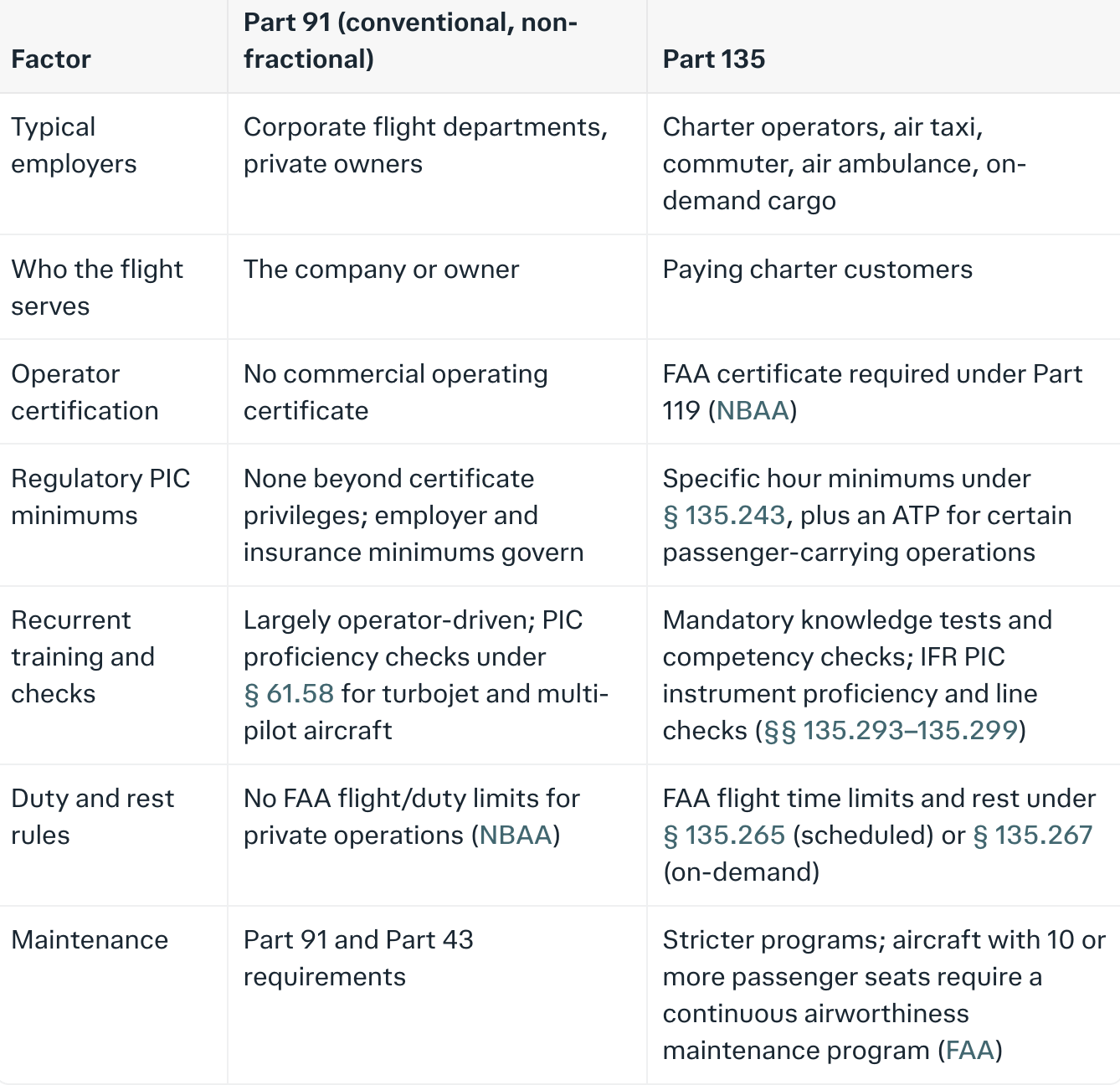
Quick Comparison
 Pilot Qualifications:
Part 135 minimums
Part 135 sets explicit experience floors for pilots in command. Under 14 CFR § 135.243, a PIC in VFR operations must hold at least a commercial pilot certificate with the appropriate category and class ratings (and a type rating where required), meet the applicable experience minimums, and — for airplane operations — hold an instrument rating or an ATP certificate with an airplane category rating. The VFR experience minimums are 500 hours of total pilot time, including 100 hours of cross-country time and 25 hours at night.
For IFR operations, the minimums rise: a PIC must hold at least a commercial pilot certificate with appropriate ratings and have 1,200 hours of flight time as a pilot, including 500 hours of cross-country time, 100 hours of night flight time, and 75 hours of actual or simulated instrument time, at least 50 of which must be in actual flight.
The same section requires an Airline Transport Pilot certificate for a PIC in passenger-carrying operations conducted in a turbojet airplane, in an airplane with a passenger-seat configuration of 10 or more seats, or in a multiengine airplane in commuter service. The standard ATP itself requires 1,500 hours of total pilot time, including 500 hours of cross-country time, 100 hours of night time, and 75 hours of instrument time, along with 250 hours of airplane time as PIC, as SIC performing PIC duties under supervision, or a combination of the two (14 CFR § 61.159). In practice, that means jet charter captains are, by regulation, experienced pilots.
Second-in-command minimums are lower. For airplane SIC positions, 14 CFR § 135.245 requires at least a commercial pilot certificate with the appropriate category and class ratings and an instrument rating — which can make charter SIC seats a first turbine job for pilots building experience, when the operator's requirements align. Our guide to landing your first turbine pilot job covers how those stepping stones fit together.
Part 91 minimums
Conventional Part 91 has no equivalent hour matrix. The pilot needs the certificates and ratings the FAA requires for the aircraft flown — for example, 14 CFR § 61.31 requires a PIC of a turbojet-powered airplane or a large aircraft to hold a type rating for it. In practice, however, corporate flight departments are also bound by insurance underwriters, which commonly demand significant total time, turbine experience, and time in type before a pilot is insurable. A listing for a Part 91 corporate jet might ask for 3,000 total hours and 500 hours of turbojet time even though no FAA rule requires it.
The practical takeaway: Part 135 gives you a published legal floor, while Part 91 gives you an insurance-driven floor that varies by aircraft and operator. For a deeper comparison of legal minimums versus market expectations, see our guide on how many flight hours you need for different pilot jobs.
Training and Checking
Part 135 pilots work inside a structured, audited training system:
- Every Part 135 pilot must pass a competency check, along with a knowledge test covering regulations and the operator's manual, within the preceding 12 calendar months (14 CFR § 135.293).
- A PIC flying under IFR must have passed an instrument proficiency check since the beginning of the sixth calendar month before that service (14 CFR § 135.297).
- A PIC must pass a line check — at least one flight over a route segment with takeoffs and landings at representative airports — within the preceding 12 calendar months (14 CFR § 135.299).
- A new PIC in commuter passenger-carrying operations must first complete supervised operating experience in each make and basic model, ranging from 10 hours in single-engine aircraft to 25 hours in turbojet airplanes (14 CFR § 135.244).
These checks are administered by the Administrator or by check pilots authorized under the operator's certificate, and the results are documented in training records the FAA can audit (14 CFR § 135.293).
Conventional Part 91 has no comparable mandated program. Training is whatever the flight department, the owner, or industry standards such as IS-BAO call for. One regulatory requirement does follow the aircraft: to serve as PIC of a turbojet-powered airplane or an aircraft type certificated for more than one required pilot, a Part 91 pilot must pass a PIC proficiency check within the preceding 12 calendar months, and in the particular aircraft type within the preceding 24 calendar months (14 CFR § 61.58). Pilots operating under Part 135 or Subpart K meet their requirements through their own programs' checks instead, which may also be used to satisfy § 61.58.
For your career, this cuts both ways. Part 135 training produces a documented, transferable record of checks and aircraft experience. Part 91 training varies by employer, which is why it should be a core question in your interview. Our pilot interview questions guide includes how to probe a department's training culture before you accept.
Scheduling, Duty, and Rest
Part 135 flight crewmembers are protected by regulatory limits that depend on the type of operation:
- Scheduled (commuter) operations are governed by § 135.265: flight time is capped at 120 hours per calendar month and 1,200 hours per calendar year, scheduled rest before a flight segment must be at least 9 to 11 hours depending on assigned flight time, and each crewmember must receive at least 24 consecutive hours free of duty in any 7 consecutive days.
- On-demand operations with unscheduled one- and two-pilot crews are governed by § 135.267: flight time is capped at 500 hours per calendar quarter, 800 hours per two consecutive quarters, and 1,400 hours per calendar year, and each crewmember must receive at least 13 rest periods of at least 24 consecutive hours in each calendar quarter. Within any 24 consecutive hours, a two-pilot crew's flight time is limited to 10 hours (8 hours for a one-pilot crew). Where an operator uses a regularly assigned duty period, that period may not exceed 14 hours and must be immediately preceded and followed by at least 10 hours of rest.
Conventional Part 91 has no FAA duty or rest scheme for private operations; Part 135 operators, by contrast, are subject to pilot flight and duty time restrictions (NBAA). A corporate pilot's schedule is governed by the owner's or company's needs and by whatever rest practices the department adopts voluntarily, often following NBAA guidance.
None of this tells you which job offers a better lifestyle. Duty limits do not guarantee a predictable rotation or more nights at home, and the rules differ even within Part 135 depending on the operation. The only way to know is to ask a specific employer about staffing levels, how schedules are actually built, typical nights away per month, and what rest practices the company follows voluntarily. Our day-in-the-life guide to commercial pilot schedules compares how these patterns can feel across charter and corporate operations.
How the Flying Differs
The rule set changes what happens in the cockpit. Part 135 operators face restrictions on conducting "look-see" approaches, less flexibility operating into airports without weather reporting on the field, stricter takeoff and landing distance calculations, and the duty time limits described above (NBAA). These constraints add safety margin, but they also mean Part 135 flying is more procedure-bound and less adaptable when a customer's destination is marginal.
Part 91 operators fly under fewer operational constraints, which gives corporate pilots more flexibility on destinations, weather decisions, and scheduling. Maintenance also differs: Part 135 aircraft with 10 or more passenger seats must be maintained under a continuous airworthiness maintenance program with complete component records, a stricter standard than Part 91 (FAA).
Pay and Stability
Compensation in both segments is driven by aircraft, experience, employer type, and market conditions rather than by the FAR part itself. For broad context, the U.S. Bureau of Labor Statistics reported a median annual wage of $123,220 for commercial pilots as of May 2025, with employment of airline and commercial pilots projected to grow 7 percent from 2025 to 2035 (BLS). BLS occupational categories do not provide a direct Part 91-versus-Part 135 comparison, so treat that figure as backdrop, not a verdict between the two.
What differ structurally are the risks. A Part 91 job is tied to one company or owner, so a change in the business or the aircraft can affect the job quickly; a Part 135 operator's revenue base is typically more diversified across customers, but exposed to charter market cycles. Advancement and benefits in either segment depend on the specific employer — fleet size, growth, retirements, insurance minimums for upgrade, and how the company staffs PIC positions. Request the full picture — base pay, per diem, retirement contribution, medical coverage, and time off — before comparing offers.
For a wider view of how these segments compare with airline careers, read our corporate pilot vs. airline pilot comparison.
Lifestyle and Passengers
The texture of the job differs. A Part 91 pilot typically flies the same people repeatedly — executives, a family, an owner's guests — and may also handle trip logistics, catering, and ground transportation. A Part 135 pilot more often meets new customers on nearly every trip, with the schedule and service standard set by the certificate holder's operation. Both roles demand professionalism, discretion, and service skill; how much each matters depends on the individual employer and its clientele.
Which Path Fits You
- Building time and turbine experience: A Part 135 SIC position can provide a route into turbine flying when the aircraft, operator qualifications, and hiring requirements align, because § 135.245 sets an achievable bar for airplane SICs.
- Wanting structure and transferable credentials: Part 135's mandatory checks and documented training records travel well on a résumé, and the duty rules define your rest in regulation.
- Wanting variety and broader responsibilities: Conventional Part 91 corporate flying can involve everything from scheduling to passenger service, with more operational flexibility.
- Planning a later airline move: Either path can work; what matters is PIC turbine time, recency, and a clean training record. See our guide to ATP vs. commercial pilot certificates for the credential side of that decision.
- Planning to stay in business aviation: Many pilots move from charter into corporate aviation as their careers mature — our guide on moving from charter flying to corporate aviation maps that transition in detail.
If you are an employer reading this, the same distinction shapes how you hire. Aviation recruiters such as OSI Recruit's aviation recruitment team advise flight departments and charter operators on pilot hiring across both operating rules — see their guide to recruiting pilots who can make the charter-to-corporate transition.
Questions to Ask Employers
- Which operating rule will I actually fly under — and does this operator mix Part 91 and Part 135 flying on the same fleet?
- What are the insurance minimums for upgrade to PIC, and how many pilots have upgraded in the past two years?
- What does the training cycle look like — training provider, recurrent interval, and who administers the checks?
- How is the schedule built, what is the reserve commitment, and how many nights away per month should I expect?
- What rest practices does the company follow voluntarily, beyond any regulatory requirement?
- What happened to the last three pilots who left, and where did they go?
Find Your Next Pilot Job
Whether you are chasing your first turbine seat in a Part 135 charter operation or targeting a corporate flight department, the next step is the same: get in front of the employers doing the hiring.
Create your free AllAviationJob.com candidate profile — upload your résumé, review the prefilled profile information, and browse current pilot opportunities matching your qualifications and career goals on the pilot jobs page.
New pilot positions are posted every day. Sharpen your application with our aviation résumé guide, plan your next move with our career pathways guide, and start applying today.
Sources
- 14 CFR Part 91 — General Operating and Flight Rules: eCFR
- 14 CFR Part 91 Subpart K — Fractional Ownership Programs: eCFR
- 14 CFR Part 135 — Commuter and On Demand Operations: eCFR
- 14 CFR § 61.31 — Type ratings required: Legal Information Institute, Cornell Law School
- 14 CFR § 61.159 — Aeronautical experience (ATP certificate): Legal Information Institute, Cornell Law School
- 14 CFR § 61.58 — Pilot in command proficiency checks: Legal Information Institute, Cornell Law School
- 14 CFR § 135.243 — Pilot in command qualifications: Legal Information Institute, Cornell Law School
- 14 CFR § 135.244 — Operating experience (commuter PIC): Legal Information Institute, Cornell Law School
- 14 CFR § 135.245 — Second in command qualifications: Legal Information Institute, Cornell Law School
- 14 CFR § 135.265 — Flight time limitations and rest (scheduled operations): eCFR
- 14 CFR § 135.267 — Flight time limitations and rest (unscheduled operations): Legal Information Institute, Cornell Law School
- 14 CFR § 135.293 — Competency checks: Legal Information Institute, Cornell Law School
- 14 CFR § 135.297 — Instrument proficiency checks: Legal Information Institute, Cornell Law School
- 14 CFR § 135.299 — Line checks: Legal Information Institute, Cornell Law School
- FAA — Part 135 Air Carrier Certification, General Requirements: Federal Aviation Administration
- NBAA — Part 135 Certification Information: National Business Aviation Association
- NBAA — General Aviation Dry Leasing Guide: National Business Aviation Association
- NBAA — Avoiding the Pitfalls of Sharing Business Aircraft: National Business Aviation Association
- NBAA — Aircraft Operating and Leasing Guide: National Business Aviation Association
- NBAA — Rules of Thumb for Business Aircraft Ownership and Operating Options: National Business Aviation Association
- U.S. Bureau of Labor Statistics — Occupational Outlook Handbook, Airline and Commercial Pilots: BLS