Your logbook, certificates, and type ratings get most of the attention in a pilot job search. Your medical certificate is less glamorous, but it is just as important. Without the right class of FAA medical certificate, a pilot cannot legally exercise most professional flying privileges, and an employer cannot put that pilot on the schedule, no matter how strong the résumé is.
For pilots applying to airlines, charter operators, corporate flight departments, cargo carriers, flight schools, or government flying jobs, the medical certificate is also a practical hiring document. Recruiters ask for it, interview panels review it, and training departments plan around its expiration date. Knowing how the system works helps you avoid surprises, protect your eligibility, and present yourself as a well-prepared candidate.
This guide explains the three classes of FAA medical certificates, how long each lasts, what employers typically require, how special issuance and recent mental health policy changes affect pilots, and how to manage your medical certificate strategically while job hunting.
Important: This article is for general educational purposes and is not medical or legal advice. For questions about your personal medical history, speak with an FAA Aviation Medical Examiner (AME), an aviation-focused attorney, or a pilot advocacy organization.
Why Your Medical Certificate Matters in a Job Search
An FAA medical certificate confirms that a pilot meets the medical standards in 14 CFR Part 67 for the type of flying they intend to do. The FAA states plainly that an applicant "must have the appropriate class of medical certificate for the flying duties the pilot intends to exercise" (FAA Guide for Aviation Medical Examiners).
From an employer's point of view, your medical certificate answers three questions:
- Are you legal to fly the job? The class and current status of your certificate must match the operation.
- Are there limitations or conditions? Restrictions such as corrective lenses, a special issuance, or a Statement of Demonstrated Ability (SODA) may need to be documented.
- How long will you stay current? Training departments do not want a new hire's medical to lapse in the middle of initial training or line operations.
Major employers make the requirement explicit. United Airlines lists a "current FAA first-class medical certificate" as a certification requirement for first officers (United Airlines Careers), and Delta lists the same requirement and asks interview candidates to provide documentation of their FAA medical certificate (Delta Air Lines Pilot Hiring FAQs). FedEx goes further, noting that all stated regulatory requirements, including a current first-class medical, are mandatory minimum qualifications and not optional (FedEx Pilot Careers).
The Three Classes of FAA Medical Certificates
The regulation that ties each medical class to specific flying privileges is 14 CFR 61.23. Here is how it applies to professional pilots (14 CFR 61.23, eCFR).
First-Class Medical Certificate
A first-class medical is required when a pilot:
- Exercises the pilot-in-command (PIC) privileges of an Airline Transport Pilot (ATP) certificate;
- Exercises ATP second-in-command (SIC) privileges in a Part 121 flag or supplemental operation that requires three or more pilots; or
- Serves as a required pilot flightcrew member in a Part 121 operation after reaching age 60.
First-class is the highest standard and the one most airline, cargo, and many corporate employers expect, even for first officer positions. The FAA notes that a pilot does not need to hold an ATP certificate to be eligible for a first-class medical (FAA Guide for Aviation Medical Examiners).
Second-Class Medical Certificate
At least a second-class medical is required to exercise:
- ATP SIC privileges in Part 121 operations (other than the three-pilot operations listed above); or
- The privileges of a commercial pilot certificate in an aircraft other than a balloon or glider (14 CFR 61.23).
This is the regulatory minimum for most commercial flying, including many Part 135 SIC roles, aerial work, banner towing, aerial survey, and other flying for compensation or hire. Some government flying jobs accept either a first- or second-class medical, though some require a first-class medical before appointment (USAJOBS Airplane Pilot Notice).
Third-Class Medical Certificate
A third-class medical covers student, recreational, and private pilot privileges, as well as flight instructors acting as PIC or as a required crewmember (14 CFR 61.23). It does not support commercial flying for hire.
Quick Reference: Medical Class by Pilot Role
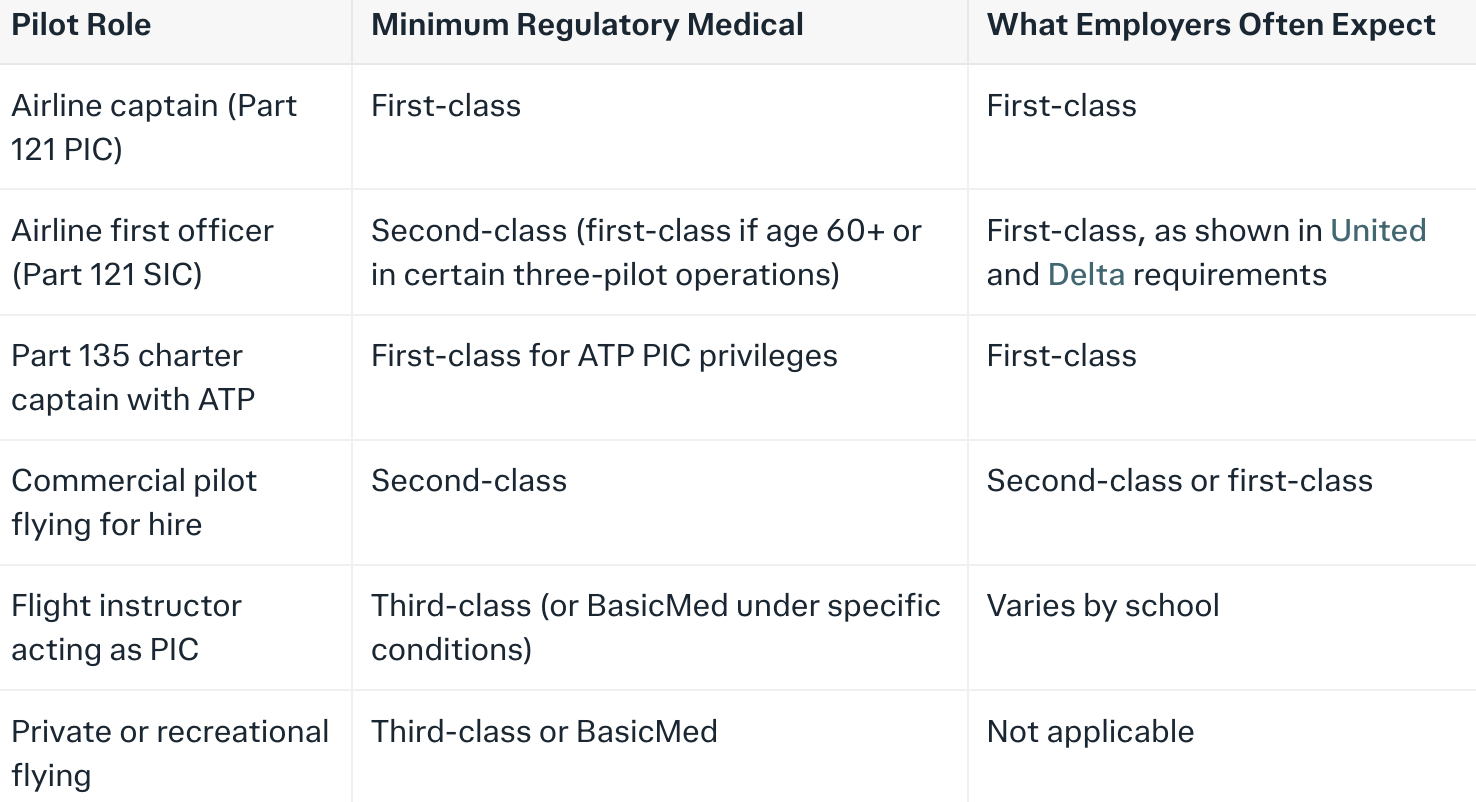
Regulatory minimums and employer requirements are not the same thing. Many employers ask for a first-class medical even when the regulation allows a second-class medical for the seat you will fill, because they want pilots who can upgrade to captain without a medical obstacle.
How Long Does a Medical Certificate Last?
Duration depends on the class of the certificate, your age on the date of the exam, and the type of flying you are doing. A key detail: a medical certificate does not simply "expire" on one date. It steps down to lower-class privileges over time (14 CFR 61.23(d)).
Privileges Being UsedUnder Age 40 at ExamAge 40 or Older at ExamFirst-class privileges (ATP PIC, certain Part 121 operations)12 calendar months6 calendar monthsSecond-class privileges (commercial flying)12 calendar months12 calendar monthsThird-class privileges (private, student, CFI acting as PIC)60 calendar months24 calendar months
Medical certificates expire at the end of the last day of the applicable month after the month of the exam. For example, a 42-year-old pilot who receives a first-class medical in March has first-class privileges through the end of September, second-class privileges through the end of the following March, and third-class privileges through the end of March two years after the exam.
Why this matters for job hunting: If you are over 40 and interviewing with an airline, your first-class privileges may last only six months. Plan your renewal so that your medical will still be current through interviews, onboarding, and initial training.
Age Limits and Career Planning
Medical certification is not the only age-related rule pilots should know. Under 14 CFR 121.383, no certificate holder may use a pilot in Part 121 operations, and no pilot may serve as a pilot in those operations, after that person has reached his or her 65th birthday (14 CFR 121.383, eCFR). In addition, Part 121 pilots who have reached age 60 must hold a first-class medical, and pilots age 40 or older need a new first-class exam every six months to keep first-class privileges (14 CFR 61.23).
That Part 121 age limit applies to operations under Part 121. Experienced pilots planning a second career often look toward Part 91 corporate flight departments, Part 135 charter operators, flight instruction, or training-center roles. If you are weighing those paths, our guide to Part 91 vs. Part 135 pilot jobs and our article on how to become an airline instructor pilot explain how those roles differ.
Get Your First-Class Medical Before You Invest in Training
One of the most common pieces of advice for aspiring professional pilots is also one of the most valuable: get a first-class medical exam before spending significant money on flight training. A disqualifying condition discovered after you have earned your commercial certificate is far more costly than one discovered at the start of your training.
Even if you only need a third-class medical for your student or private pilot training, applying for a first-class medical tells you early whether you meet the highest standard. If you do not, you will have time to pursue a special issuance or SODA, or to make informed decisions about your career path.
How the Medical Exam Process Works
Step 1: Complete FAA MedXPress
Before your appointment, you complete FAA Form 8500-8 online through FAA MedXPress. The FAA describes MedXPress as the web application pilots must use to submit Items 1 through 20 of the form, and it requires only a valid email address to create an account (FAA Medical Certification). Your AME will need your confirmation number.
Step 2: Disclose Your History Accurately
The application asks about medical conditions, medications, visits to health professionals, and certain legal history, including alcohol- or drug-related driving offenses. According to the FAA, applicants report health professional visits from the previous three years and all medications being taken (FAA Pilot Mental Fitness).
Honesty is not optional. MedXPress instructions warn that intentional falsification may result in federal criminal prosecution and in the suspension or revocation of all airman, ground instructor, and medical certificates and ratings held (FAA MedXPress Instructions). Federal law under 18 U.S.C. 1001 provides for imprisonment of up to five years for knowingly and willfully making materially false statements to a federal agency (18 U.S.C. 1001, U.S. House Office of the Law Revision Counsel). The U.S. Department of Justice has prosecuted pilots for concealing a diagnosis on their medical applications (U.S. Department of Justice).
For a career pilot, a falsification finding can end a career far more decisively than almost any medical condition. Employers also verify records through background checks, and a revoked certificate is hard to explain in an interview.
Step 3: The AME Exam and the Three Possible Outcomes
An AME examines you and makes one of three decisions:
- Issue the certificate during the visit;
- Defer the application to the FAA for further review; or
- Deny the application.
A deferral is not a denial. It means the FAA needs more information. For job seekers, however, a deferral can create a timing problem if an interview or class date is approaching, so start the process early.
Disqualifying Conditions, Special Issuance, and SODAs
Specifically Disqualifying Conditions
Part 67 lists certain conditions as specifically disqualifying. The FAA's AME Guide lists them as angina pectoris; bipolar disorder; cardiac valve replacement; coronary heart disease that has required treatment or has been symptomatic or clinically significant; diabetes mellitus requiring insulin or other hypoglycemic medication; disturbance of consciousness without satisfactory explanation; epilepsy; heart replacement; myocardial infarction; permanent cardiac pacemaker; certain severe personality disorders; psychosis; substance abuse and dependence; and transient loss of nervous system function without satisfactory explanation (FAA Guide for Aviation Medical Examiners).
A specifically disqualifying condition does not automatically end a flying career. The FAA notes that it may use its discretionary authority to grant an Authorization for Special Issuance (FAA Guide for Aviation Medical Examiners).
Special Issuance
Under 14 CFR 67.401, the Federal Air Surgeon may grant an Authorization for Special Issuance, valid for a specified period, to an applicant who does not meet the standards if the applicant shows that the duties of the medical class can be performed without endangering public safety (14 CFR Part 67, eCFR). A special issuance typically comes with follow-up reporting requirements, such as periodic test results or specialist reports.
Statement of Demonstrated Ability (SODA)
A SODA may be granted for a disqualifying condition that is static or non-progressive. It does not expire and allows an AME to issue a medical certificate of a specified class if the condition has not worsened (FAA Guide for Aviation Medical Examiners). SODAs are commonly associated with stable conditions such as certain color vision deficiencies, monocular vision, or hearing loss, and may require a special medical flight test.
Do Special Issuances Hurt Your Hiring Chances?
Not necessarily. Southwest Airlines, for example, lists a first-class medical "and, if applicable, any necessary Special Issuance of a Medical Certificate (Authorization) or Statement of Demonstrated Ability (SODA)" among its first officer qualifications (Southwest Airlines Careers). The most important things are that the certificate is valid, the documentation is complete, and you can explain your status calmly and confidently.
Job-hunting tip: If you hold a special issuance or SODA, keep the authorization letter, recent follow-up reports, and certificate together in your application folder. Track your special issuance reporting deadlines as carefully as your recurrent training dates.
Recent Policy Changes Pilots Should Know About
Aeromedical policy has changed significantly in recent years, especially around mental health. Pilots who stopped pursuing a career because of outdated information should take a fresh look.
Mental Health Pathways Have Expanded
- AME-issued certificates for certain conditions: The FAA has updated its AME Guide to allow AMEs to issue certificates for eleven anxiety or depression diagnoses when certain criteria are met, and it has added decision tools for adjustment disorder and for anxiety, depression, and related conditions, including PTSD, plus an ADHD fast-track pathway (FAA Fact Checking Medical Myths in Aviation).
- Counseling is encouraged: On May 27, 2026, the FAA updated its AME Guide with mental health counseling resources for pilots and air traffic controllers (Skyfarer Academy Blog). NBAA reported that AMEs are now directed to focus on the underlying condition and its severity rather than on the fact that a pilot sought counseling (NBAA).
- Expanded antidepressant options: The FAA has updated its AME Guide to allow pilots and air traffic controllers to be treated with Cymbalta, Effexor, and Pristiq (FAA Pilot Mental Fitness). The FAA's AME Guide revision history also shows the time required on a stable antidepressant dose was reduced from six months to three months (FAA Guide for Aviation Medical Examiners Archive).
- AME-Assisted Special Issuance (AASI) for mental health: On July 29, 2026, the FAA added a pathway that allows AMEs to reissue later certificates for pilots with certain treated anxiety, depression, and related conditions after the FAA makes the initial special issuance decision (AVweb).
Mental Health Legislation Is Moving Forward
On September 24, 2026, the U.S. Senate unanimously approved the John A. Hauser Mental Health in Aviation Act and the Aviation Medication Transparency Act (AOPA). The mental health bill would direct the FAA to revise its regulations to encourage pilots and controllers to seek help and disclose mental health conditions, require regular reviews of the special issuance process, and provide up to $15 million per year through 2028 to recruit and train more AMEs to reduce the special issuance backlog (AOPA). Pilots should follow the final legislative outcome and any FAA rulemaking that follows.
Proposed Change for Non-Insulin Diabetes Medications
In September 2026, the FAA proposed amending Part 67 so that diabetes controlled with non-insulin medications would no longer be a specifically disqualifying condition, allowing qualified applicants to receive a medical certificate without going through the special issuance process (Federal Register). This is a proposed rule, not a final rule, so pilots should confirm its status before relying on it.
What About BasicMed?
BasicMed allows some pilots to fly without an FAA medical certificate if they meet specific conditions. After the FAA Reauthorization Act of 2024, BasicMed covers aircraft with up to seven occupants and a maximum takeoff weight of 12,500 pounds, with no more than six passengers (FAA BasicMed).
For job seekers, the most important limitation is this: BasicMed flights may not be operated for compensation or hire, and they must stay at or below 18,000 feet MSL and at or below 250 knots (FAA Updates BasicMed Program). BasicMed is therefore not a substitute for a first- or second-class medical in airline, charter, corporate, or other commercial flying jobs. Regulations do allow BasicMed for flight instructors acting as PIC under certain conditions (14 CFR 61.23), but individual flight schools may set stricter hiring policies.
Your Responsibility Between Exams
Holding a current certificate is not the end of a pilot's medical responsibility. Under 14 CFR 61.53, a pilot may not act as PIC or as a required flightcrew member while they know, or have reason to know, of a medical condition that would make them unable to meet the requirements for their medical certificate, or while taking medication or receiving treatment that would have the same result (14 CFR 61.53, eCFR).
In practice, this means professional pilots must self-assess before every flight. Over-the-counter medications, new prescriptions, illness, fatigue, and stress can all affect fitness for duty. Employers rely on this professional judgment, and many interview panels ask scenario-based questions about it.
Medical Certificate Strategy for Job Hunting
1. Match Your Medical Class to the Jobs You Are Targeting
If you are applying to airlines, cargo carriers, or Part 135 captain positions, hold a current first-class medical. Review job listings carefully. On AllAviationJob.com pilot jobs, most listings spell out the certificate, rating, flight-time, and medical requirements so you can see what each employer expects before you apply.
2. Time Your Renewal Around Your Hiring Timeline
Look at your interview calendar and potential class dates. If your first-class privileges would lapse during training, renew before you start. This is especially important for pilots over 40, whose first-class privileges last only six months.
3. Build a Medical Documentation File
Keep the following organized and ready to share:
- A clear copy of the front and back of your current medical certificate;
- Any special issuance authorization letters or SODA documents;
- Recent follow-up reports required by a special issuance; and
- Your MedXPress confirmation records.
Delta, for example, requires interview candidates to provide documentation of their FAA medical certificate along with their flight hours and pilot certificates (Delta Air Lines Pilot Hiring FAQs).
4. List Your Medical Correctly on Your Résumé and Profile
Include your medical class and the date of issue in your certificates section, for example: "FAA First-Class Medical (issued March 2026)." For layout ideas, see our article on corporate pilot résumé examples and the free résumé samples from OSI Recruit. Then keep your online profile current. Our guide on how often to update your aviation job profile explains why outdated credentials can cost you opportunities.
5. Prepare to Discuss Your Medical Professionally
If you hold a special issuance or have a medical history that may come up, prepare a short, factual explanation. Focus on your current status, your compliance with FAA requirements, and your commitment to safety. Interview preparation resources from OSI Recruit and our guide on how to prepare for a pilot simulator interview can help you practice.
6. Understand the Difference Between an FAA Medical and an Employer Screening
Your FAA medical certificate is separate from employer-specific requirements such as DOT pre-employment drug testing, background checks, and records reviews. FedEx, for example, lists a pre-employment drug test and a Pilot Records Improvement Act evaluation alongside its first-class medical requirement (FedEx Pilot Careers). Being prepared for each step helps the hiring process run smoothly.
7. Use Experts When You Need Them
The FAA notes that HIMS-trained AMEs are trained to evaluate airmen with substance- or alcohol-related conditions or other mental conditions and can provide sponsorship and monitoring when required for certification (FAA Medical Certification). If your case is complex, an experienced AME, a HIMS AME, an aviation attorney, or a pilot advocacy organization can help you navigate it before it affects your job search.
Special Considerations for Specific Pilot Groups
Military Pilots Transitioning to Civilian Careers
Military flight physicals do not replace an FAA medical certificate for most civilian professional flying. Under 14 CFR 61.23(b)(11), a military medical exam can only substitute for flights that require no more than a third-class medical and are conducted domestically (14 CFR 61.23). Veterans should get a civilian first-class medical early in the transition process. Our guide on how military veterans can launch civilian aviation careers covers the broader transition.
Pilots Seeking International Jobs
Flying for a foreign operator often requires a medical certificate issued under that country's civil aviation authority, in addition to licensing conversion and work authorization. If you are exploring overseas opportunities, OSI Recruit's article on international pilot recruitment, compliance, and credentialing explains how employers evaluate cross-border credentials.
Helicopter and Specialty Pilots
The same medical class rules apply to helicopter, aerial survey, and other commercial pilots flying for hire, so at least a second-class medical is generally the minimum. Explore role-specific requirements in our guides to helicopter pilot careers and aerial survey pilot jobs.
Frequently Asked Questions
Do I need a first-class medical to be an airline first officer?
The regulatory minimum for most Part 121 SIC flying is a second-class medical, but major airlines such as United and Delta list a current first-class medical as a requirement. Plan on holding a first-class medical.
Can I fly professionally with a special issuance?
Yes. A special issuance or SODA allows an AME to issue a medical certificate for which you would otherwise be ineligible, and some employers, such as Southwest Airlines, expressly recognize these authorizations in their requirements.
Can I use BasicMed for a paid pilot job?
No. BasicMed flights may not be operated for compensation or hire (FAA). Flight instruction is a regulatory exception for CFIs acting as PIC, but employers may still require an FAA medical certificate.
Will seeking counseling end my flying career?
Current FAA policy encourages pilots to seek counseling, and AMEs are directed to focus on the underlying condition rather than on the counseling itself (NBAA). Disclose accurately and consult an AME if you have questions.
What happens if my application is deferred?
The FAA will review your file and may request additional information. Respond promptly and completely, and if you have pending interviews, keep recruiters informed in a professional, factual way.
Ready to Put Your Medical Certificate to Work?
Your medical certificate is your ticket to the flight deck. Once it is current, documented, and matched to the jobs you want, the next step is finding the right employer.
AllAviationJob.com connects pilots with airlines, charter operators, corporate flight departments, and specialty operators that are hiring now.
- Browse pilot jobs on AllAviationJob.com to compare medical, certificate, and flight-time requirements across employers.
- Explore flight department jobs if you are targeting corporate or Part 91 flying.
- Check the AllAviationJob.com salary report to understand pay before you negotiate.
- Set up job alerts so you hear about new openings first.
Create your free AllAviationJob.com job-seeker profile today
List your certificates, ratings, flight time, and medical class so employers can find you. Your next pilot job may already be posted. Make sure you are ready when it is.
Looking for personalized career support? The OSI Recruit aviation recruitment team works with aviation employers and pilot candidates, and job seekers can learn more on the OSI Recruit job seekers page.
Related Reading on AllAviationJob.com
- Regional Airline Pilot Jobs: What to Expect Before You Apply
- How to Land Your First Turbine Pilot Job
- How Many Flight Hours Do You Need for Different Pilot Jobs?
- Five Certifications That Can Help Advance Your Aviation Career
- AllAviationJob.com Blog
Sources
- Electronic Code of Federal Regulations, 14 CFR 61.23, Medical Certificates: Requirement and Duration: https://www.ecfr.gov/current/title-14/chapter-I/subchapter-D/part-61/subpart-A/section-61.23
- Electronic Code of Federal Regulations, 14 CFR 61.53, Prohibition on Operations During Medical Deficiency: https://www.ecfr.gov/current/title-14/chapter-I/subchapter-D/part-61/subpart-A/section-61.53
- Electronic Code of Federal Regulations, 14 CFR Part 67, Medical Standards and Certification: https://www.ecfr.gov/current/title-14/chapter-I/subchapter-D/part-67
- Electronic Code of Federal Regulations, 14 CFR 121.383, Airman: Limitations on Use of Services: https://www.ecfr.gov/current/title-14/chapter-I/subchapter-G/part-121/subpart-M/section-121.383
- FAA, Guide for Aviation Medical Examiners, Classes of Medical Certificates: https://www.faa.gov/ame_guide/app_process/general/classes
- FAA, Guide for Aviation Medical Examiners, Medical Certification Decision Making: https://www.faa.gov/ame_guide/app_process/general/decision
- FAA, Guide for Aviation Medical Examiners, Statement of Demonstrated Ability (SODA): https://www.faa.gov/ame_guide/app_process/general/appeals/soda
- FAA, Guide for Aviation Medical Examiners, Version Archive and Revision History: https://www.faa.gov/ame_guide/media/archives.pdf
- FAA, Medical Certification: https://www.faa.gov/pilots/medical_certification
- FAA, MedXPress Instructions: https://medxpress.faa.gov/MedXPress/Help/Instructions.htm
- FAA, Pilot Mental Fitness: https://www.faa.gov/pilot-mental-fitness
- FAA, Fact Checking Medical Myths in Aviation: https://www.faa.gov/about/officeorg/headquartersoffices/avs/fact-checking-medical-myths-aviation
- FAA, BasicMed: https://www.faa.gov/licenses_certificates/airmen_certification/basic_med
- FAA, FAA Updates BasicMed Program: https://www.faa.gov/newsroom/faa-updates-basicmed-program
- Federal Register, Proposed Rule on Diabetes Mellitus Medical Standards (September 4, 2026): https://www.federalregister.gov/documents/full_text/html/2026/09/04/2026-18162.html
- U.S. House Office of the Law Revision Counsel, 18 U.S.C. 1001: https://uscode.house.gov/view.xhtml?req=(title:18%20section:1001%20edition:prelim)
- U.S. Department of Justice, California Aviator Convicted of Making False Statements: https://www.justice.gov/usao-ndca/pr/california-aviator-convicted-making-false-statements
- AOPA, Senate Unanimously Approves Mental Health, Medication Bills: https://www.aopa.org/news-and-media/all-news/2026/september/30/senate-unanimously-approves-mental-health-medication-bills
- AVweb, FAA Gives AMEs More Authority on Mental Health Medical Review: https://avweb.com/aviation-news/faa-ame-mental-health-medical-review/
- NBAA, NBAA Champions New FAA Mental Wellness Policy Supporting Counseling: https://nbaa.org/2026-press-releases/nbaa-champions-new-faa-mental-wellness-policy-supporting-counseling/
- Skyfarer Academy, FAA Adds Mental Health Counseling Guidance to AME Guide: https://blog.skyfareracademy.com/2026/05/23/faa-adds-mental-health-counseling-guidance-to-ame-guide-a-step-forward-for-pilot-wellness/
- United Airlines Careers, First Officer: https://careers.united.com/us/en/first-officer
- Delta Air Lines, Pilot Hiring Process and FAQs: https://www.delta.com/us/en/careers/pilots/hiring-faqs
- Southwest Airlines Careers, Pilots: https://careers.southwestair.com/us/en/pilots/
- FedEx Careers, Pilot Careers: https://careers.fedex.com/career-areas/pilot/